The Qur'an: What It Is, How It Came Down, and How It Was Kept
A guide for anyone curious about the Qur'an: the world it came into, how it was revealed over 23 years, how it was written down and kept, why Muslims say not one word has changed, and a tour of all 114 chapters.
Deen · The Qur'an
Every other page in this part of the site eventually leans on one book. The arguments about hadith, the schools of law, the old disputes between Sunni and Shia: all of them assume a text that everyone involved already accepts. This page is about that text. What it is, when and how it arrived, how it was written down and gathered, why Muslims say not a word of it has changed, and how someone who has never opened it might start.
It is written for two readers: the curious non-Muslim who has heard the Qur'an quoted, usually badly, and wants to know what is inside it, and the Muslim who grew up with it and would like the whole story in one place with the evidence laid out. Arabic terms are explained as they appear, and there is a glossary at the end.
This is a research article, not a fatwa. Where I describe practice or rulings I am reporting what scholars have said. For guidance on your own worship, please ask a qualified scholar you trust.
The short version
- The Qur'an is, for Muslims, the speech of God, revealed in Arabic to the Prophet Muhammad ﷺ through the angel Gabriel (Jibrīl) over roughly 23 years, from about 610 CE until his death in 632.
- It has 114 chapters (sūras) and 6,236 verses (āyāt) on the Kufan count. It is arranged mostly from longest chapter to shortest, not in the order it was revealed, so it reads less like a history than like a long conversation that keeps returning to a handful of great themes.
- It was memorised by many and written down in pieces while the Prophet ﷺ was alive, gathered into one set of sheets under Abū Bakr (632–34), and issued as a standard written text under ʿUthmān around 650, with copies sent to the main cities.
- Muslims hold that not one word of it has been changed. The consonantal text standardised under ʿUthmān is the text in every copy printed today (allowing for a few single letters in which ʿUthmān's own regional copies differed), and manuscripts dated by radiocarbon to within a few decades of the Prophet ﷺ match it. One early palimpsest from Ṣanʿāʾ preserves a different, pre-ʿUthmānic text under its upper writing, which is the kind of Companion copy the standardisation reports describe.
- What did change was the handwriting: dots to tell similar letters apart and marks for the short vowels were added over the following century and more, to fix pronunciation, not to alter the words. A small set of recognised recitations (qirāʾāt) also exists, and Muslims regard these as part of what was revealed.
- If you want to start reading, pick a modern translation, begin with al-Fātiḥa and the short chapters at the end of the book, then read Maryam and Yūsuf. A fuller route is set out below.
Contents
- What the Qur'an is
- The world it came into
- How it came down
- How it was written down and gathered
- "Not one word has been changed"
- How the book is arranged
- A tour of the chapters
- What it keeps coming back to
- How to start reading it
- Timeline
- Glossary
- Sources
What the Qur'an is
The word qurʾān comes from the Arabic root q-r-ʾ, to read aloud or recite; "The Recitation" is the most faithful English rendering.1 Early in the revelation the Prophet ﷺ is told not to rush his tongue while the words are coming, because "It is certainly upon Us to ˹make you˺ memorize and recite it [qurʾānahu]."2 Before it is a book, it is something said and heard.
It has other names for itself. It is al-Kitāb, the Book: "There is no doubt about it."3 It is al-Furqān, the Criterion that sorts right from wrong.4 It is al-Dhikr, the Reminder.5 It calls itself light, guidance, healing for what is in the heart, and mercy.678 And it describes itself, over and over, as tanzīl: something sent down.9
The numbers
The Qur'an is divided into 114 sūras, usually translated "chapters", which range from al-Baqara (The Cow) at 286 verses to al-Kawthar (Abundance) at three short lines.10 Each sūra is made of āyāt (singular āya), a word that means "sign" as well as "verse": the same word is used for the alternation of night and day and for the sentences of scripture.11
On the Kufan count, which is the one printed in the standard Ḥafṣ editions used by most Muslims today, there are 6,236 verses. Other early schools counted slightly differently (from 6,204 to 6,232) because they placed some verse endings differently, not because they had different words; Raymond Farrin found the systems agree on verse endings 97.6 to 99.5 per cent of the time.12 A simple count of the words in the standard Arabic text comes to a little over 77,000.
For reading over a month, especially in Ramaḍān, the text is cut into 30 equal parts called juzʾ, each split into two ḥizb. The thirtieth juzʾ, which begins at sūra 78, is known as Juzʾ ʿAmma after its first word, and it holds most of the short chapters children learn first.13
The language
The Qur'an insists on being Arabic. "Indeed, We have sent it down as an Arabic Quran so that you may understand," says the opening of Yūsuf,14 and when opponents claimed a foreigner was feeding the Prophet ﷺ his material, the reply was that the man they had in mind spoke a foreign tongue, "whereas this ˹Quran˺ is ˹in˺ eloquent Arabic."15 This is why Muslims treat translations as translations of the meaning, useful and necessary, but not the Qur'an itself. Prayer is performed in Arabic by Muslims everywhere, from Jakarta to Lakemba.
How Muslims treat it
For Muslims the Qur'an is the literal speech of God, and that belief explains most of what an outsider notices.1 The book is recited in every one of the five daily prayers; the Prophet ﷺ said that a prayer without its opening chapter, al-Fātiḥa, is no prayer.16 A great many people, often children who do not yet speak Arabic, memorise all of it. Copies are kept on a high shelf, often wrapped, and many Muslims will only handle an Arabic copy after performing wuḍūʾ, the ritual washing before prayer.17 The Prophet ﷺ said: "The best of you are those who learn the Qur'an and teach it."18
What it is not
Readers who come from the Bible often expect a history that starts at creation and moves forward through patriarchs, kings and prophets. There is no such line. Stories of earlier prophets appear in several places, told from different angles, usually briefly and with the moral pressed home at once. Law sits next to prayer, argument, warning and descriptions of the natural world.
It helps to know this in advance. The Qur'an assumes you know the outline of the stories, as its first listeners did from Jewish and Christian neighbours, and it confirms, corrects and reframes them.1920 It is less a chronicle than a voice speaking to you directly, and it keeps asking you to think: "Do they not then reflect on the Quran?"21
The world it came into
Mecca in the late sixth century was a small town in a dry valley of the Ḥijāz, the western strip of the Arabian peninsula. It had no river, poor soil and no king. What it had was the Kaʿba, a cube-shaped sanctuary that drew pilgrims from across Arabia, and a tribe, the Quraysh, who controlled the town, ran its trade and looked after the shrine.22 Muslims believe the Kaʿba was built by Abraham and his son Ishmael as a house for the worship of the one God, and that by the Prophet's ﷺ time it was ringed with idols; one report puts their number at 360.23
The Prophet ﷺ was born into one of the Quraysh clans, Banū Hāshim.22 Arabia had no central state; loyalty ran through tribe and kin, and a person without a clan had almost no protection. Byzantium and Persia fought over the lands to the north. There were Christians in the south and north of the peninsula and Jewish tribes in the oases, including Yathrib, the town later called Medina.
Arabia was a culture of the spoken word. Its prestige art was poetry, performed and carried from memory. The long odes later collected as the Muʿallaqāt come from this world.24 So do the kāhins, soothsayers who spoke in short, rhyming, charged phrases. When the Qur'an began to be recited in Mecca, its hearers reached first for these two categories, and the Qur'an rejects both of them by name: "It is not the prose of a poet ˹as you claim˺, ˹yet˺ you hardly have any faith. Nor is it the mumbling of a fortune-teller [kāhin], ˹yet˺ you are hardly mindful. ˹It is˺ a revelation from the Lord of all worlds."2526 It matters for what follows: people who could hold hundreds of lines of verse in their heads were exactly the people to memorise a recited scripture, and to notice if anyone tampered with it.
The Prophet's life to 610
Muḥammad ibn ʿAbd Allāh ﷺ was born in Mecca around 570.2728 His father died before he was born, and his mother when he was about six, so he was raised first by his grandfather ʿAbd al-Muṭṭalib and then by his uncle Abū Ṭālib. The Qur'an itself later reminds him of this: "Did He not find you as an orphan then sheltered you?"29 As a young man he worked in the caravan trade and earned the nickname al-Amīn, the trustworthy. At about twenty-five he married Khadīja, a widowed merchant some years older than him, and they had a long and close marriage. This page keeps to what bears on the Qur'an; the fuller story of his life is in Muhammad ﷺ: A Life.
In his late thirties he took to retreating to a cave called Ḥirāʾ on a mountain outside Mecca, to be alone and to pray. It was there, in about 610, when he was forty, that the Qur'an began.3031
How it came down
The first revelation
The earliest account comes from his wife ʿĀʾisha, preserved in the opening pages of Ṣaḥīḥ al-Bukhārī. The angel came to him in the cave and said, "Read" or "Recite" (iqraʾ). He answered, "I am not a reader." The angel took hold of him and pressed him until he could bear no more, released him, and said it again. This happened three times, and then the angel recited the first words of the Qur'an.30
ٱقۡرَأۡ بِٱسۡمِ رَبِّكَ ٱلَّذِي خَلَقَ ﴿١﴾ خَلَقَ ٱلۡإِنسَٰنَ مِنۡ عَلَقٍ ﴿٢﴾ ٱقۡرَأۡ وَرَبُّكَ ٱلۡأَكۡرَمُ ﴿٣﴾ ٱلَّذِي عَلَّمَ بِٱلۡقَلَمِ ﴿٤﴾ عَلَّمَ ٱلۡإِنسَٰنَ مَا لَمۡ يَعۡلَمۡ ﴿٥﴾
Read, ˹O Prophet,˺ in the Name of your Lord Who created, created humans from a clinging clot. Read! And your Lord is the Most Generous, Who taught by the pen, taught humanity what they knew not.
Qur'an 96:1–5 (Khattab, The Clear Quran), quran.com/96/1-5
A man who did not read is told to read, and the first thing he learns about God is that He teaches by the pen. The Prophet ﷺ went home shaking and asked Khadīja to cover him. She comforted him with a list of his virtues, and took him to her cousin Waraqa ibn Nawfal, an old man who had become a Christian and knew the scriptures. Waraqa told him this was the same angel who had come to Moses, and warned him that his people would drive him out.30 Sūra 96, al-ʿAlaq, is classed as Meccan by consensus, and its first five verses are held to be the first revelation.32
Then there was silence for a period, known as the fatra, before the revelation resumed. Jābir ibn ʿAbd Allāh reports the Prophet ﷺ describing how he later saw the same angel seated between sky and earth, went home in fear asking to be wrapped up, and received the opening of sūra 74: "O you covered up ˹in your clothes˺! Arise and warn ˹all˺." After that, he said, revelation came thick and fast.33
Laylat al-Qadr and the month of Ramaḍān
The Qur'an ties its own arrival to a particular night and a particular month.
إِنَّآ أَنزَلۡنَٰهُ فِي لَيۡلَةِ ٱلۡقَدۡرِ ﴿١﴾ وَمَآ أَدۡرَىٰكَ مَا لَيۡلَةُ ٱلۡقَدۡرِ ﴿٢﴾ لَيۡلَةُ ٱلۡقَدۡرِ خَيۡرٞ مِّنۡ أَلۡفِ شَهۡرٖ ﴿٣﴾
Indeed, ˹it is˺ We ˹Who˺ sent this ˹Quran˺ down on the Night of Glory [laylat al-qadr]. And what will make you realize what the Night of Glory is? The Night of Glory is better than a thousand months.
Qur'an 97:1–3 (Khattab, The Clear Quran), quran.com/97/1-3
Elsewhere it says the Qur'an was sent down in the month of Ramaḍān,34 and on "a blessed night".35 The Prophet ﷺ told his followers to seek that night, Laylat al-Qadr (often translated "the Night of Decree"; Khattab renders it "the Night of Glory"), among the odd nights of the last ten days of Ramaḍān.36 Commentators reconciled "one night" with a revelation spread over years through a report from Ibn ʿAbbās. It is his own statement, not a saying of the Prophet ﷺ; al-Nasāʾī records it in al-Sunan al-kubrā, and al-Ḥākim graded its chain ṣaḥīḥ.172 In it, the whole Qur'an was sent down on that night from the Preserved Tablet to the lowest heaven, and from there it came to the Prophet ﷺ in parts, as events required, over about twenty-three years.3738
Piece by piece, over twenty-three years
The Prophet's ﷺ opponents asked why, if this was really from God, it did not arrive all at once. The Qur'an answers them directly: "˹We have sent it˺ as such ˹in stages˺ so We may reassure your heart with it. And We have revealed it at a deliberate pace."39 And again: "˹It is˺ a Quran We have revealed in stages so that you may recite it to people at a deliberate pace. And We have sent it down in successive revelations."40
This is one of the keys to reading the Qur'an. Much of it answered something: a question, an argument in Mecca, a battle, a family dispute, a moment of grief. Scholars built a discipline, asbāb al-nuzūl ("the occasions of revelation"), to record these contexts. One example shows how immediate it could be. When the verse saying that believers who stay at home are not equal to those who strive in God's cause came down, the Prophet ﷺ called Zayd ibn Thābit to write it. As he dictated it, a blind Companion sitting behind him, Ibn Umm Maktūm, asked what it meant for someone like him. The verse was then revealed again with the words "except those with valid excuses [ghayru ulī al-ḍarar, those with an impairment]" added.41
What revelation was like
A Companion named al-Ḥārith ibn Hishām once asked the Prophet ﷺ directly how revelation came to him. He described two ways. Sometimes it came "like the ringing of a bell", which was the hardest on him, and would leave him having grasped what was said. At other times the angel came in the form of a man and spoke to him. ʿĀʾisha added that she had seen revelation come to him on a bitterly cold day and seen sweat running from his forehead when it lifted.42 The Qur'an itself describes three modes in which God speaks to a human being: by inspiration, from behind a veil, or by sending a messenger.43 It names that messenger as Gabriel and as "the trustworthy spirit", who brought it down "into your heart ˹O Prophet˺, so that you may be one of the warners, in a clear Arabic tongue."944
Early on he would move his lips quickly, trying to hold on to the words, and was told to stop: God would gather it in his heart.245 Muslims see here the first promise of preservation.
The scribes
The Prophet ﷺ did not write the revelation himself; he dictated it. Of several scribes the best known is Zayd ibn Thābit, a young man of the Anṣār, whom he would call with his writing materials when verses came.4146 Revelation was written on whatever was to hand. One report has the Prophet ﷺ asking for Zayd to bring "the board, the inkpot and the shoulder blade", and when Zayd later gathered the Qur'an he found it written on palm stalks and thin white stones.4146 Zayd's own story, from learning to write for the Prophet ﷺ to gathering the Qur'an, is told more fully in The People Around Muhammad ﷺ.
Mecca and Medina
The Prophet's ﷺ mission divides into two periods, and so does the Qur'an. For about thirteen years he preached in Mecca, first privately and then, from around 613, in public.3128 Persecution grew; in about 615 a group of Muslims fled across the Red Sea to the Christian king of Abyssinia, and in 619, the "Year of Sorrow", both Khadīja and his protector Abū Ṭālib died.28 In 622 he emigrated with his followers to Yathrib, which became Madīnat al-Nabī, the City of the Prophet, or simply Medina. That emigration, the hijra, marks year one of the Islamic calendar.27
In Medina he led a community, and in time a state. There were battles with the Quraysh, beginning at Badr in 624, and treaties, and in 630 he took Mecca almost without a fight.2728 Chapters revealed before the hijra are called Meccan (Makkī) and those revealed after it Medinan (Madanī). The standard Cairo edition labels 86 chapters Meccan and 28 Medinan, though a few are disputed.1047
The last verses
The Companions gave different answers about which verse came last, and I would rather give their answers than pick one. Ibn ʿAbbās said the last verse revealed was the one on usury, which most commentators take to include 2:281: "Be mindful of the Day when you will ˹all˺ be returned to Allah …"4849 Al-Barāʾ ibn ʿĀzib said the last verse was the one on inheritance that closes sūra 4, and the last complete sūra was al-Tawba (sūra 9).5051 Many Muslims think first of 5:3, "Today I have perfected your faith for you", which ʿUmar said came on a Friday at ʿArafa, during the final pilgrimage, about three months before the Prophet's ﷺ death.5253 The differences are about what "last" means, and none affects the text.
In the year he died, the Prophet ﷺ recited the whole Qur'an with Gabriel twice. Abū Hurayra reports that Gabriel used to go over the Qur'an with him once every year, and in the year he died did it twice; Ibn ʿAbbās places these meetings in the nights of Ramaḍān.5455 Muslims attach great weight to this final review because it means the text was checked in full shortly before he died. He died in Medina in June 632, aged sixty-three.2731
How it was written down and gathered
The Qur'an became a single book in three stages, and it is easy to blur them. In the Prophet's ﷺ lifetime the whole of it existed in memory and in writing, but not bound between two covers. After his death, Abū Bakr had it gathered into one set of sheets. Under ʿUthmān, those sheets became the basis of an official text copied and sent across the Muslim world. What followed was centuries of refinement in how the text was written and recited, not in what it said.
In the Prophet's lifetime: hearts and pages
Memorisation came first, and it was never a mere back-up. The Qur'an was recited aloud in every prayer, and the Companions learned it from the Prophet ﷺ and from each other. Anas ibn Mālik named four men of the Anṣār who had gathered the whole of it in the Prophet's lifetime: Ubayy ibn Kaʿb, Muʿādh ibn Jabal, Zayd ibn Thābit and Abū Zayd.56 Other reports name others, and scholars read these lists as examples rather than a full count. What they show is that complete memorisation existed while the Prophet ﷺ was alive to be checked against.
Writing ran alongside. In one report ʿUthmān describes how, when verses came, the Prophet ﷺ would call a scribe and say, "Put these verses in the sūra where such-and-such is mentioned."57 That report is graded ḥasan (sound) by the Darussalam editors of Tirmidhī but ḍaʿīf (weak) by al-Albānī in the Abū Dāwūd version, so I give it for the picture rather than as proof on its own. The stronger evidence for the order is the annual review with Gabriel, and the Companions reciting whole sūras in prayer, in public, day after day.54
Abū Bakr and the sheets (632–34)
Within months of becoming caliph, Abū Bakr was fighting the wars of the ridda against tribes that had broken away. At the battle of al-Yamāma, in late 632 or early 633, many Muslims who knew the Qur'an by heart were killed. Zayd ibn Thābit's own account of what followed is preserved in Bukhārī.
ʿUmar warned Abū Bakr that if the reciters kept dying, much of the Qur'an could be lost. Abū Bakr hesitated: how could he do something the Prophet ﷺ had not done? ʿUmar kept pressing until he agreed, and Abū Bakr summoned Zayd, young, trusted and a former scribe of the revelation. Zayd's reaction is one of the most human lines in the literature: had they asked him to move a mountain, it would have been lighter. He gathered the Qur'an "from palm stalks, thin white stones and the chests of men", and found the last two verses of sūra 9 in writing with only one man, Abū Khuzayma al-Anṣārī. The sheets stayed with Abū Bakr until he died, then with ʿUmar, and then with ʿUmar's daughter Ḥafṣa, one of the Prophet's ﷺ widows.4658
The Abū Khuzayma detail is sometimes waved about as though those verses rested on one man's word. That is not what the report says. Zayd was looking for the verses in writing, not learning them for the first time. The same pattern shows up in a second report from the ʿUthmānic stage, where Zayd says he had missed a verse of sūra 33 "which I used to hear the Prophet ﷺ recite", searched for it and found it written with one man.59 He knew the words; what he wanted was a written copy to set beside them. Muslim scholars have read the Abū Khuzayma report the same way.
ʿUthmān and the standard copies (c. 650)
Within twenty years the Muslim world stretched from North Africa to Iran, and soldiers taught by different Companions recited in slightly different ways. The second report in Bukhārī begins on campaign in Armenia and Azerbaijan. The general Ḥudhayfa ibn al-Yamān came back to Medina alarmed by the quarrels he had seen and told the caliph ʿUthmān: "Save this community before they differ over the Book as the Jews and Christians did."
ʿUthmān asked Ḥafṣa for the sheets and set up a committee of four: Zayd ibn Thābit, ʿAbd Allāh ibn al-Zubayr, Saʿīd ibn al-ʿĀṣ and ʿAbd al-Raḥmān ibn al-Ḥārith ibn Hishām. Where the three Quraysh members disagreed with Zayd about how to write something, they were to follow the dialect of Quraysh, "for it was revealed in their tongue". The sheets went back to Ḥafṣa, a copy went to each province, and ʿUthmān ordered other written collections, whole or partial, to be burned.60
Most historians place this around 650; ʿUthmān ruled from 644 to 656.61 Britannica gives the same outline from outside the tradition.62 Harald Motzki, using the methods Western scholars apply to date reports, traced the Bukhārī accounts to the Medinan scholar al-Zuhrī (d. 742), which undercut older claims that they were invented a century or two later.63
The burning order troubles modern readers most, and it deserves a straight answer. The other copies were personal collections, in their owners' own order, sometimes with notes, sometimes incomplete. The best known belonged to ʿAbd Allāh ibn Masʿūd and Ubayy ibn Kaʿb.64 Ibn Masʿūd, an early convert who protested that he had accepted Islam while Zayd was "in the loins of a disbeliever", was openly unhappy at being passed over and at first told the people of Iraq to keep their copies; Tirmidhī's report adds that some of the most senior Companions disliked his stance.65 Bukhārī also records Ubayy being asked about something Ibn Masʿūd said concerning the last two sūras, al-Falaq and al-Nās, and answering that the Prophet ﷺ had told him they were revealed as Qur'an.6667 These were the kinds of differences the standard text settled, and its acceptance was, as far as we can tell, quick and complete. Mainstream Twelver Shia scholarship accepts the same text; the leading modern Shia exegete Abū al-Qāsim al-Khūʾī devoted a chapter of his introduction to the Qur'an to arguing that it has been protected from alteration.68 He states that "the accepted view among Muslims is that no alteration has occurred in the Qur'an", names Ibn Bābawayh, al-Ṭūsī and al-Sharīf al-Murtaḍā among the Shia scholars who said so, and describes Shia scholars as generally agreed on it.68 The minority view is best known from the Iranian traditionist Mīrzā Ḥusayn al-Nūrī al-Ṭabarsī (1839–1902), whose Faṣl al-khiṭāb, finished in Jumādā al-Ākhira 1292 AH (mid-1875) and printed in 1298 AH (1880–81),170171 gathered reports to argue that words had dropped out of the ʿUthmānic text; it is still the most controversial Shia book on the question, and the early Imāmī reports it relied on are edited and studied in Etan Kohlberg and Mohammad Ali Amir-Moezzi's Revelation and Falsification.165166
Dots and vowels
Early Arabic script was a skeleton. It had no short vowels, and several letters shared one shape: the same stroke could be b, t, th, n or y depending on dots that were often left out. Scholars call this bare outline the rasm. In the oldest Qur'an manuscripts, dots are used sparingly and vowel signs are absent.6970
That worked because nobody learned the Qur'an from the page alone; the page prompted a recitation already held in memory. As new converts whose first language was not Arabic filled the community, mistakes crept in, and scholars added marks to fix pronunciation. Tradition credits the grammarian Abū al-Aswad al-Duʾalī (d. c. 688) with the first system, coloured dots marking vowels; his students Naṣr ibn ʿĀṣim and Yaḥyā ibn Yaʿmar with systematising the consonant dots under the governor al-Ḥajjāj around 700; and al-Khalīl ibn Aḥmad (c. 718–c. 791) with the small vowel shapes still used today.7172 Modern specialists think the real history was longer and messier; Alain George, studying the coloured dots in early manuscripts, calls the individual names "elusive".73 Either way, the marks were added to the skeleton to pin down its pronunciation. The skeleton itself did not change.
The recognised readings (qirāʾāt)
This part surprises many Muslims, never mind outsiders. There is more than one way of reciting the Qur'an that Muslims regard as correct, and several have been taught side by side for over a thousand years.
The root is a hadith. ʿUmar ibn al-Khaṭṭāb heard Hishām ibn Ḥakīm reciting sūra al-Furqān differently from the way the Prophet ﷺ had taught him. ʿUmar barely waited for him to finish before dragging him by his cloak to the Prophet ﷺ, who had each of them recite, said of each, "That is how it was revealed," and added: "This Qur'an has been revealed in seven aḥruf (modes), so recite whichever is easiest."74 What exactly the seven aḥruf were is one of the longest-running debates in Islamic scholarship, and I will not pretend to settle it.75 The main positions can at least be named. Al-Ṭabarī held that ʿUthmān's codex rests on a single ḥarf, the others having been a concession; Makkī ibn Abī Ṭālib and Ibn al-Jazarī held that it keeps some of the differences between the aḥruf, as far as its consonantal outline allows; and the view most often taken today describes the aḥruf as kinds of variation, in number and gender, tense and grammatical person, wording and pronunciation, rather than seven dialects.75
What grew from it can be described. Recitation was passed down by teachers in the main cities, and the Baghdad scholar Ibn Mujāhid (d. 936) chose seven famous readers of the second Islamic century as the canonical authorities in his Kitāb al-Sabʿa. Later scholars, above all Ibn al-Jazarī (d. 1429), established ten.7677 The reading used by most Muslims today is that of ʿĀṣim of Kufa as transmitted by his student Ḥafṣ (d. 796), called Ḥafṣ ʿan ʿĀṣim; the reading of Nāfiʿ of Medina in the transmission of Warsh is dominant in much of North Africa.7547
Ibn al-Jazarī's rule for an accepted reading has three parts: it must fit Arabic grammar, it must fit one of the ʿUthmānic copies, and its chain must be sound, meaning well known among the masters of recitation.77 The second condition is the one that matters here. Every canonical reading fits the ʿUthmānic skeleton.
Two points of classification are worth keeping straight. The seven readings are not the seven aḥruf: the aḥruf belong to the Prophet's ﷺ own time, while the seven readers became the standard only in the fourth Islamic century, through Ibn Mujāhid.17476 And the readings are not all graded alike. Al-Zarqānī reports that Ibn al-Subkī, Ibn al-Jazarī and al-Nuwayrī held all ten to be mutawātir, transmitted by so many that error is ruled out; a reading outside them, or one that fails the three conditions, is called shādhdh (anomalous), and al-Nawawī states that it may not be recited as Qur'an, in prayer or anywhere else.173
An example. In the fourth verse of al-Fātiḥa, the Ḥafṣ reading has māliki yawm al-dīn, "Master of the Day of Judgment"; other canonical readers have maliki, "King". In the early spelling the consonants are identical; the difference is one vowel's length. Al-Ṭabarī (d. 923) discussed both readings at length and explained why he preferred "King".7879 Differences of this kind are what the qirāʾāt consist of, and Muslims regard them as part of what the Prophet ﷺ taught, not as copying errors.
Print, Cairo and Medina
The first printed Arabic Qur'an came from the Paganini press in Venice in 1537–38; riddled with errors, it was thought lost until Angela Nuovo found a single copy in 1987.80 Hinckelmann's Hamburg edition followed in 1694,81 and in 1787 an edition was printed in St Petersburg under Catherine the Great, among the earliest printed by Muslims, reprinted in Kazan in 1803.82
The edition behind almost every copy you are likely to hold was published in Cairo in 1924 at the initiative of King Fuʾād I. It followed the Ḥafṣ reading, and its editors took the spelling not from old manuscripts but from classical treatises on the Qur'an's orthography, especially those of al-Dānī (d. 1053). It labelled each sūra Meccan or Medinan, divided the text into thirty parts, and became the most widely known edition in the Muslim world.47 Its main successor is the Medina muṣḥaf of the King Fahd Glorious Qur'an Printing Complex, which opened in 1984 and has produced hundreds of millions of copies and translations; its standard copy is in the hand of the calligrapher ʿUthmān Ṭāhā.83
Memory today
Printing never replaced the older system. The Qur'an is still learned from a teacher, word by word, with mistakes corrected by ear. A student who masters a reading can receive an ijāza, a licence to teach it, listing the chain of teachers back to the Prophet ﷺ.75 Someone who has memorised the whole book is a ḥāfiẓ. Walk into a mosque in Sydney, Istanbul or Dakar during the night prayers of Ramaḍān and you will hear the Qur'an recited from memory, in order, often the whole of it across the month. This oral chain is as old as the written one, and for most of Islamic history it was the one that mattered more.
"Not one word has been changed"
Muslims believe the Qur'an in their hands is, word for word, the Qur'an the Prophet ﷺ recited, and that not one word has been added, removed or altered. It is a strong claim, not usually made about ancient texts, so it is fair to ask what it rests on. The honest answer is: more than most people expect, and enough that the claim, stated carefully, holds.
The promise
For Muslims the starting point is the Qur'an's own promise.
إِنَّا نَحۡنُ نَزَّلۡنَا ٱلذِّكۡرَ وَإِنَّا لَهُۥ لَحَٰفِظُونَ
It is certainly We Who have revealed the Reminder, and it is certainly We Who will preserve it.
Qur'an 15:9 (Khattab, The Clear Quran), quran.com/15/9
لَّا يَأۡتِيهِ ٱلۡبَٰطِلُ مِنۢ بَيۡنِ يَدَيۡهِ وَلَا مِنۡ خَلۡفِهِۦۖ تَنزِيلٞ مِّنۡ حَكِيمٍ حَمِيدٖ
It cannot be proven false from any angle [lā yaʾtīhi al-bāṭil, literally "falsehood does not come to it"]. ˹It is˺ a revelation from the ˹One Who is˺ All-Wise, Praiseworthy.
Qur'an 41:42 (Khattab, The Clear Quran), quran.com/41/42
A sceptic will say, reasonably, that a text promising its own preservation proves nothing by itself. Agreed. But the promise tells you how the first Muslims understood their task: they were guarding the exact words of God, and behaved accordingly. The evidence that they succeeded is historical, and it comes from several directions.
Evidence one: a text held by many people at once
Islamic scholars use the term tawātur for knowledge transmitted by so many people, in so many places, that collusion on a falsehood is ruled out. The Qur'an is the clearest case. It was recited in the daily prayers from the start, memorised in full by Companions in the Prophet's ﷺ lifetime,56 and taught by them in Medina, Mecca, Kufa, Basra, Damascus and Egypt. Within a generation it was being recited from memory by people from Egypt to Iran. Change a verse in Kufa and Damascus would have noticed.
The qirāʾāt belong in this evidence too. A tradition that recorded whether a reader said māliki or maliki was watching the words very closely indeed.78
Evidence two: checked by the Prophet, gathered in public
The text was reviewed with the Prophet ﷺ in full every Ramaḍān, and twice in his final year.54 Both compilations were then made in Medina, in the open, by people who had known him, including Zayd ibn Thābit, a scribe of the revelation and a ḥāfiẓ himself, and they used writing and memory to check each other.466056 Where there was friction, as with Ibn Masʿūd, it was about who should lead the work and which copy to use, and it left a record. That we know about it at all shows how visible the process was.65
Evidence three: the manuscripts
This is where the last twenty years have changed the conversation, and the evidence here comes from outside the Muslim tradition.
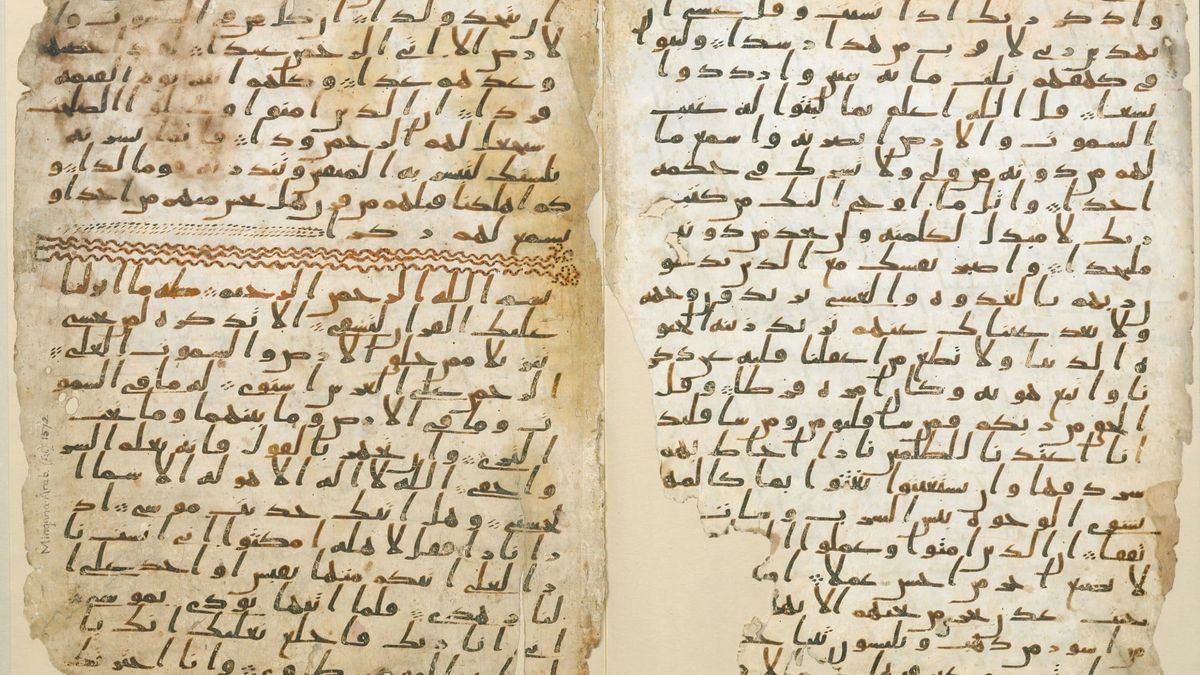
The Birmingham leaves. In 2015 the University of Birmingham announced that two parchment leaves in its Mingana Collection had been radiocarbon dated at the University of Oxford to between 568 and 645 CE, with 95.4 per cent probability. They carry parts of sūras 18 to 20 in the early Ḥijāzī script.84 Professor David Thomas, the university's specialist in Christianity and Islam, said the text "must have been in a form that is very close to the form of the Qur'an read today, supporting the view that the text has undergone little or no alteration".84 One caution: radiocarbon dates the animal skin, not the ink, and 568 to 645 is a wide range. Keith Small, writing for the Bodleian Libraries, noted that different ends of it suit very different stories.85 What no one disputes is that these are among the oldest Qur'an leaves known, and that their text is ours.
The Tübingen codex. In November 2014 the University of Tübingen announced that a Qur'an manuscript in its library, shelfmark Ma VI 165, had been dated at ETH Zurich to between 649 and 675 CE, again with 95.4 per cent probability, which places it between about seventeen and forty-three years after the Prophet's ﷺ death.86 Its text runs from sūra 17 to sūra 36.
Codex Parisino-petropolitanus. The 98 surviving leaves of this early Qur'an, now split mainly between Paris and St Petersburg, cover roughly half the text. François Déroche's 2009 study dates it to the third quarter of the seventh century. Its differences from a printed copy are mostly in spelling, spacing and the marking of verse ends, what you would expect from a scribe writing before spelling was standardised.70 Where it differs by a letter, Yasin Dutton has noted that it tends to follow the Syrian regional copy, the one behind the reading of Ibn ʿĀmir of Damascus.87
The "ʿUthmānic" codices of Istanbul and Tashkent. Two great manuscripts, one in the Topkapı Palace and one in Tashkent (on UNESCO's Memory of the World register since 1997), have long been revered as ʿUthmān's own.8889 In fairness, specialists date both later; the Tashkent codex, on script and radiocarbon evidence, is more likely eighth or ninth century.90 Their value here does not depend on who commissioned them. They are large, early, near-complete witnesses, and they carry the same text.
Families of manuscripts. Perhaps the most elegant evidence is recent. Marijn van Putten, at Leiden, looked at an odd spelling habit: the phrase "the grace of God" (niʿmat Allāh) is sometimes spelled with one form of the final letter and sometimes with another. In fourteen early manuscripts from different places, the unusual spelling appears in exactly the same verses and the usual spelling in the others. That kind of shared quirk only survives when manuscripts are copied from a common written ancestor. His conclusion supports a single written archetype, consistent with ʿUthmān's standardisation.91 Nicolai Sinai at Oxford reviewed the arguments of scholars who wanted to date the Qur'an's final form to around 700 or later, and concluded that the traditional dating of the standard text to around 650 or earlier should remain the default.61
Corpus Coranicum. Since 2007 the Berlin-Brandenburg Academy has documented the text "in the form in which it has been transmitted in manuscripts and in oral transmission", with a database of variant readings; anyone can browse its early manuscript images.92
What honest scholarship also notes
The script changed. As described above, dots and vowel marks were added over the following century and more, and early spelling was not uniform.69 That changed how the text looked, not its words.
There are recognised readings. The qirāʾāt differ in vowels, pronunciation and occasionally a letter within what the ʿUthmānic skeleton allows. Muslims regard them as revealed, going back to the Prophet's ﷺ own teaching of the seven aḥruf, not as corruptions.7477 The copies ʿUthmān sent to the cities themselves differed in a few dozen small places, typically a single letter such as "and" at the start of a phrase, and classical scholars such as Ibn Abī Dāwūd (d. 929) and al-Dānī (d. 1053) recorded every one of them.93 Some readings follow one city's copy and some another's, which means a Warsh muṣḥaf printed in Morocco can differ from a Ḥafṣ muṣḥaf printed in Medina at those few points. Both follow an ʿUthmānic copy.
Some verses were withdrawn. Sunni scholarship has always held that a few passages were revealed and later lifted from the recited text, a category the jurists call naskh al-tilāwa, abrogation of the recitation. The reports most often quoted are both in Muslim's Ṣaḥīḥ. ʿĀʾisha says a verse on ten sucklings was revealed and then replaced by one on five, and adds that the five was still being recited when the Prophet ﷺ died.162 ʿUmar, preaching in Medina, says the verse of stoning "was included in what was sent down" and that the Companions recited it.163 The classical answer is that the withdrawal was itself part of revelation, made before the text was closed, so it does not bear on whether anything was lost after the Prophet ﷺ. Critics read the same reports as traces of material that did not survive, and John Burton built a whole theory of the collection around them; Motzki's work, mentioned above, was partly a reply.16463
One early manuscript is different. The Ṣanʿāʾ palimpsest was found in the Great Mosque of Ṣanʿāʾ in Yemen in 1972. A palimpsest is a manuscript that was washed and written over; under its standard upper text lies an earlier Qur'an. Behnam Sadeghi and Mohsen Goudarzi described this lower text, which they call C-1, as "the only known extant copy from a textual tradition beside the standard ʿUthmānic one". It differs from the standard text in words and parts of words, and radiocarbon dating of the parchment puts it before 671 with 99 per cent probability.9464 This is the strongest evidence that other text types once circulated, and it is exactly what the Bukhārī reports lead us to expect: Companions had their own copies, ʿUthmān standardised because they differed, and C-1 looks like one of them. Comparing the two, Sadeghi and Uwe Bergmann concluded that the ʿUthmānic tradition "is better than C-1 in reproducing the Prophetic prototype".64 Sadeghi and Goudarzi also found that the sūras had already taken shape before ʿUthmān, even though C-1 arranges them in a sequence that matches no known list, and that the evidence supports the broad outline of the traditional account.94
The statement that holds
Put all of that together and this can be said plainly. The consonantal text of the Qur'an was standardised under the caliph ʿUthmān around 650, about twenty years after the Prophet's ﷺ death, from the sheets gathered under Abū Bakr and checked against people who had heard it from him. That text is the text of every muṣḥaf printed today, whether in Cairo, Medina, Istanbul, Lahore or Rabat, allowing only for the few single letters in which ʿUthmān's own copies differed from one another. Not one word of it has been changed since. The early leaves dated by laboratories in Oxford and Zurich carry it. The recited Qur'an, passed from teacher to student in unbroken chains, carries it too.
Muslims believe more than this, of course: that the ʿUthmānic text is itself exactly what the Prophet ﷺ recited, and that God kept His promise in 15:9. The historical evidence cannot prove a theological claim. But it fits it closely, and it has made scholars who began very sceptical of the traditional account take it more seriously than they once did.
How the book is arranged
Not in the order it was revealed
Open a printed Qur'an and the first long chapter, al-Baqara, is Medinan and late. The first words revealed are near the end, in sūra 96. Broadly, after the short opening prayer, the chapters run from longest to shortest, so a reader who starts at the front meets the dense, legal material of Medina first and the short, blazing Meccan chapters last. Many teachers recommend reading the other way round.
When a man from Iraq asked ʿĀʾisha to show him her copy so he could order his own, her reply was a small lesson in how revelation worked. The first thing revealed, she said, was a sūra from the shorter chapters (al-mufaṣṣal) that speaks of Paradise and the Fire; only when people had settled into Islam did the rules about what is lawful and forbidden come down. "If the first thing revealed had been 'Do not drink wine', they would have said, 'We will never give up wine.'"95
Who decided the order?
Muslim scholars agree that the order of verses within each sūra was fixed by the Prophet ﷺ himself; that is what the scribes' instructions and the annual review with Gabriel imply.575496 On the order of the sūras, there are two views. The majority hold that it too is tawqīfī, meaning set by the Prophet ﷺ, and point to the recitation of whole sequences of sūras in prayer and to the final review. Others hold that some of it reflects the judgement of the Companions, and point to reports like ʿUthmān's explanation of why sūras 8 and 9 sit together without a basmala between them.5796 Either way, the order in every copy today is the ʿUthmānic order.
Meccan and Medinan voices
You can hear the two periods even in translation. Meccan chapters are mostly shorter, with short rhyming verses and an urgent rhythm; they speak of God as Creator, the signs of nature, Judgement, earlier prophets rejected by their people, and duties to orphans and the poor. Medinan chapters are longer, with longer verses, and address a community: prayer and fasting, marriage, divorce and inheritance, war and treaties, relations with Jews and Christians, and the hypocrites within.9798
The mysterious letters
Twenty-nine sūras open with letters of the Arabic alphabet read out one by one: Alif Lām Mīm at the start of al-Baqara, Kāf Hā Yā ʿAyn Ṣād at the start of Maryam, Yā Sīn, Ṭā Hā, Ḥā Mīm, and so on.10 They are called al-ḥurūf al-muqaṭṭaʿa, the "disjointed letters". Nobody knows for certain what they mean. Commentators offered many suggestions, and many ended by saying that God knows best. A hadith graded ḥasan says that each letter recited earns a reward, and uses exactly these as its example: "I do not say Alif Lām Mīm is one letter; Alif is a letter, Lām is a letter and Mīm is a letter."99
The basmala
Every sūra but one begins with the basmala: bismillāh al-raḥmān al-raḥīm, "In the Name of Allah, the Most Compassionate, Most Merciful." The exception is sūra 9, al-Tawba, which opens without it.57 The phrase makes up for the absence by appearing twice in sūra 27, once at the head of the chapter and once inside it, at the start of the letter the prophet Solomon sends to the Queen of Sheba.100 The two names of mercy in it, al-Raḥmān and al-Raḥīm, both come from the Arabic root for "womb". Khattab, whose translation I quote on this page, gives the pair as "the Most Compassionate, Most Merciful"; in my own prose I borrow Abdel Haleem's "Lord of Mercy, Giver of Mercy", because I have not found a better pair in English.98
A tour of the chapters
You can browse all 114 chapters in the explorer below: search by name or meaning, filter by theme or by Meccan and Medinan, and switch between the order of the book and the traditional order of revelation (which scholars treat as approximate). After it, I stop at the chapters I think a newcomer should meet first. The chapter notes and key-verse lines in the explorer are my own summaries, not a translation; direct quotations on this page follow Khattab, The Clear Quran (quran.com).
Seven short verses that open the book and are recited in every unit of the daily prayer, so a practising Muslim says them at least seventeen times a day. They praise God as Lord of all and Master of the Day of Judgement, then turn into a plea to be guided on the straight path.
- 1:5: Worship and the asking of help are directed to God alone
- 1:6: The central request: guide us along the straight path
Read al-Fātiḥa in Arabic and English on quran.com; also called Umm al-Kitāb, al-Sabʿ al-Mathānī
The longest surah, revealed in the early Medinan years as the first Muslim community took shape. It moves between stories of Adam, Moses and Abraham and the practical law of a young society: prayer direction, fasting, pilgrimage, marriage, debts and charity. Its name comes from the cow the Israelites were told to sacrifice (2:67–73).
Named after the family of Mary's father, it tells of Mary's own birth and dedication, the birth of John, and the angels announcing Jesus to Mary. It speaks directly to Christians and Jews about common ground, then reflects on the setback the Muslims suffered at Uḥud in 625.
A Medinan surah that sets out the rights of women, orphans and heirs, along with rules on marriage and family life. It returns again and again to fairness, calling believers to uphold justice even when it cuts against their own interests.
One of the last surahs revealed, it opens with a call to honour agreements and covers lawful food, ritual washing and legal matters. Its name comes from the table of food that Jesus's disciples asked to be sent down from heaven (5:112–115).
A long Meccan surah arguing against idol worship through the signs of the natural world. It includes Abraham's reasoning as he watches a star, the moon and the sun set, and ends with a short list of core moral commands.
Tells the story of Adam and Satan's refusal to bow, then the messages of Noah, Hūd, Ṣāliḥ, Lot, Shuʿayb and a long account of Moses. The 'heights' are a place between Paradise and Hell described in the surah.
Revealed after the Battle of Badr in 624, the first major clash between the Muslims and the Quraysh of Mecca. It deals with the question of war gains, reminds the victors that success came from God, and sets out conduct in conflict.
The only surah that does not begin with 'In the name of God, the Merciful, the Compassionate'. Revealed late in the Prophet's life, it addresses broken treaties with the Meccan polytheists, the expedition to Tabūk and those who stayed behind, and the acceptance of sincere repentance.
- 9:40: In the cave during the migration: do not grieve, God is with us
- 9:60: The categories of people who may receive zakat
- 9:128: A messenger from among you who is grieved by your hardship
Read al-Tawba in Arabic and English on quran.com; also called Barāʾa
A Meccan surah defending the truth of revelation and the coming judgement. It retells Noah and Moses, and notes that Jonah's people were the one community that believed in time and were spared.
A sequence of prophets and their peoples: Noah, Hūd, Ṣāliḥ, Abraham, Lot, Shuʿayb and Moses, each met with rejection. Noah's plea for his drowning son is one of its most moving passages. In a hadith in Tirmidhī (which he graded ḥasan gharīb), the Prophet says Hūd and a few other surahs had turned his hair grey.
Almost the whole surah is one continuous story, told in order: Joseph's dream, his brothers' betrayal, slavery in Egypt, prison, and rise to power. It ends in reunion and forgiveness, and the Qurʾān itself calls it the best of stories.
A short surah on God's power seen in the sky, rain, thunder and growing things, and on the certainty of resurrection. Its classification is disputed; the standard Egyptian listing counts it as Medinan though its style resembles Meccan surahs.
Named after Abraham, whose prayer for the valley of Mecca and his descendants comes near its end (14:35–41). It compares a good word to a firmly rooted tree and reminds people that gratitude brings increase.
Named after al-Ḥijr, home of the ancient Thamūd people. It contains the verse Muslims cite most often for the Qurʾān's preservation, and retells Iblīs's refusal to bow to Adam.
A catalogue of blessings in the natural world, from rain and livestock to the bee and its healing honey. It holds one of the most quoted summaries of Qurʾānic ethics and teaches how to invite others to faith.
- 16:68: God inspired the bee to build its homes
- 16:90: God commands justice, kindness and giving to relatives
- 16:125: Invite others with wisdom and good advice, argue in the best way
Read al-Naḥl in Arabic and English on quran.com; also called Sūrat al-Niʿam
Opens with the Prophet's night journey from Mecca to the 'Farthest Mosque' in Jerusalem. It includes a set of commandments on kindness to parents, honesty, and care for the poor and orphans.
- 17:1: God took His servant by night to the Farthest Mosque
- 17:23: Be good to parents; do not even say 'uff' to them
- 17:85: Of the spirit, people have been given only a little knowledge
Read al-Isrāʾ in Arabic and English on quran.com; also called Banī Isrāʾīl
Four stories: young believers who sleep for centuries in a cave, a proud owner of two gardens, Moses learning from a mysterious servant of God, and the just ruler Dhū l-Qarnayn. Many Muslims read it every Friday, following a hadith outside Bukhārī and Muslim that al-Albānī and others graded authentic.
The only surah named after a woman, and Mary is the only woman named in the Qurʾān. It tells of John's birth to the aged Zechariah and of Mary giving birth to Jesus alone under a palm tree. The Muslim refugees in Abyssinia reportedly recited it before the Christian king there.
Named after its two opening letters. Most of it is Moses's story: the burning bush, facing Pharaoh, the sorcerers, and the golden calf. A story in Ibn Isḥāq's biography of the Prophet, not in the ṣaḥīḥ collections, links it to the conversion of ʿUmar ibn al-Khaṭṭāb.
A rapid survey of many prophets, from Abraham smashing idols to Job's patience and Jonah's prayer in the belly of the whale. It ends by describing the Prophet Muhammad's mission as mercy.
Recounts Abraham's call to pilgrimage and the meaning of the rites and sacrifice. It gives the first permission to fight back for those driven from their homes. Its classification is disputed: it mixes Meccan and Medinan material.
Opens with a portrait of the successful believer: humble in prayer, avoiding idle talk, keeping trusts. It traces the stages of the human embryo and the messengers sent to earlier peoples.
A Medinan surah on social conduct: modesty for men and women, seeking permission before entering homes, and the punishment for false accusation. It was revealed partly to clear ʿĀʾisha of a slander, and contains the famous Light Verse.
The 'criterion' is the Qurʾān as what separates right from wrong. It answers the objections of Mecca's leaders and closes with a portrait of the 'servants of the Most Merciful'.
Seven prophet stories, each ending in the same refrain about God's might and mercy. Near the end it distinguishes the Qurʾān from the poetry of its day, whose poets say what they do not do.
Solomon, who understood the speech of birds and ants, hears an ant warn its colony. A hoopoe tells him of the Queen of Sheba, and his letter to her contains the second 'In the name of God' found in the text.
Moses's early life in the greatest detail anywhere in the Qurʾān: set adrift as a baby, raised in Pharaoh's palace, his flight to Midian and marriage. It also warns through the story of Qārūn, destroyed by pride in his wealth.
Opens by saying that faith will be tested, a message to the persecuted Muslims of Mecca. It likens relying on anything other than God to the flimsy house of a spider.
Begins by noting the Byzantine (Roman) defeat by Persia and saying they would win within a few years, which Muslims see as a fulfilled prophecy. It lists the signs of God, including love between spouses and the diversity of human languages and colours.
Named after Luqmān, a sage known to the Arabs, whose advice to his son forms its heart: avoid associating anything with God, pray, be patient, and walk without arrogance. It also speaks of a mother's burden in pregnancy.
A short Meccan surah on the creation of humans from clay and the certainty of resurrection. It describes believers who leave their beds at night to pray, and contains a verse at which listeners traditionally prostrate.
Named after the allied tribes who besieged Medina in 627, the Battle of the Trench. It covers the Prophet's family and wives, and lists the virtues of believing men and women side by side.
Contrasts David and Solomon, who were grateful for great gifts, with the people of Sheba in Yemen, whose ingratitude ended in a devastating flood.
Praises God as the Originator of the heavens and earth, who made angels as messengers with wings. It reminds each person that no one carries another's burden.
- 35:1: God made angels messengers with two, three or four wings
- 35:18: No bearer of burdens will bear another's burden
- 35:28: Those with knowledge are the ones who truly stand in awe of God
Read Fāṭir in Arabic and English on quran.com; also called al-Malāʾika
Often called 'the heart of the Qurʾān', from a hadith graded weak. Many recite it for the dying, a custom resting on a report in Abū Dāwūd (3121) that al-Albānī graded weak. It tells of a town that rejected its messengers and a man who came running to support them, then points to the sun, moon and night as signs of the resurrection.
Opens with angels standing in ranks and tells, among other stories, of Abraham's dream that he must sacrifice his son and the ram sent in his place, and of Jonah swallowed by the great fish.
Named after its opening letter. It tells of David judging between two disputing parties, Solomon and his horses, Job's patient suffering and healing, and Iblīs's refusal to bow to Adam out of pride.
Calls for worship devoted purely to God and ends with people led in groups to Hell or Paradise. It contains one of the Qurʾān's strongest statements of hope in God's forgiveness.
The first of seven surahs opening with the letters Ḥā Mīm. It tells of a believer in Pharaoh's household who hid his faith and spoke up for Moses, and promises that God answers those who call on Him.
- 40:28: A believer at Pharaoh's court defends Moses for saying 'My Lord is God'
- 40:60: Your Lord says: call on Me and I will answer you
Read Ghāfir in Arabic and English on quran.com; also called al-Muʾmin
Describes the Qurʾān as a book whose verses are made clear, and records the Meccan leaders' attempts to drown it out. It advises answering harm with good.
- 41:34: Repel evil with what is better, and an enemy may become a close friend
- 41:42: Falsehood cannot reach it from before or behind
- 41:53: God will show His signs on the horizons and within themselves
Read Fuṣṣilat in Arabic and English on quran.com; also called Ḥā Mīm al-Sajda
Stresses that the same core religion was given to Noah, Abraham, Moses, Jesus and Muhammad. It praises believers who run their affairs by mutual consultation.
Criticises people who follow their forefathers' ways without thought, and those dazzled by wealth and gold. It speaks of Jesus as a servant God favoured and an example to the Children of Israel.
Says the Qurʾān was sent down on a blessed night, and warns of a day when the sky brings visible smoke. It recalls Pharaoh's destruction and the gardens he left behind.
Points to creation as a set of signs, and answers those who say only time destroys us. It pictures every community kneeling on the Day of Judgement.
- 45:13: Everything in the heavens and earth has been made of service to you
- 45:28: Every community will be seen kneeling, called to its record
Read al-Jāthiya in Arabic and English on quran.com; also called al-Sharīʿa
Named after the dunes where the people of ʿĀd lived. It gives a tender account of a child's duty to parents and describes a group of jinn who heard the Qurʾān and believed.
The only surah named after the Prophet, whose name appears in its second verse. It is set in the early years of armed conflict with Mecca and challenges people to reflect on the Qurʾān.
- 47:7: If you help God's cause, He will help you
- 47:24: Do they not reflect on the Qurʾān, or are there locks on their hearts?
Read Muḥammad in Arabic and English on quran.com; also called al-Qitāl
Revealed on the way back from the Treaty of Ḥudaybiyya in 628, which many Muslims first saw as a setback. The surah calls the truce a clear victory, and it led to the peaceful entry into Mecca two years later.
A short surah of social manners: checking news before acting on it, making peace between quarrelling groups, and avoiding mockery, suspicion and backbiting. It ends with a verse often quoted on human equality.
Opens with oaths by the winds and tells of the angelic guests who brought Abraham news of a son. It contains a well-known statement of the purpose of creation.
Named after Mount Sinai, by which it swears. It describes Paradise and challenges the Prophet's opponents with a series of sharp questions about their own creation.
Describes the Prophet's encounters with the angel Gabriel and insists that he does not speak from his own desire. Each person, it says, will have only what they strove for.
Opens by saying the Hour has drawn near and the moon has split, an event hadith reports as a miracle seen in Mecca. A refrain returns after each story: the Qurʾān has been made easy to remember.
Begins with a single divine name, 'the Most Merciful', and sets out God's gifts in creation. The refrain 'Which, then, of your Lord's blessings will you both deny?' repeats 31 times, addressed to humans and jinn. It is classed as Medinan in the Egyptian edition, though many scholars consider it Meccan.
- 55:4: God taught the human being clear expression
- 55:13: Which of your Lord's blessings will you both deny?
- 55:27: All will pass away except the Face of your Lord
Read al-Raḥmān in Arabic and English on quran.com; also called ʿArūs al-Qurʾān
Opens with a rich description of God as the First and the Last, the Outward and the Inward. It calls on believers to spend for good causes and mentions that iron was sent down with great strength and benefit.
Opens with God hearing a woman, traditionally Khawla bint Thaʿlaba, who complained to the Prophet about her husband's unjust form of divorce. The surah abolishes that practice and teaches manners for gatherings.
Refers to the expulsion of the Banū Naḍīr tribe from Medina. It praises the Anṣār who gave generously to the emigrants and closes with a sequence of God's beautiful names.
Addresses relations with the Meccans who were at war with the Muslims, and how to treat women who left Mecca to join them. It makes a clear distinction for non-Muslims who do not fight.
Instructs believers to leave trade and hurry to the Friday congregational prayer, then return to seeking their livelihood. It describes the Prophet as sent to a people without scripture to teach them.
Speaks of the Day of Judgement as a day when true gain and loss will be revealed. It reminds believers that hardship comes by God's permission and that effort is expected only within one's capacity.
Sets out the rules of divorce, especially the waiting period and the wife's right to housing and maintenance. It pairs the law with reassurance that God provides a way out for those who are mindful of Him.
Addresses an episode in the Prophet's household and calls believers to sincere repentance. It holds up two women, the wife of Pharaoh and Mary, as examples of faith for all believers.
Opens Juzʾ 29 and describes God's sovereignty over a flawless creation. Many Muslims recite it every night, based on a hadith in Tirmidhī (2891, graded ḥasan) that it intercedes for its reader.
- 67:2: God created death and life to test who is best in deeds
- 67:3: Look at the sky again: do you see any flaw?
Read al-Mulk in Arabic and English on quran.com; also called Tabārak, al-Māniʿa
One of the earliest revelations, swearing by the pen and defending the Prophet against the charge of madness. It tells the parable of owners of a garden who planned to deny the poor their share.
- 68:4: You are of an exalted character
- 68:17: The owners of the garden plot to harvest without the poor
Read al-Qalam in Arabic and English on quran.com; also called Nūn
Describes the final reality of judgement, when each person receives their record in the right hand or the left. It insists the Qurʾān is neither poetry nor soothsaying.
Describes humans as anxious by nature, fretful in hardship and grasping in good times, except those who pray and give a known share of their wealth to those in need.
Read al-Maʿārij in Arabic and English on quran.com; also called Saʾala Sāʾil
Entirely about Noah, who called his people night and day, publicly and privately, for centuries with little response. It includes his promise that seeking forgiveness brings rain and blessing.
Relates what a group of jinn said after hearing the Qurʾān recited, and teaches that only God knows the unseen. The jinn describe themselves as a mixed people, some righteous and some not.
An early surah addressing the Prophet wrapped in his cloak and telling him to rise for night prayer and recite with measured care. Its final verse, revealed later, eases the burden of night prayer.
Traditionally among the first revelations after a pause, calling the Prophet to arise, warn, and magnify his Lord. It marks the start of his public mission.
Argues that God can restore a person down to their fingertips, and swears by the self-reproaching soul. It tells the Prophet not to hurry his tongue in repeating revelation.
Reminds humans they were once nothing worth mentioning and were then shown the way, to be grateful or not. It praises those who feed the poor, the orphan and the captive for God's sake alone. Classed Medinan in the Egyptian edition; many consider it Meccan.
- 76:3: God showed the human the way, to be grateful or ungrateful
- 76:8: They feed the poor, the orphan and the captive
- 76:9: We feed you for God's sake alone, wanting no thanks
Read al-Insān in Arabic and English on quran.com; also called al-Dahr, Hal Atā
A powerful early surah built around the refrain 'Woe that day to the deniers', repeated ten times as it describes the end of the world.
Opens Juzʾ ʿAmma, the thirtieth part that children often learn first. It asks what people are disputing, the 'great news' of resurrection, and answers with the earth, mountains and sleep as signs.
Read al-Nabaʾ in Arabic and English on quran.com; also called ʿAmma
Gently corrects the Prophet for turning from a blind man, Ibn Umm Maktūm, while speaking with Meccan leaders. A striking example of the Qurʾān correcting the one who received it.
A short surah asking what has deceived the human being about their generous Lord, and reminding them that honourable scribes record their deeds.
Condemns merchants who take full measure for themselves and short-change others, then describes the records of the righteous and the wicked. The last Meccan surah in the Egyptian list; some early authorities classed it as Medinan.
Swears by the piercing night star and says every soul has a guardian over it. It reminds humans of their humble beginning as a sign of God's power to bring them back.
Opens with a command to glorify God, the Most High, and promises the Prophet he will not forget what he is taught. The Prophet often recited it in Friday and ʿĪd prayers.
Contrasts faces humbled and faces joyful on the Day of Judgement, then asks the listener to look at the camel, the sky, the mountains and the earth.
Recalls ʿĀd, Thamūd and Pharaoh, and criticises people who neglect orphans and devour inheritances. It closes with a gentle call to the soul at peace to return to its Lord.
Swears by the city of Mecca and says humans are created into toil. It defines the steep path of virtue: freeing a slave and feeding an orphan or a poor person in hard times.
Contrasts the person who gives and is mindful of God with the one who is stingy and self-satisfied, and says each will be eased towards their chosen end.
Revealed after a pause in revelation that troubled the Prophet, it reassures him that his Lord has not abandoned him. It recalls his own childhood as an orphan and tells him to care for orphans and those who ask.
Eight short verses of comfort to the Prophet, including a line repeated twice that Muslims quote in hard times.
Read al-Sharḥ in Arabic and English on quran.com; also called al-Inshirāḥ, Alam Nashraḥ
Swears by the fig, the olive, Mount Sinai and the city of Mecca, then declares that humans were made in the finest form, and fall low unless they believe and do good.
- 95:4: We created the human being in the finest form
Its first five verses are, by the majority view, the very first words revealed to the Prophet in the cave of Ḥirāʾ in 610, beginning with the command 'Read!' or 'Recite!'. The rest, revealed later, confronts a man who tried to stop him praying.
Read al-ʿAlaq in Arabic and English on quran.com; also called Iqraʾ
Speaks of the People of the Book and polytheists waiting for a clear sign, then states the essence of religion simply: sincere worship of God, prayer and charity. Its classification is disputed.
The earth shakes and gives up its burdens, and speaks of what happened on it. Ends with one of the Qurʾān's most quoted lines on accountability. Classed Medinan in the Egyptian edition; many consider it Meccan.
Swears by galloping warhorses striking sparks at dawn, then turns to the human heart: ungrateful to its Lord and intensely attached to wealth.
People scattered like moths, mountains like fluffed wool, and deeds weighed on the scales. A short, vivid picture of the Day of Judgement.
Condemns the mocking backbiter who piles up wealth and counts it, thinking it will make him immortal.
Recalls the army with an elephant, led by Abraha of Yemen, that marched on Mecca to destroy the Kaʿba and was destroyed. By tradition this happened in the year the Prophet was born, about 570.
Ties faith directly to how people treat others: whoever turns away the orphan and does not urge feeding the poor has not understood religion. It also criticises those who pray only to be seen.
Read al-Māʿūn in Arabic and English on quran.com; also called al-Dīn, Araʾayta
The shortest surah, three verses. Reports the commentators cite say it consoled the Prophet when opponents mocked him after the death of his sons. Al-Kawthar is understood as abundant good, and, in a hadith in Muslim, as a river in Paradise.
According to reports in the sīra and in al-Ṭabarī's commentary, it was revealed when Meccan leaders proposed a compromise of taking turns to worship each other's gods. The Prophet is told to refuse politely and firmly, and the surah ends with its famous last line.
The last surah in the revelation order, linked to the conquest of Mecca and the final pilgrimage. It tells the Prophet that when people enter the faith in crowds, he should glorify God and seek forgiveness, which companions understood as a sign his life's work was nearly done.
Names Abū Lahab, the Prophet's own uncle and fierce opponent, and his wife, and declares that their wealth will not save them.
Read al-Masad in Arabic and English on quran.com; also called al-Lahab, Tabbat
Four verses that sum up the Islamic belief in God: One, Self-Sufficient, not begetting nor begotten, with nothing comparable to Him. A hadith in Bukhārī says it equals a third of the Qurʾān.
Read al-Ikhlāṣ in Arabic and English on quran.com; also called al-Tawḥīd
A short prayer for protection, seeking refuge in the Lord of daybreak from harm in creation, the dark of night, sorcery and envy. With al-Nās it forms 'the two refuges', recited for protection.
- 113:1: Say: I seek refuge with the Lord of daybreak
- 113:5: And from the evil of an envier when he envies
Read al-Falaq in Arabic and English on quran.com; also called al-Muʿawwidhatān (with 114)
The final surah, a prayer for refuge in the Lord, King and God of humankind from the whisperer who withdraws and returns, from among jinn and people.
- 114:1: Say: I seek refuge with the Lord of humankind
- 114:4: From the evil of the whisperer who withdraws
Read al-Nās in Arabic and English on quran.com; also called al-Muʿawwidhatān (with 113)
Verse counts follow the standard Kufan count (6,236 in all). Meccan or Medinan labels and the order of revelation follow the list printed in the 1924 Cairo edition; for a handful of surahs (for example 13, 22, 55, 76, 98 and 99) scholars have long disagreed, and several surahs contain verses from both periods. Summaries are my own; read the text itself through the links.
Al-Fātiḥa (1): The Opening
Seven short verses, and the most recited words in the Muslim world, since they are said in every unit of every prayer. The Prophet ﷺ called it "the seven oft-repeated verses" and the greatest sūra in the Qur'an.10116 It is a prayer, and it teaches the whole relationship between a person and God in miniature: praise, then acknowledgement, then a request.
بِسۡمِ ٱللَّهِ ٱلرَّحۡمَٰنِ ٱلرَّحِيمِ ﴿١﴾ ٱلۡحَمۡدُ لِلَّهِ رَبِّ ٱلۡعَٰلَمِينَ ﴿٢﴾ ٱلرَّحۡمَٰنِ ٱلرَّحِيمِ ﴿٣﴾ مَٰلِكِ يَوۡمِ ٱلدِّينِ ﴿٤﴾ إِيَّاكَ نَعۡبُدُ وَإِيَّاكَ نَسۡتَعِينُ ﴿٥﴾ ٱهۡدِنَا ٱلصِّرَٰطَ ٱلۡمُسۡتَقِيمَ ﴿٦﴾ صِرَٰطَ ٱلَّذِينَ أَنۡعَمۡتَ عَلَيۡهِمۡ غَيۡرِ ٱلۡمَغۡضُوبِ عَلَيۡهِمۡ وَلَا ٱلضَّآلِّينَ ﴿٧﴾
In the Name of Allah, the Most Compassionate, Most Merciful. All praise is for Allah, Lord of all worlds, the Most Compassionate, Most Merciful, Master of the Day of Judgment. You ˹alone˺ we worship and You ˹alone˺ we ask for help. Guide us along the Straight Path, the Path of those You have blessed, not those You are displeased with, or those who are astray.
Qur'an 1:1–7 (Khattab, The Clear Quran), quran.com/1
Al-Baqara (2): The Cow
The longest sūra, 286 verses, Medinan. It is named after a story about the Israelites told to sacrifice a cow and finding every reason to delay. It describes believers, rejecters and hypocrites, tells of Adam, the Children of Israel, and Abraham building the Kaʿba, and then lays down much of the practical shape of Muslim life: the direction of prayer, fasting in Ramaḍān, pilgrimage, marriage and divorce, charity, the ban on usury and the rules for recording debts.34102 In the middle of the law sits one of its most quoted lines: "Let there be no compulsion in religion …"103
Two passages in it are known by heart far beyond scholars. The first is Āyat al-Kursī, the Verse of the Throne, which the Prophet ﷺ confirmed to Ubayy ibn Kaʿb was the greatest verse in the Qur'an.104
ٱللَّهُ لَآ إِلَٰهَ إِلَّا هُوَ ٱلۡحَيُّ ٱلۡقَيُّومُۚ لَا تَأۡخُذُهُۥ سِنَةٞ وَلَا نَوۡمٞۚ لَّهُۥ مَا فِي ٱلسَّمَٰوَٰتِ وَمَا فِي ٱلۡأَرۡضِۗ
Allah! There is no god ˹worthy of worship˺ except Him, the Ever-Living, All-Sustaining. Neither drowsiness nor sleep overtakes Him. To Him belongs whatever is in the heavens and whatever is on the earth. …
Qur'an 2:255 (opening) (Khattab, The Clear Quran), quran.com/2/255
It goes on: "His Seat [kursī] encompasses the heavens and the earth, and the preservation of both does not tire Him." Muslims recite it before sleep, after prayers and when afraid.
The second is the last two verses of the sūra, which the Prophet ﷺ said are enough for whoever recites them at night.105 They end with a prayer I find very moving in its honesty: "Allah does not require of any soul more than what it can afford. … Our Lord! Do not punish us if we forget or make a mistake. … Pardon us, forgive us, and have mercy on us. …"106
Āl ʿImrān (3): The Family of ʿImrān
The second long Medinan sūra, 200 verses, and the Prophet ﷺ paired it with al-Baqara, saying the two would come on the Day of Resurrection like two clouds or two flocks of birds, pleading for those who recited them.107 Its title refers to the family of Mary. It says God chose "Adam, Noah, the family of Abraham, and the family of ’Imrân above all people ˹of their time˺",108 and then tells the story of Mary's mother dedicating her unborn child to God, of Mary raised in the sanctuary, of the angels telling her that God has chosen her "over all women of the world",109 and of the announcement of Jesus, "a Word from Him, his name will be the Messiah, Jesus, son of Mary".110 One of its verses, addressed to Christians and Jews, has become a touchstone for interfaith dialogue: "O People of the Book! Let us come to common terms [kalimatin sawāʾ, literally "a word common"]: that we will worship none but Allah …"111
Maryam (19): Mary
This is where I would send a Christian reader first. Mary is the only woman named in the Qur'an, and she is named 34 times, more than in the whole New Testament; this is the chapter that carries her name.112 It is Meccan, and Ibn Kathīr, drawing on Ibn Isḥāq's biography and Aḥmad's Musnad, records that Jaʿfar ibn Abī Ṭālib recited its opening to the Christian king of Abyssinia when the first Muslim refugees reached his court.113
وَٱذۡكُرۡ فِي ٱلۡكِتَٰبِ مَرۡيَمَ إِذِ ٱنتَبَذَتۡ مِنۡ أَهۡلِهَا مَكَانٗا شَرۡقِيّٗا
And mention in the Book ˹O Prophet, the story of˺ Mary when she withdrew from her family to a place in the east …
Qur'an 19:16 (Khattab, The Clear Quran), quran.com/19/16
It tells of Zachariah given John in old age, then of Mary, the angel, the birth of Jesus alone under a palm tree, and the infant Jesus speaking from the cradle: "I am truly a servant of Allah. He has destined me to be given the Scripture and to be a prophet."114 The Qur'an honours Jesus as Messiah, a word from God and a spirit from Him, born of a virgin, and it denies that he is God or God's son;115116 a Christian reader will meet both the reverence and the disagreement here, stated with great tenderness.
Yūsuf (12): Joseph
The only sūra that tells one story from start to finish, and it calls itself "the best of stories".117 It begins with a boy's dream of eleven stars and the sun and moon bowing to him,118 and follows him into the well, into slavery in Egypt, prison and power, and finally a reunion with the brothers who betrayed him. Readers who know Genesis will notice what the Qur'an emphasises: Joseph's patience and chastity, Jacob's grief and trust, and forgiveness at the end. It ends by saying that in these stories "there is truly a lesson for people of reason".20
Al-Kahf (18): The Cave
Many Muslims read this sūra every Friday, following a report in al-Ḥākim and al-Bayhaqī that al-Albānī graded ṣaḥīḥ, and the Prophet ﷺ said that whoever memorises its first ten verses will be protected from the Dajjāl, the false messiah of the end of time.119120 Its four stories are often read as four trials: young men who sleep in a cave for centuries (faith), a proud owner of two gardens (wealth), Moses and the mysterious al-Khiḍr (knowledge), and the just ruler Dhū al-Qarnayn (power).121122 It closes with the Prophet ﷺ told to say, "I am only a man like you, ˹but˺ it has been revealed to me that your God is only One God."123
Yā Sīn (36)
A Meccan sūra of 83 verses, often recited for the dying (a practice based on a report in Abū Dāwūd that al-Albānī graded weak)161 and widely called "the heart of the Qur'an", though the hadith behind that name is weak; Tirmidhī himself called it gharīb (having a single, unusual chain) and the Darussalam editors grade it ḍaʿīf.124 The sūra does not need the label. It is a sustained argument for resurrection, and it answers the man who picks up a crumbling bone and asks who could bring it back to life: "Say, ˹O Prophet,˺ ‘They will be revived by the One Who produced them the first time, for He has ˹perfect˺ knowledge of every created being.’"125
Al-Raḥmān (55): The Lord of Mercy
If you want to hear what the Qur'an sounds like, start here, and listen before you read. It opens with a single word, al-Raḥmān, and then: "taught the Quran, created humanity, ˹and˺ taught them speech."126 It moves through sun and moon, stars and trees, the two seas, the pearls and coral, the passing of everything on earth but "your Lord Himself [wajhu rabbika, literally "the face of your Lord"]", and the gardens of the next world. Between the images comes a refrain, 31 times:
فَبِأَيِّ ءَالَآءِ رَبِّكُمَا تُكَذِّبَانِ
Then which of your Lord’s favours will you ˹humans and jinn˺ both deny?
Qur'an 55:13 and 30 further times in the sūra (Khattab, The Clear Quran), quran.com/55/13
The "you … both" is dual in Arabic, addressed to humans and jinn, which is why Khattab adds them in his half-brackets. The Cairo edition labels the sūra Medinan, but most Companions and Followers are reported to have considered it Meccan, a good example of how the Meccan/Medinan labels are sometimes a matter of scholarly judgement.127
Al-Mulk (67): Sovereignty
Thirty verses, Meccan, recited by many Muslims every night before sleep because of a hadith, graded ḥasan by Tirmidhī and by the Darussalam editors, that "a sūra of thirty verses" will intercede for its reciter until he is forgiven.128 It begins: "Blessed is the One in Whose Hands rests all authority [al-mulk]. And He is Most Capable of everything. ˹He is the One˺ Who created death and life in order to test which of you is best in deeds."129 Then it asks you to look up at the sky, and look again, and see if you can find a flaw.
The short chapters of Juzʾ ʿAmma
The last juzʾ is where most Muslims begin, and where I would suggest a newcomer begin too: short enough to take in whole, with the early Meccan voice at full strength. Sūra 81 describes the end of the world, the sun folded up, the stars falling, and then asks a question on behalf of baby girls buried alive, victims of a pre-Islamic practice: "for what crime they were put to death".130 Sūra 93 was revealed, according to a report in Bukhārī, when the Prophet ﷺ had been ill and unable to pray at night and a woman taunted him that he had been abandoned; it reassures him that his Lord has not forsaken him, and ends by turning his own orphanhood into a duty to orphans.13129 Sūra 99 says every atom's weight of good and every atom's weight of harm will be seen.132
Four in particular are worth learning:
Al-ʿAṣr (103). Three verses. Ibn Kathīr quotes al-Shāfiʿī as saying that if people pondered this sūra, it would be enough for them.133 Read it and you see what he meant.
وَٱلۡعَصۡرِ ﴿١﴾ إِنَّ ٱلۡإِنسَٰنَ لَفِي خُسۡرٍ ﴿٢﴾ إِلَّا ٱلَّذِينَ ءَامَنُواْ وَعَمِلُواْ ٱلصَّـٰلِحَٰتِ وَتَوَاصَوۡاْ بِٱلۡحَقِّ وَتَوَاصَوۡاْ بِٱلصَّبۡرِ ﴿٣﴾
By the ˹passage of˺ time! Surely humanity is in ˹grave˺ loss, except those who have faith, do good, and urge each other to the truth, and urge each other to perseverance.
Qur'an 103:1–3 (Khattab, The Clear Quran), quran.com/103
Al-Ikhlāṣ (112). Four verses on the oneness of God, which the Prophet ﷺ said equal a third of the Qur'an.134
قُلۡ هُوَ ٱللَّهُ أَحَدٌ ﴿١﴾ ٱللَّهُ ٱلصَّمَدُ ﴿٢﴾ لَمۡ يَلِدۡ وَلَمۡ يُولَدۡ ﴿٣﴾ وَلَمۡ يَكُن لَّهُۥ كُفُوًا أَحَدُۢ ﴿٤﴾
Say, ˹O Prophet,˺ “He is Allah, One ˹and Indivisible˺; Allah, the Sustainer ˹needed by all˺. He has never had offspring, nor was He born. And there is none comparable to Him.”
Qur'an 112:1–4 (Khattab, The Clear Quran), quran.com/112
Al-Falaq (113) and al-Nās (114). The two "sūras of refuge", in which the reader seeks protection with the Lord of daybreak from the harm in creation, and with the Lord, King and God of people from the whisperer who retreats.135136 The Prophet ﷺ greeted their revelation by saying no verses like them had ever been seen,67 and every night before sleeping he would recite al-Ikhlāṣ and these two into his cupped hands and wipe them over his body, three times.137 Many Muslim parents still do exactly this for their children.
What it keeps coming back to
Because the Qur'an is not arranged by topic, its themes are threads that surface again and again.
God
Above everything, the Qur'an is about God: one, without partner or equal, Creator of everything, near to every person. "When My servants ask you ˹O Prophet˺ about Me: I am truly near. I respond to one’s prayer when they call upon Me."138139 The whole of creation is presented as a set of signs pointing back to Him, and the reader is told to look, think and reflect.11140
Prophets
The Qur'an names some two dozen prophets, most of them familiar from the Bible: Adam, Noah, Abraham, Ishmael, Isaac, Jacob, Joseph, Moses, Aaron, David, Solomon, Jonah, Zachariah, John, Jesus and others, alongside Arabian prophets such as Hūd and Ṣāliḥ. Moses is named more than any other figure, over a hundred times. Muslims are told to believe in all of them and to "make no distinction between any of them".141142 Abraham has a special place as the model of pure monotheism and the builder of the Kaʿba. Jesus is named 25 times, and Muhammad ﷺ, by name, only four, with a fifth mention as Aḥmad.143
The Hereafter
The Day of Judgement, resurrection, Paradise and the Fire are everywhere, especially in the Meccan chapters, and the images are vivid. The point is accountability: every person will meet what they have done. "So whoever does an atom’s weight of good will see it. And whoever does an atom’s weight of evil will see it."132
Justice
"O believers! Stand firm for justice as witnesses for Allah even if it is against yourselves, your parents, or close relatives. Be they rich or poor, Allah is best to ensure their interests."144 The Qur'an says God sent messengers "so that people may administer justice",145 and much of its early moral teaching is about the vulnerable: orphans, the poor, the traveller, slaves, and girls unwanted at birth.102130 It says that people were made into nations and tribes "so that you may ˹get to˺ know one another", and that the noblest of them in God's sight is the most mindful of Him.146
Mercy
Every sūra but one opens with two names of mercy. God says, "My mercy encompasses everything";147 the Prophet ﷺ is described as sent "only as a mercy for the whole world";148 and one of the most hopeful verses in any scripture tells those who have wronged themselves not to despair of God's mercy, "for Allah certainly forgives all sins".149
Family and ordinary life
The Qur'an speaks about marriage as a sign of God: "He created for you spouses from among yourselves so that you may find comfort in them. And He has placed between you compassion and mercy."150 It tells children never to say to ageing parents "˹even˺ ‘ugh’ [uff]".151 Much of the Medinan material deals in detail with marriage, inheritance, contracts and debts: faith is expected to shape ordinary life.
Stories of earlier prophets
Noah, Abraham breaking the idols, Moses before Pharaoh, Jesus and his mother: the stories are told to make a point the first listeners needed, often that a prophet rejected by his own people is in good company. Mary, the only woman named, is held up as a model of devotion for everyone,112109 and other women, such as the wife of Pharaoh and the Queen of Sheba, appear unnamed but no less important.
How to start reading it
First-time readers often give up somewhere in al-Baqara, and I understand why: you are dropped into a long Medinan chapter full of references to events you do not know. A little preparation changes the experience.
Choose a translation
Every translation is an interpretation. These are the ones I would suggest, roughly in order of readability:
- M. A. S. Abdel Haleem, The Qur'an (Oxford University Press, 2004). Clear, modern English by an Egyptian-born professor at SOAS, London, with short notes. My first recommendation.98
- Mustafa Khattab, The Clear Quran (2015). Plain, contemporary English by a Canadian-Egyptian scholar, approved by al-Azhar, and since 2020 the default translation on quran.com. It is the translation quoted on this page.152
- Saheeh International (1997). Close to the Arabic, with bracketed additions showing where the translators have filled in the sense. Widely used in mosques and study circles; a little stiff to read for pleasure.
- Muhammad Asad, The Message of the Qur'an (1980). Extensive notes by a Jewish-born convert from Austria-Hungary; thoughtful, and in places more rationalist than mainstream commentary.
- Abdullah Yusuf Ali (1934). For decades the standard English Qur'an; deliberately archaic, and still loved by many older readers.
- The Study Quran (HarperOne, 2015), edited by Seyyed Hossein Nasr with Caner Dagli, Maria Dakake, Joseph Lumbard and Mohammed Rustom. A translation with running commentary drawn from classical Sunni and Shia exegetes. Not the book to start with, but the best companion once you are hooked.153
Read with a commentary
The classical way into the Qur'an is tafsīr, commentary on its language, occasions and related verses and hadith. The Study Quran's notes are one route in; another is the English abridgement of Ibn Kathīr (d. 1373), available free alongside the text on quran.com.37 For the history of the text and the scholarly debates, Nicolai Sinai's short The Qur'an: A Historical-Critical Introduction (Edinburgh University Press, 2017) and The Cambridge Companion to the Qur'ān (ed. Jane Dammen McAuliffe, Cambridge University Press, 2006) are good academic starting points,97154 and Yasir Qadhi's An Introduction to the Sciences of the Qur'aan gives the traditional Muslim account of the same ground.96
A suggested reading path
This is the route I would give a friend.
- Week one: al-Fātiḥa (1), then the last juzʾ, from about sūra 93 to the end. Read each short sūra aloud in translation and, if you can, listen to it in Arabic.
- Week two: Maryam (19) and Yūsuf (12), two continuous narratives.
- Week three: al-Raḥmān (55), al-Mulk (67), Yā Sīn (36) and al-Kahf (18).
- Week four: Āl ʿImrān (3), then al-Baqara (2) with a commentary open beside you.
- After that: start at the beginning and read straight through, a juzʾ a day. At that pace it takes a month, which is exactly how many Muslims read it in Ramaḍān.
Use quran.com
The free site quran.com puts the Arabic, several translations, word-by-word glosses, commentary and audio on one screen, and every verse has its own address: quran.com/15/9 is sūra 15, verse 9. Every Qur'an reference here links that way, so you can check each quotation against the Arabic and other translations.
Listen
The Qur'an was revealed to be heard, and it is recited according to rules of pronunciation and rhythm called tajwīd. It tells the Prophet ﷺ to "recite the Quran ˹properly˺ in a measured way [tartīl]",155 and tells its listeners: "When the Quran is recited, listen to it attentively and be silent, so you may be shown mercy."156 Even without Arabic you will hear the rhyme, the long vowels held and released, the change of pace between Meccan and Medinan. Try al-Raḥmān or Juzʾ ʿAmma on quran.com and just listen, once, with nothing else open.
Etiquette, if you are a guest
You will not offend anyone by reading a translation. With an Arabic muṣḥaf, handle it with clean hands and keep it off the floor. Many Muslims will only touch an Arabic copy after wuḍūʾ, and on this the four Sunni schools agree: Ibn Taymiyya called it "the position of the four Imams", and the Ḥanbalī Ibn Qudāma knew of no jurist who differed except Dāwūd al-Ẓāhirī, although some later Mālikīs, such as al-Dardīr, allow a teacher or a student to handle it.167 Their texts are the Prophet's ﷺ letter to ʿAmr ibn Ḥazm, reported in Mālik's Muwaṭṭaʾ without a Companion in the chain, that "no-one should touch the Qur'an unless he was pure",17 and 56:79, which Ibn Qudāma cites as a ruling. Khattab translates that verse "touched by none except the purified ˹angels˺"; the half-bracketed word is his, and it follows Ibn ʿAbbās, for whom the verse describes the angels.157158 The Ẓāhirī Ibn Ḥazm took that reading to its end. In al-Muḥallā he allows touching the muṣḥaf with or without wuḍūʾ, arguing that the verse is a statement, not a command, that every report behind the rule has a broken chain, an unsupported written source or a weak or unknown narrator, and that the Prophet ﷺ sent Heraclius a letter containing a verse of the Qur'an.168169 Muslims begin recitation by seeking refuge in God from Satan, as the Qur'an itself instructs.159 If you visit a mosque and people are reciting, sitting quietly is always welcome.
And if you can, learn a little Arabic
A few months with the alphabet and the short sūras will change how the translation reads. The Qur'an says of itself, several times in one sūra, "And We have certainly made the Quran easy to remember. So is there anyone who will be mindful?"160 Plenty of children who speak no Arabic have memorised the whole of it.
Timeline
Dates before about 622 are approximate. Where a date depends on a traditional attribution rather than surviving evidence, I have said so.
- c. 570Birth of Muḥammad ﷺ in Mecca, into the Banū Hāshim clan of Quraysh.27
- c. 610First revelation in the cave of Ḥirāʾ: sūra 96:1–5. He is about forty.3031
- c. 613Public preaching begins in Mecca.28
- c. 615First Muslim refugees cross to Abyssinia; Jaʿfar recites sūra Maryam before the king.28113
- 619"Year of Sorrow": deaths of Khadīja and Abū Ṭālib.28
- 622The hijra to Medina; year one of the Islamic calendar. The Medinan period of revelation begins.27
- 624Battle of Badr.27
- 630The Prophet ﷺ returns to Mecca; the idols around the Kaʿba are broken.2723
- 631Ramaḍān of the Prophet's ﷺ last year: the Qur'an reviewed with Gabriel twice.5455
- 632Final pilgrimage (March); 5:3 revealed at ʿArafa. Death of the Prophet ﷺ in Medina in June.5227
- 632–33Battle of al-Yamāma; Abū Bakr commissions Zayd ibn Thābit to gather the Qur'an into sheets, later kept by Ḥafṣa.46
- c. 650ʿUthmān (r. 644–656) has standard copies made from Ḥafṣa's sheets and sent to the provinces.6061
- 649–675Date range for the parchment of the Tübingen codex; the Codex Parisino-petropolitanus is dated palaeographically to the same period.8670
- before 671Parchment date of the Ṣanʿāʾ palimpsest, whose lower text is non-ʿUthmānic.94
- c. 680sAbū al-Aswad al-Duʾalī (d. c. 688) credited by tradition with the first vowel dots.71
- c. 700Consonant pointing systematised under al-Ḥajjāj, by tradition through Naṣr ibn ʿĀṣim and Yaḥyā ibn Yaʿmar.7169
- late 700sAl-Khalīl ibn Aḥmad (d. c. 791) credited with the vowel signs still used today.7172
- 936Death of Ibn Mujāhid, whose Kitāb al-Sabʿa fixed the seven canonical readers.76
- 1537–38First printed Arabic Qur'an, by the Paganini in Venice; a single copy rediscovered in 1987.80
- 1694Abraham Hinckelmann's Arabic edition, Hamburg.81
- 1787St Petersburg edition under Catherine the Great, among the first printed by Muslims; reprinted in Kazan in 1803.82
- 1924The Cairo edition, under King Fuʾād I, in the Ḥafṣ reading.47
- 1984King Fahd Glorious Qur'an Printing Complex opens in Medina.83
- 2007Corpus Coranicum launched in Berlin; IRCICA publishes the Topkapı codex.9288
- 2012Sadeghi and Goudarzi publish their study of the Ṣanʿāʾ palimpsest.94
- 2014Tübingen announces the radiocarbon dating of Ma VI 165 (649–675).86
- 2015Birmingham announces the dating of its two leaves (568–645).84
Glossary
- āya (pl. āyāt)
- A verse of the Qur'an; also "sign".
- aḥruf
- The "seven modes" in which, according to a hadith, the Qur'an was revealed. Their exact meaning is debated.
- asbāb al-nuzūl
- "Occasions of revelation": reports about the circumstances in which a passage was revealed.
- basmala
- The phrase bismillāh al-raḥmān al-raḥīm, "In the Name of Allah, the Most Compassionate, Most Merciful", at the head of every sūra except the ninth.
- ḥāfiẓ (pl. ḥuffāẓ)
- Someone who has memorised the whole Qur'an. Memorisation itself is ḥifẓ.
- ḥizb
- One sixtieth of the Qur'an; half a juzʾ.
- ijāza
- A teacher's licence certifying that a student has mastered a recitation, with the chain of teachers back to the Prophet ﷺ.
- Jibrīl
- Gabriel, the angel of revelation.
- juzʾ (pl. ajzāʾ)
- One thirtieth of the Qur'an, for reading over a month.
- Laylat al-Qadr
- Often translated "the Night of Decree" (Khattab: "the Night of Glory"): the night the Qur'an was first sent down, sought in the last ten nights of Ramaḍān.
- Makkī / Madanī
- Meccan / Medinan: revealed before or after the hijra of 622.
- muqaṭṭaʿāt
- The "disjointed letters" that open 29 sūras.
- muṣḥaf
- A written or printed copy of the Qur'an.
- palimpsest
- A manuscript whose first text was washed off and written over.
- qirāʾa (pl. qirāʾāt)
- A recognised reading or recitation of the Qur'an, such as Ḥafṣ ʿan ʿĀṣim or Warsh ʿan Nāfiʿ.
- rasm
- The consonantal skeleton of the written text, without dots or vowels.
- sūra
- A chapter of the Qur'an; there are 114.
- tafsīr
- Commentary on the Qur'an.
- tajwīd
- The rules of correct recitation.
- tanzīl
- "Sending down": revelation as something that descends from God.
- tawātur
- Transmission by so many people that error or collusion is ruled out.
- tawqīfī
- Fixed by the Prophet ﷺ on the basis of revelation, rather than by later judgement.
- waḥy
- Revelation.
- wuḍūʾ
- The ritual washing before prayer.
Sources
Qur'an quotations are Mustafa Khattab's, from The Clear Quran as published on quran.com, where every reference links and you can compare other translations. The half-brackets ˹ ˺ are Khattab's own additions; Arabic in square brackets is mine, added where his English takes a side this page discusses or drops a word the argument needs; "…" marks a shortened verse, and his dashes are given as commas. Chapter summaries (including the notes in the chapter explorer) and paraphrases are mine. The Arabic is the standard Ḥafṣ text in Uthmani script. Hadith references link to sunnah.com. Reports from Ṣaḥīḥ al-Bukhārī and Ṣaḥīḥ Muslim are accepted as ṣaḥīḥ (authentic) by Sunni scholarship and sunnah.com shows no separate grade for them; for other collections I give the grade shown on sunnah.com and who made it.
- Helmer Ringgren and the Editors of Encyclopaedia Britannica, "Qurʾān", Encyclopaedia Britannica: britannica.com/topic/Quran
- Qur'an 75:16–19: quran.com/75/16-19
- Qur'an 2:2: quran.com/2/2
- Qur'an 25:1: quran.com/25/1
- Qur'an 15:9: quran.com/15/9
- Qur'an 4:174: quran.com/4/174
- Qur'an 10:57: quran.com/10/57
- Qur'an 17:82: quran.com/17/82
- Qur'an 26:192–195: quran.com/26/192-195
- Chapter and verse counts, Meccan/Medinan labels and the 29 sūras opening with disjointed letters checked against the standard Ḥafṣ text (Uthmani script, as on quran.com): quran.com/2, quran.com/108; chapter list at quran.com
- Qur'an 3:190: quran.com/3/190
- Raymond K. Farrin, "The Verse Numbering Systems of the Qurʾān: A Statistical and Literary Comparison", Journal of the International Qur'anic Studies Association 4 (2019): academia.edu
- Juzʾ 30 (from sūra 78): quran.com/juz/30
- Qur'an 12:2: quran.com/12/2
- Qur'an 16:103: quran.com/16/103
- Ṣaḥīḥ al-Bukhārī 756: no prayer without al-Fātiḥa. sunnah.com/bukhari:756. In Ṣaḥīḥ al-Bukhārī (see note above).
- Muwaṭṭaʾ Mālik book 15, hadith 1: the letter to ʿAmr ibn Ḥazm. sunnah.com/malik/15/1. Reported by Mālik from ʿAbd Allāh ibn Abī Bakr ibn Ḥazm without a Companion in the chain; sunnah.com shows no grade.
- Ṣaḥīḥ al-Bukhārī 5027: "The best of you are those who learn the Qur'an and teach it". sunnah.com/bukhari:5027. In Ṣaḥīḥ al-Bukhārī (see note above).
- Qur'an 5:48: quran.com/5/48
- Qur'an 12:111: quran.com/12/111
- Qur'an 4:82: quran.com/4/82
- Encyclopaedia Britannica, "Quraysh": britannica.com/topic/Quraysh
- Ṣaḥīḥ al-Bukhārī 4287: the 360 idols around the Kaʿba on the day of the conquest. sunnah.com/bukhari:4287. In Ṣaḥīḥ al-Bukhārī (see note above).
- Encyclopaedia Britannica, "Arabic literature: Categories and forms" (on the Muʿallaqāt): britannica.com/art/Arabic-literature/Categories-and-forms
- Qur'an 69:41–43: quran.com/69/41-43
- Qur'an 36:69: quran.com/36/69
- Encyclopaedia Britannica, "Muhammad" (c. 570–632; first revelation c. 610; hijra 622; Badr 624; Mecca 630; death 8 June 632): britannica.com/biography/Muhammad
- Syed Muhammad Khan, "Prophet Muhammad", World History Encyclopedia, 2 December 2019: worldhistory.org/Prophet_Muhammad
- Qur'an 93:6–11: quran.com/93/6-11
- Ṣaḥīḥ al-Bukhārī 3: ʿĀʾisha on the first revelation in Ḥirāʾ. sunnah.com/bukhari:3. In Ṣaḥīḥ al-Bukhārī (see note above).
- Ṣaḥīḥ al-Bukhārī 3902: Ibn ʿAbbās: revelation at forty, thirteen years in Mecca, ten in Medina, died at sixty-three. sunnah.com/bukhari:3902. In Ṣaḥīḥ al-Bukhārī (see note above).
- Quran.com, "Surah Al-ʿAlaq: introduction" (surah info): quran.com/surah/96/info
- Ṣaḥīḥ al-Bukhārī 4: the pause in revelation and sūra 74. sunnah.com/bukhari:4. In Ṣaḥīḥ al-Bukhārī (see note above).
- Qur'an 2:185: quran.com/2/185
- Qur'an 44:3: quran.com/44/3
- Ṣaḥīḥ al-Bukhārī 2017: seeking Laylat al-Qadr in the odd nights. sunnah.com/bukhari:2017. In Ṣaḥīḥ al-Bukhārī (see note above).
- Ibn Kathīr, Tafsīr (abridged English), on 97:1, reporting Ibn ʿAbbās on the descent to Bayt al-ʿIzza: quran.com/97:1/tafsirs/en-tafisr-ibn-kathir
- Qur'an 85:21–22: quran.com/85/21-22
- Qur'an 25:32: quran.com/25/32
- Qur'an 17:106: quran.com/17/106
- Ṣaḥīḥ al-Bukhārī 4990: Zayd as scribe; Ibn Umm Maktūm and 4:95. sunnah.com/bukhari:4990. In Ṣaḥīḥ al-Bukhārī (see note above).
- Ṣaḥīḥ al-Bukhārī 2: how revelation came, "like the ringing of a bell". sunnah.com/bukhari:2. In Ṣaḥīḥ al-Bukhārī (see note above).
- Qur'an 42:51: quran.com/42/51
- Qur'an 2:97: quran.com/2/97
- Qur'an 20:114: quran.com/20/114
- Ṣaḥīḥ al-Bukhārī 4986: Zayd ibn Thābit on the collection under Abū Bakr. sunnah.com/bukhari:4986. In Ṣaḥīḥ al-Bukhārī (see note above).
- Qur'ān 12-21 project, "The Cairo Edition (1924)": quran12-21.org/en/contexts/caire
- Ṣaḥīḥ al-Bukhārī 4544: Ibn ʿAbbās: the last verse revealed was the verse on usury. sunnah.com/bukhari:4544. In Ṣaḥīḥ al-Bukhārī (see note above).
- Qur'an 2:281: quran.com/2/281
- Ṣaḥīḥ al-Bukhārī 4654: al-Barāʾ: the last verse was 4:176, the last sūra Barāʾa. sunnah.com/bukhari:4654. In Ṣaḥīḥ al-Bukhārī (see note above).
- Qur'an 4:176: quran.com/4/176
- Ṣaḥīḥ al-Bukhārī 45: ʿUmar on when 5:3 was revealed. sunnah.com/bukhari:45. In Ṣaḥīḥ al-Bukhārī (see note above).
- Qur'an 5:3: quran.com/5/3
- Ṣaḥīḥ al-Bukhārī 4998: Gabriel reviewing the Qur'an yearly, twice in the final year. sunnah.com/bukhari:4998. In Ṣaḥīḥ al-Bukhārī (see note above).
- Ṣaḥīḥ al-Bukhārī 6: Ibn ʿAbbās: Gabriel met the Prophet every night of Ramaḍān to study the Qur'an with him. sunnah.com/bukhari:6. In Ṣaḥīḥ al-Bukhārī (see note above).
- Ṣaḥīḥ al-Bukhārī 5003: Anas: four who gathered the Qur'an in the Prophet's lifetime. sunnah.com/bukhari:5003. In Ṣaḥīḥ al-Bukhārī (see note above).
- Jāmiʿ al-Tirmidhī 3086: ʿUthmān on placing al-Anfāl and Barāʾa. sunnah.com/tirmidhi:3086. Graded ḥasan by Darussalam. The same report in Sunan Abī Dāwūd 786 (sunnah.com/abudawud:786) is graded ḍaʿīf by al-Albānī.
- Qur'an 9:128–129: quran.com/9/128-129
- Ṣaḥīḥ al-Bukhārī 4988: Zayd ibn Thābit on the verse of sūra 33 he had heard the Prophet recite and found written with Khuzayma ibn Thābit. sunnah.com/bukhari:4988. In Ṣaḥīḥ al-Bukhārī (see note above).
- Ṣaḥīḥ al-Bukhārī 4987: Ḥudhayfa, ʿUthmān and the standard copies. sunnah.com/bukhari:4987. In Ṣaḥīḥ al-Bukhārī (see note above).
- Nicolai Sinai, "When Did the Consonantal Skeleton of the Quran Reach Closure?", Parts I and II, Bulletin of the School of Oriental and African Studies 77 (2014), 273–292 and 509–521. Part II: doi.org/10.1017/S0041977X14000111; Oxford Research Archive
- Encyclopaedia Britannica, "Qurʾān: Origin and compilation": britannica.com/topic/Quran/Origin-and-compilation
- Harald Motzki, "The Collection of the Qurʾān: A Reconsideration of Western Views in Light of Recent Methodological Developments", Der Islam 78 (2001), 1–34: academia.edu/14756861
- Behnam Sadeghi and Uwe Bergmann, "The Codex of a Companion of the Prophet and the Qurʾān of the Prophet", Arabica 57 (2010), 343–436: doi.org/10.1163/157005810X504518
- Jāmiʿ al-Tirmidhī 3104: Ibn Masʿūd's objection to Zayd. sunnah.com/tirmidhi:3104. Graded ṣaḥīḥ by Darussalam.
- Ṣaḥīḥ al-Bukhārī 4977: Ubayy ibn Kaʿb on the two sūras of refuge. sunnah.com/bukhari:4977. In Ṣaḥīḥ al-Bukhārī (see note above).
- Ṣaḥīḥ Muslim 814a: "verses the like of which have never been seen". sunnah.com/muslim:814a. In Ṣaḥīḥ Muslim (see note above).
- Abū al-Qāsim al-Khūʾī, The Prolegomena to the Qur'an (al-Bayān fī tafsīr al-Qurʾān), trans. Abdulaziz Sachedina (New York: Oxford University Press, 1998), ch. 7, "The Protection of the Qur'an from Alteration"; translator's introduction online: al-islam.org; chapter 7 online: al-islam.org
- François Déroche, Qur'ans of the Umayyads: A First Overview (Leiden: Brill, 2014); see the review by Andrew Rippin, American Journal of Islam and Society: ajis.org
- François Déroche, La transmission écrite du Coran dans les débuts de l'islam: le codex Parisino-petropolitanus (Leiden: Brill, 2009); see the review by Mehammed Mack, Journal of Arabic Literature (2012): academia.edu/112212015
- On Abū al-Aswad al-Duʾalī and the traditional history of pointing (drawing on Ibn al-Nadīm's Fihrist and Ibn Khallikān): "Abu al-Aswad ad-Du'ali", Wikipedia: en.wikipedia.org/wiki/Abu_al-Aswad_ad-Du'ali. Treat as a summary of the tradition; see also George (next) for the scholarly caution.
- Encyclopaedia Britannica, "al-Khalīl ibn Aḥmad" (c. 718–c. 791): britannica.com/biography/al-Khalil-ibn-Ahmad
- Alain George, "Coloured Dots and the Question of Regional Origins in Early Qur'ans (Part I)", Journal of Qur'anic Studies 17.1 (2015): doi.org/10.3366/jqs.2015.0178; open copy at ora.ox.ac.uk
- Ṣaḥīḥ al-Bukhārī 4992: ʿUmar, Hishām ibn Ḥakīm and the seven aḥruf. sunnah.com/bukhari:4992. In Ṣaḥīḥ al-Bukhārī (see note above).
- Nazir Khan and Ammar Khatib, "The Origins of the Variant Readings of the Qur'an", Yaqeen Institute, 23 August 2019 (updated 2024): yaqeeninstitute.org
- Shady Hekmat Nasser, The Second Canonization of the Qurʾān (324/936): Ibn Mujāhid and the Founding of the Seven Readings (Leiden: Brill, 2020); review in Journal of Qur'anic Studies: doi.org/10.3366/jqs.2022.0494
- Faraz Rabbani, "Is the Variant Reading of Ghalabat al-Rum Soundly Transmitted?", SeekersGuidance, quoting Ibn al-Jazarī's three conditions from al-Nashr fī al-qirāʾāt al-ʿashr: seekersguidance.org
- Al-Ṭabarī (d. 923), Jāmiʿ al-bayān, on 1:4, discussing the readings malik and mālik (Arabic): quran.com/1:4/tafsirs/ar-tafsir-al-tabari
- Qur'an 1:1–7: quran.com/1
- Angela Nuovo, "A Lost Arabic Koran Rediscovered", The Library, 6th series, 12 (1990); summary at History of Information, "Paganino & Alessandro Paganini Issue the First Printed Edition of the Qur'an in Arabic": historyofinformation.com
- Achim Rohde, "A Hamburg Koran and the Downgrading of the Hebraic in the Christian Theology of the 17th Century", Key Documents of German-Jewish History: keydocuments.net
- Quran Archive Project, "St. Petersburg 1787" (with the Kazan reprint of 1803): qrnr.org/1787
- Saudipedia, "King Fahd Glorious Quran Printing Complex": saudipedia.com
- University of Birmingham, "Birmingham Qur'an manuscript dated among the oldest in the world", press release, 22 July 2015: birmingham.ac.uk
- Keith E. Small, "The Birmingham Qur'an: Too Many Options", Digital Mushaf, Bodleian Libraries, 4 December 2015: digitalmushaf.bodleian.ox.ac.uk
- Universität Tübingen, "Rarität entdeckt: Koranhandschrift stammt aus der Frühzeit des Islam", press release, 10 November 2014 (649–675 CE at 95.4 per cent, ETH Zurich): uni-tuebingen.de; also via idw-online.de/de/news612350 and in English at tuenews.de
- Islamic Awareness, "Codex Parisino-Petropolitanus: A Qur'anic Manuscript From 1st Century Hijra" (98 surviving folios, about 46 per cent of the text; Déroche's dating; Yasin Dutton on its agreement with the reading of Ibn ʿĀmir): islamic-awareness.org
- IRCICA, Al-Muṣḥaf al-Sharīf Attributed to ʿUthmān bin ʿAffān (The Copy at the Topkapı Palace Museum), ed. Tayyar Altıkulaç (Istanbul, 2007): ircica.org
- UNESCO Memory of the World, "Holy Koran Mushaf of Othman" (inscribed 1997): unesco.org
- On the dating of the Tashkent (Samarkand) and Topkapı codices, including E. A. Rezvan, "On the Dating of an 'ʿUthmanic Qur'an' from St. Petersburg", Manuscripta Orientalia 6.3 (2000): summary at "Samarkand Kufic Quran", Wikipedia: en.wikipedia.org/wiki/Samarkand_Kufic_Quran
- Marijn van Putten, "'The Grace of God' as Evidence for a Written Uthmanic Archetype: The Importance of Shared Orthographic Idiosyncrasies", Bulletin of the School of Oriental and African Studies 82 (2019), 271–288: doi.org/10.1017/S0041977X19000338
- Berlin-Brandenburg Academy of Sciences and Humanities, "Corpus Coranicum" (project since 2007): bbaw.de; the project site: corpuscoranicum.org
- Mohammad Said Mitwally Ibrahim Alrahawan, "Correlating Some Early Ḥijāzī and Kūfan Qurʾān Fragments to their Ancestral ʿUthmānī Codices", Al-Burhān: Journal of Qurʾān and Sunnah Studies (2021), on the consonantal differences between the regional copies recorded by Ibn Abī Dāwūd and al-Dānī: journals.iium.edu.my
- Behnam Sadeghi and Mohsen Goudarzi, "Ṣanʿāʾ 1 and the Origins of the Qurʾān", Der Islam 87 (2012), 1–129: doi.org/10.1515/islam-2011-0025
- Ṣaḥīḥ al-Bukhārī 4993: ʿĀʾisha on the order of revelation. sunnah.com/bukhari:4993. In Ṣaḥīḥ al-Bukhārī (see note above).
- Abu Ammaar Yasir Qadhi, An Introduction to the Sciences of the Qur'aan (Birmingham: Al-Hidaayah, 1999), ch. 8 on the arrangement of the sūras
- Nicolai Sinai, The Qur'an: A Historical-Critical Introduction (Edinburgh: Edinburgh University Press, 2017)
- M. A. S. Abdel Haleem (trans.), The Qur'an, Oxford World's Classics (Oxford: Oxford University Press; first published 2004): global.oup.com
- Jāmiʿ al-Tirmidhī 2910: a reward for every letter. sunnah.com/tirmidhi:2910. Tirmidhī: ḥasan ṣaḥīḥ gharīb. Graded ḥasan by Darussalam.
- Qur'an 27:30: quran.com/27/30
- Ṣaḥīḥ al-Bukhārī 4474: al-Fātiḥa as "the seven oft-repeated" and the greatest sūra. sunnah.com/bukhari:4474. In Ṣaḥīḥ al-Bukhārī (see note above).
- Qur'an 2:177: quran.com/2/177
- Qur'an 2:256: quran.com/2/256
- Ṣaḥīḥ Muslim 810: Ubayy ibn Kaʿb and Āyat al-Kursī. sunnah.com/muslim:810. In Ṣaḥīḥ Muslim (see note above).
- Ṣaḥīḥ al-Bukhārī 5009: the last two verses of al-Baqara. sunnah.com/bukhari:5009. In Ṣaḥīḥ al-Bukhārī (see note above).
- Qur'an 2:285–286: quran.com/2/285-286
- Ṣaḥīḥ Muslim 804a: al-Baqara and Āl ʿImrān as two clouds. sunnah.com/muslim:804a. In Ṣaḥīḥ Muslim (see note above).
- Qur'an 3:33: quran.com/3/33
- Qur'an 3:42: quran.com/3/42
- Qur'an 3:45: quran.com/3/45
- Qur'an 3:64: quran.com/3/64
- Amir Hussain, "Our Lady of the Qur'an", LMU Magazine, Loyola Marymount University, 21 July 2021: magazine.lmu.edu
- Ibn Kathīr, Tafsīr (abridged English), introduction to sūra 19, citing Ibn Isḥāq and Aḥmad on Jaʿfar reciting it before the Negus: quran.com/19:1/tafsirs/en-tafisr-ibn-kathir
- Qur'an 19:30: quran.com/19/30
- Qur'an 4:171: quran.com/4/171
- Qur'an 3:59: quran.com/3/59
- Qur'an 12:3: quran.com/12/3
- Qur'an 12:4: quran.com/12/4
- On reading al-Kahf on Fridays: the report "Whoever reads Sūrat al-Kahf on Friday will have a light shining for him from one Friday to the next", recorded by al-Ḥākim (2/399) and al-Bayhaqī (3/249) and graded ṣaḥīḥ by al-Albānī, Ṣaḥīḥ al-Jāmiʿ 6470; as cited in IslamQA, answer 10700: islamqa.info/en/answers/10700
- Ṣaḥīḥ Muslim 809a: the first ten verses of al-Kahf. sunnah.com/muslim:809a. In Ṣaḥīḥ Muslim (see note above).
- Quran.com, "Surah Al-Kahf: introduction" (surah info): quran.com/surah/18/info
- Qur'an 18:13: quran.com/18/13
- Qur'an 18:110: quran.com/18/110
- Jāmiʿ al-Tirmidhī 2887: "the heart of the Qur'an is Yā Sīn". sunnah.com/tirmidhi:2887. Tirmidhī: gharīb. Graded ḍaʿīf by Darussalam.
- Qur'an 36:78–79: quran.com/36/78-79
- Qur'an 55:1–4: quran.com/55/1-4
- Quran.com, "Surah Ar-Rahman: introduction" (surah info), on the Meccan/Medinan question and the refrain repeated 31 times: quran.com/surah/55/info
- Jāmiʿ al-Tirmidhī 2891: the sūra of thirty verses that intercedes. sunnah.com/tirmidhi:2891. Tirmidhī: ḥasan. Graded ḥasan by Darussalam.
- Qur'an 67:1–3: quran.com/67/1-3
- Qur'an 81:8–9: quran.com/81/8-9
- Ṣaḥīḥ al-Bukhārī 4950: the occasion of sūra 93. sunnah.com/bukhari:4950. In Ṣaḥīḥ al-Bukhārī (see note above).
- Qur'an 99:7–8: quran.com/99/7-8
- Ibn Kathīr, Tafsīr (abridged English), on sūra 103, quoting al-Shāfiʿī: quran.com/103:1/tafsirs/en-tafisr-ibn-kathir
- Ṣaḥīḥ al-Bukhārī 5015: al-Ikhlāṣ equal to a third of the Qur'an. sunnah.com/bukhari:5015. In Ṣaḥīḥ al-Bukhārī (see note above).
- Qur'an 113:1–5: quran.com/113
- Qur'an 114:1–6: quran.com/114
- Ṣaḥīḥ al-Bukhārī 5017: reciting the last three sūras before sleep. sunnah.com/bukhari:5017. In Ṣaḥīḥ al-Bukhārī (see note above).
- Qur'an 2:186: quran.com/2/186
- Qur'an 112:1–4: quran.com/112
- Qur'an 38:29: quran.com/38/29
- Qur'an 2:136: quran.com/2/136
- Qur'an 3:84: quran.com/3/84
- Qur'an 61:6: quran.com/61/6
- Qur'an 4:135: quran.com/4/135
- Qur'an 57:25: quran.com/57/25
- Qur'an 49:13: quran.com/49/13
- Qur'an 7:156: quran.com/7/156
- Qur'an 21:107: quran.com/21/107
- Qur'an 39:53: quran.com/39/53
- Qur'an 30:21: quran.com/30/21
- Qur'an 17:23: quran.com/17/23
- Mustafa Khattab, The Clear Quran (2015), the translation quoted on this page, read on quran.com: quran.com/1?translations=131; background at "Mustafa Khattab", Wikipedia: en.wikipedia.org/wiki/Mustafa_Khattab
- Seyyed Hossein Nasr (ed.), Caner K. Dagli, Maria Massi Dakake, Joseph E. B. Lumbard and Mohammed Rustom, The Study Quran: A New Translation and Commentary (New York: HarperOne, 2015); review in Iranian Studies: cambridge.org
- Jane Dammen McAuliffe (ed.), The Cambridge Companion to the Qur'ān (Cambridge: Cambridge University Press, 2006): cambridge.org
- Qur'an 73:4: quran.com/73/4
- Qur'an 7:204: quran.com/7/204
- Qur'an 56:77–79: quran.com/56/77-79
- Ibn Kathīr, Tafsīr (abridged English), on 56:79, citing Ibn ʿAbbās that "the purified" are the angels: quran.com/56:79/tafsirs/en-tafisr-ibn-kathir
- Qur'an 16:98: quran.com/16/98
- Qur'an 54:17: quran.com/54/17
- Sunan Abī Dāwūd 3121: "Recite Yā Sīn over your dying", narrated by Maʿqil ibn Yasār. sunnah.com/abudawud:3121. Graded ḍaʿīf by al-Albānī.
- Ṣaḥīḥ Muslim 1452a: ʿĀʾisha on the verse of ten sucklings replaced by five. sunnah.com/muslim:1452a. In Ṣaḥīḥ Muslim (see note above).
- Ṣaḥīḥ Muslim 1691a: ʿUmar on the verse of stoning. sunnah.com/muslim:1691a. In Ṣaḥīḥ Muslim (see note above).
- John Burton, The Collection of the Qurʾān (Cambridge: Cambridge University Press, 1977): Google Books record
- K. Ostadi, "A Critical attitude to the book of Muhaddith Nouri's to the Faṣl al-khiṭāb", International Journal of Iranian-Islamic Studies 13.1 (2023), doi:10.30484/jii.2023.3136.1082: jii.nlai.ir/article_2939.html
- Etan Kohlberg and Mohammad Ali Amir-Moezzi (eds), Revelation and Falsification: The Kitāb al-qirāʾāt of Aḥmad b. Muḥammad al-Sayyārī (Leiden: Brill, 2009): Google Books record
- Islamweb fatwa 452281, "Mass al-muṣḥaf li-l-muḥdith ḥadathan aṣghar" (Arabic), quoting Ibn Taymiyya (al-Fatāwā al-kubrā), Ibn Qudāma (al-Mughnī) and al-Dardīr (al-Sharḥ al-kabīr): islamweb.net/ar/fatwa/452281
- Ibn Ḥazm, al-Muḥallā bi-l-āthār, vol. 1, masʾala 116 (Arabic): islamweb.net/ar/library/content/17/110
- Ṣaḥīḥ al-Bukhārī 7: the Prophet's letter to Heraclius, quoting Qur'an 3:64. sunnah.com/bukhari:7. In Ṣaḥīḥ al-Bukhārī (see note above).
- "The Author and His Writings", in Mīrzā Ḥusayn Nūrī Ṭabarsī, The Shooting Star (trans. of al-Najm al-thāqib), Al-Islam.org, list of his works no. 16: Faṣl al-khiṭāb "completed on 28 Jamadi al-Thani, 1292 A.H.": al-islam.org/shooting-star-mirza-husayn-noori-tabarsi/author-his-writings
- WorldCat record of a printed copy of Faṣl al-khiṭāb fī ithbāt taḥrīf kitāb Rabb al-arbāb, dated 1298 AH, place and publisher not identified (OCLC 47746750; the catalogue's Gregorian equivalent "1860" is a slip, as 1298 AH runs from December 1880 to November 1881): search.worldcat.org/title/47746750
- Al-Ḥākim, al-Mustadrak 4268 (also al-Nasāʾī, al-Sunan al-kubrā 7937): Ibn ʿAbbās on the Qur'an placed in Bayt al-ʿIzza in the lowest heaven; al-Ḥākim: ṣaḥīḥ al-isnād. As collected in the Dorar hadith encyclopedia (Arabic): dorar.net/h/DZYasPaO
- IslamQA, answer 178120, "The seven modes of recitation are mutawaatir and it is not permissible to cast aspersions on them", quoting al-Zarqānī, Manāhil al-ʿirfān 1/441, and al-Nawawī, al-Majmūʿ 3/392: islamqa.info/en/answers/178120
- Anas al-Musa, "Are the Seven Ahruf (Modes of Recitation) the Same as the Seven Qira'at (Readings) of the Quran?", SeekersGuidance, 24 December 2023: seekersguidance.org