How Islam Came to Australia
From Makassan trepangers and Afghan cameleers to Lakemba and Dandenong: how Islam reached Australia, which schools came with each wave, and what shaped the map.
New to the Qur'an? Start with The Qur'an: What It Is, How It Came Down, and How It Was Kept, then read Muhammad ﷺ: A Life. All articles: Deen: Start Here.
Deen · History · A companion to the Sunni and Shia series
This piece is a companion to the three-part Sunni and Shia series. Part three, How Islam Travelled, followed each school to the lands it holds today and never once stopped in Australia. That felt like an odd gap for someone writing from Sydney, so here is the missing chapter.
Islam did not arrive in Australia once. It came in on praus from Sulawesi that never meant to stay, on ships' rolls as a handful of lascars and convicts, on camel strings out of Karachi, and then, after a long closed door, on jets from Ankara, Beirut, Sarajevo, Karachi and Kabul. Each wave carried its own school of law, its own mosque culture and its own idea of who should lead prayer. What exists today is less a single community than a set of layers laid down at different times for different reasons.
The short version
- Makassan trepang fleets from Sulawesi visited Arnhem Land and the Kimberley every year from at least the early 1700s until the South Australian government stopped issuing licences in 1906.456 They left words, objects and ceremony among the Yolŋu, but there is no evidence that Aboriginal communities converted to Islam.735
- The first Muslims to settle, as opposed to visit, were a scattering of lascars and convicts in the colonial records, then the so-called "Afghan" cameleers from 1860. Most were Pashtun, Baluch or Punjabi and almost all were Sunni, very likely Ḥanafī. They built Australia's first mosques, including Adelaide (1888–89), Broken Hill (1891) and Perth (1905–06).93638141516
- The White Australia policy from 1901 starved that community of newcomers. For sixty years Islam survived mainly through ageing cameleers, their families, and European Muslims (Albanians, and later Bosnians) who could pass the racial filter.401920
- The door reopened in stages. The 1967 agreement with Turkey, the Lebanese civil war from 1975, the end of White Australia by 1973 and the refugee programmes of the 1990s and 2000s brought the communities that now define Australian Islam.222419
- At the 2021 census 813,392 people, or 3.2% of Australians, gave Islam as their religion.1 The map of madhhabs in Lakemba, Auburn, Broadmeadows and Dandenong is almost entirely a map of where those migrants came from.
- The engines here were trade, labour recruitment, refugee intake and, above all, state immigration policy. No Australian government ever appointed a qāḍī, which is exactly why the older mechanisms of Part three barely apply.
This is a research article, not a fatwa. Where it touches on questions of belief or practice, please take them to a qualified scholar. Numbers are dated to their source; where I could not confirm something I have said so.
1. The Makassans: contact without conversion
The story usually starts in the wrong place, with camels. Well before the cameleers, fishing fleets from Makassar in south Sulawesi were sailing south on the north-west monsoon every December to harvest trepang, the sea cucumber that sold well in China as food and medicine. They called the Arnhem Land coast Marege' and the Kimberley grounds Kayu Jawa. The crews boiled, dried and smoked their catch on the beaches and went home on the south-east trade winds a few months later.45
When did this begin? Campbell Macknight's 1976 study, The Voyage to Marege', still the standard account, accepted a start around 1720, with the earliest documented voyage in 1751.56 Others argue for earlier contact, pointing to rock-art dating and Sulawesi sources that would push it back into the 1600s. The National Museum of Australia settles on "from at least 1700".4 Regina Ganter, writing in 2012, pulls in the other direction: on her reading the trepang trade reached the Kimberley in the 1750s and Arnhem Land only around 1780.35 I would treat anything before the eighteenth century as plausible but unproven, and the exact start as still open.
We have one famous outside witness. In February 1803 Matthew Flinders, surveying the Gulf of Carpentaria, met a Makassan fleet and its commander, Pobassoo, near what is now Nhulunbuy. Talking through his Malay-speaking cook, Flinders learned that about sixty praus were working the coast that season.46 That is not a stray boat. It is an industry.
The industry ended by decision, not decline. The coast was then administered by South Australia (the Northern Territory did not pass to the Commonwealth until 1911), and the South Australian government stopped issuing licences to the Makassans in July 1906. The last recorded prau, under Using Daeng Rangka, came in 1907.65 After roughly two centuries, the trade simply stopped.
What they left behind, and what they did not
The Makassan crews were Muslims. Makassar's rulers had accepted Islam in the early 1600s, so the fishermen who beached their praus at Arnhem Land carried the faith with them.7 The question is what, if anything, it did on the Australian side of the Arafura Sea.
The linguistic trace is clear. Alan Walker and David Zorc identified around 200 Austronesian loanwords in Yolŋu Matha, most of them Makassarese: rrupiya for money, balanda for a white person (via the Malay borrowing of Dutch Hollander), words for boats, cloth and tools. Metal knives, cloth, tobacco and tamarind trees came too. Some Yolŋu travelled to Makassar and some Makassans fathered children on the Arnhem coast.84
Religion is where care is needed. The anthropologist Ian McIntosh has written about a Yolŋu Dreaming figure known as Walitha'walitha, whose name he traces to Allah taʿālā, and about mortuary ceremonies whose songs and movements seem to remember Makassan practice. That is a real and interesting finding. It is not evidence of conversion. Howard Morphy and others read it as the Yolŋu absorbing something from outsiders into their own cosmology on their own terms, which is what McIntosh himself describes when he talks of "outside" and "inside" levels of meaning in the ceremony.7 Ganter, surveying the same material, puts it plainly: the Yolŋu never embraced Islam as a faith, but took elements of what they saw into their own cosmology.35 There were no mosques, no teachers and no Yolŋu Muslim community. You will sometimes see the Makassans presented as the first chapter of Muslim Australia. They are the first chapter of Muslim contact with Australia, which is a different and more honest claim.
2. Lascars, convicts and a land grant
The early colonial record is thin but not empty. Bilal Cleland's short history, drawing on musters and victualling books, notes Muslim lascars (South Asian seamen) stranded on Norfolk Island in the 1790s, a man named Saib Sultan who received a 27-acre grant near New Norfolk in Van Diemen's Land, and a small number of Muslim convicts transported from places such as Mauritius, the Cape and India after 1813. The musters of 1802, 1811 and 1822 and the 1828 census list a few "Mohammedans".9
Cleland's pamphlet is not the only witness, which matters, because a single short history is a thin base for a claim. Abdullah Saeed's 2004 handbook, published with the federal immigration department, also names Saib Sultan: a Muslim who held land on Norfolk Island and in 1809 sailed with his wife to Van Diemen's Land on the Lady Nelson.36 Bert Spinks, writing for Tasmanian Geographic, describes him as an Indian seaman shipwrecked in 1795 and later granted 27 acres at New Norfolk, and adds Muslim convicts from Oman, Iraq, Mauritius and South Africa whose names mostly fade from the records.37 The three accounts differ in detail, which is what you would expect when everything rests on scattered muster entries, but they agree on the man and on the pattern. A researcher who wants to go further should start with the colonial musters and convict indents themselves, which I have not examined.
These were individuals, not a community. They left no mosque and, as far as I can find, no continuous line of practice. They matter mainly because they show that Muslims were present in colonial Australia from very early on, usually because the British maritime and penal system put them there. I have not tried to give a total, because the sources I could check do not support one.
3. The cameleers and the first mosques
The first Muslims to arrive as a working community came with camels. In June 1860 a small group of cameleers landed in Melbourne with camels for the Burke and Wills expedition; accounts differ on whether there were three men or eight.1139 On 31 December 1865 Samuel Stuckey landed at Port Augusta with 124 camels and 31 cameleers from Karachi, on a three-year contract, for Thomas Elder's station at Beltana in South Australia.3938 From then until the railways and motor trucks made them redundant, cameleers carried stores and wool across the interior and hauled materials for the Overland Telegraph and the rail lines.
Australians called them "Afghans" or "Ghans". A few were from Afghanistan. Most were Pashtun, Baluch and Punjabi men recruited through Karachi from what is now Pakistan, with smaller numbers from Sindh, Kashmir and Rajasthan and a handful from Egypt, Persia and Turkey.101138 Estimates of the total vary. Ismail Albayrak and Džavid Haverić put it at about 3,000 between 1860 and 1930;10 the South Australian Museum's 2007 exhibition, curated by Philip Jones and Anna Kenny, gave "more than 2000" between 1870 and 1900;38 other writers give a range of 2,000 to 4,000 at the peak around 1900.11 These were almost all men, and many went home after a contract or two.
Which Islam did they bring?
Nobody at the time recorded their madhhab, so this is inference, but it is safe inference. Pashtun, Baluch and Punjabi Sunnis of the nineteenth century were overwhelmingly Ḥanafī, and there is no sign of anything else among them. Their Islam also had a devotional, Sufi-inflected side. Roger Bateman's recent archaeological study of the outback mosques describes mosques devoted to particular tribal groups and to the veneration of an unnamed pīr, a saint.12 Abu Bakr Sirajuddin Cook's work on Sufism in Australia likewise traces early Sufi threads to the cameleers.13 In the vocabulary of Part three, the first Australian madhhab was carried by a labour contract, not a court.
The mosques
Cameleers built small mosques wherever they camped for long: at railheads, in the "Ghantowns" on the edge of outback settlements and on the West Australian goldfields. Albayrak and Haverić count around 36 across the outback.10 A few survive.
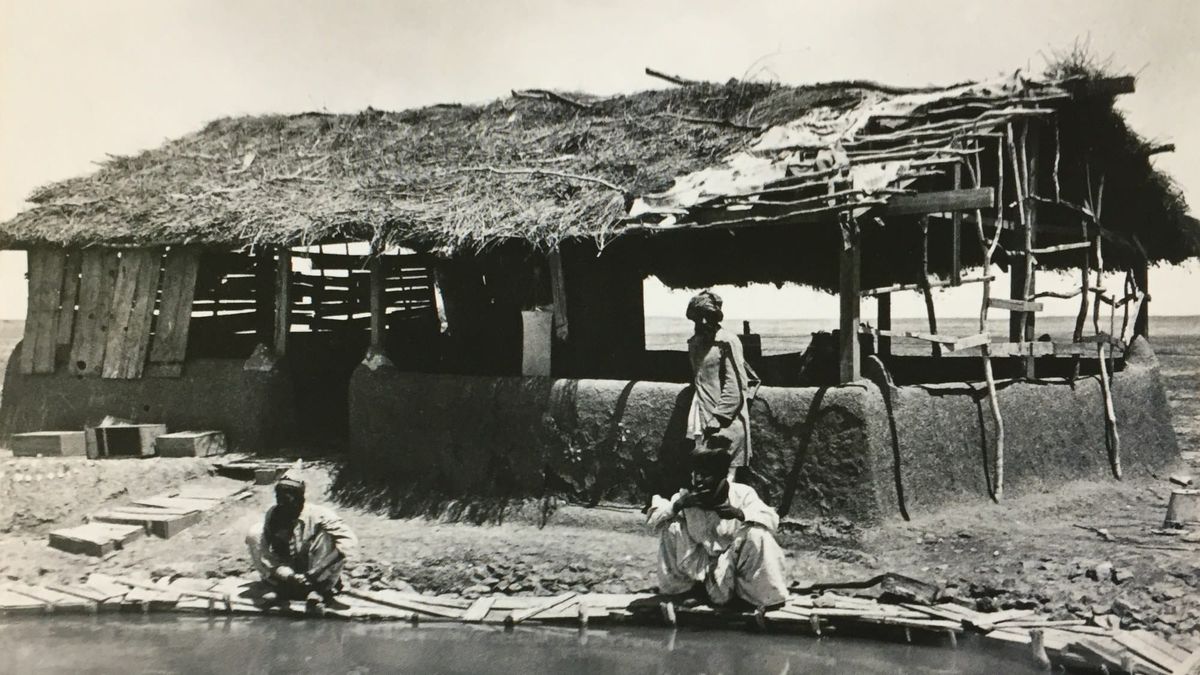
Marree (Hergott Springs), South Australia. This is usually called Australia's first mosque, and its date is a genuine muddle. You will see 1861 quoted, including on Wikipedia and in tourist material. I do not think that date can be right. Elder's camels and their handlers did not land until the last day of 1865,3938 and Hergott Springs only became a camel depot when the Great Northern Railway reached it in 1883; the town was surveyed and proclaimed on 20 December 1883.11 Albayrak and Haverić write that the mosque was built "in 1865 or 1882" by Abdul Kadir, and photographs survive from around 1884.10 Their "1865" looks to me like the year the first large party of cameleers landed rather than a building date. The Broken Hill Historical Society's cameleer timeline, which draws on Philip Jones and Anna Kenny's Australia's Muslim Cameleers (2007) and on Christine Stevens's Tin Mosques and Ghantowns, gives 1882 and the same builder, Abdul Kadir.39 So the independent dates I could find point to the early 1880s. My best reading is that a simple mud-and-timber mosque stood at Hergott Springs from about 1882, and certainly by the time it was photographed around 1884, and that the 1861 figure is an error that has been copied forward. That is still an inference from secondary sources; I have not seen a dated primary record of the building. The original building is gone; what visitors see today is a reconstruction.39
Adelaide, Little Gilbert Street. Built in 1888–89 at a cost of about £450, led by Hadji Mullah Merban of Kandahar, with the camel contractor Abdul Wade among its trustees. The four minarets were added in 1903. It is the oldest surviving permanent mosque in Australia and is still in use. In 1890 it drew twenty to forty men on an ordinary Friday.14
Broken Hill. The Broken Hill Historical Society, which saved and still looks after the building, dates it to 1891 on the North Camel Camp, noting that the site had been used for prayer since 1887. The NSW State Heritage Register lists it as the first mosque built in the state and the only surviving Ghantown mosque in Australia. It was re-dedicated in 1968 and now doubles as a small museum.1539
Perth, William Street. The foundation stone was laid on 13 November 1905 by Faiz Mahomet, who had collected money from cameleers and merchants across Western Australia, and the building was completed in 1906. So "1905" and "1906" are both right, depending on whether you mean the stone or the finished mosque. One of its founders, Hassan Musa Khan, later became Australia's first known Aḥmadī, a detail I return to below.1627
Brisbane, Holland Park. A mosque stood on this site from about 1908–09. The present building dates from 1968–71.17
The cameleer era also has a darker page. On 1 January 1915 two Broken Hill men, the cameleer Gool Badsha Mahomed and Mullah Abdullah, the local imam and halal butcher, fired on a picnic train, killing four people before they were themselves killed. Muslim families in the town's Ghantown, who had nothing to do with it, bore the backlash.18 It is part of the history and should not be edited out.
4. White Australia: the thin years
The Immigration Restriction Act of 1901, one of the first laws passed by the new Commonwealth, was designed to stop non-European migration. It used a dictation test that officials could set in any European language, so it did not need to name a race to exclude one.4019 The 1903 naturalisation law barred "natives of Asia, Africa or the Pacific Islands" from citizenship. For the cameleers this meant no new recruits, great difficulty bringing wives from home, and often refusal of naturalisation. As motor transport and the railways took their work in the 1920s and 1930s, the community aged and shrank. Some married Aboriginal or European women; many simply went home.1911
Islam survived these decades through a side door. Because the policy filtered by race rather than religion, European Muslims could come. Albanian Muslims began arriving in 1924, first through Fremantle, and many settled around Shepparton in Victoria's Goulburn Valley as orchardists and farm workers. They laid the foundation stone of their own mosque in 1956 and finished it in 1960: the first mosque in Victoria.20 After the Second World War, displaced persons from Yugoslavia included Bosnian Muslims, and by 1951 the imam Ahmed Skaka was helping to revive the then-neglected Adelaide mosque with the new post-war arrivals.2614 Both communities were Ḥanafī, heirs of the Ottoman Balkans.
There was one other quiet exception. In 1955 Britain transferred the Cocos (Keeling) Islands to Australia, and with them a Malay Muslim community whose ancestors had been brought to the atolls as plantation workers in the 1820s. In 1984 the islanders voted in a UN-supervised act of self-determination to integrate with Australia. The Cocos Malays are among the oldest continuous Muslim communities under the Australian flag. They follow the Shāfiʿī school, like most of the Malay world.21
Muslims from this small community also served in both world wars, a story the historian Dzavid Haveric has done much to recover.46 He counts about twenty soldiers of Muslim background in the First AIF and about two hundred in the Second.45 One of the first group was Charley Khan, an Indian-born merchant from Renmark in South Australia, who enlisted on 6 April 1915 at thirty, landed at Gallipoli that September as a cook with the 50th Battalion, was wounded at Bullecourt in 1917 and came home with the Meritorious Service Medal.45 In the Second World War Kurtali Raman, an Albanian from Mareeba in north Queensland, went into Kokoda with the 2/31st Battalion and was killed in Papua on 1 December 1942. Abu Kassim bin Marah, a Malay pearl diver from Broome, parachuted into Japanese-held Sarawak with Z Special Unit in April 1945; when he came home his application for naturalisation was refused. He died in 1949 and lay in an unmarked grave in Perth's Karrakatta Cemetery until his grandson found it in 2021.47
The policy was dismantled in stages. The Migration Act of 1958 abolished the dictation test.40 The Holt government's reforms of 1966 opened the door to non-European skilled migrants. In 1973 the Whitlam government formally ended White Australia.19 The mid-century Muslim population was small enough that the Australian Federation of Islamic Societies, formed on 1 January 1964, could plausibly hope to speak for all of it.30
5. The door reopens
Turkey, 1967
On 5 October 1967 Australia and Turkey signed an assisted-migration agreement, the first such deal Australia made with a Muslim-majority country. The first arrivals under it landed on 14 October 1968, and nearly 19,000 assisted Turkish migrants came between 1968 and 1974.2241 They went where the factory jobs were: Melbourne's north (Broadmeadows, Coburg, later Roxburgh Park and Meadow Heights) and Auburn in Sydney. They brought Turkish Ḥanafī Islam of the Republic's official kind. Some Turkish mosques in Australia now work with religious staff sent by Turkey's Directorate of Religious Affairs (Diyanet), and a Diyanet Foundation of Australia is registered with the national charities regulator.23 The best-known Turkish mosque, the Auburn Gallipoli Mosque, began in a converted house in 1979 and opened its present building on 28 November 1999. At the 2021 census, 38,582 Australians were born in Turkey and 67.6% of them gave Islam as their religion.22
Lebanon, 1975
Lebanese migration to Australia is old, but until the 1970s it was overwhelmingly Christian. When civil war broke out in 1975, Christian community leaders lobbied the Fraser government, and the resulting "Lebanon concession" eased entry for people fleeing the war. That wave, which roughly doubled the Lebanese-born population to about 50,000 by 1981, was majority Muslim.24 It settled heavily in Sydney's south-west, around Lakemba, Bankstown and Punchbowl. The Lebanese Muslim Association, founded in the early 1960s, opened the Imam Ali bin Abi Taleb mosque in Lakemba in 1977, still one of the largest in the country.25
These Lebanese Muslims were not one thing. Sunnis, many from Tripoli and the north, brought a mix of Shāfiʿī practice and the Ḥanafī school that Ottoman rule had made official. Shīʿa from the south and the Bekaa brought Twelver (Jaʿfarī) Islam, with its own mosques and ḥusayniyyas in Sydney's south and south-west. Smaller numbers of ʿAlawīs came from Lebanon, Syria and Turkey. The Druze came too, though the Druze faith sits outside mainstream Islamic definitions and most Druze would not describe themselves simply as Muslims; I mention them here because they arrived in the same migration stream, not to settle that question.
South Asia, Southeast Asia and the refugee decades
From the 1970s onward skilled and student migration brought Pakistanis, Indians, Bangladeshis, Fijian Indians, Indonesians and Malaysians. Colombo Plan students from Malaysia and Indonesia had been coming since the 1950s, and some stayed. The Dawoodi Bohras date their Australian community to students of the 1950s.28 The South Asians brought the whole range of subcontinental Sunni Islam: Deobandi and Barelvī mosques, the Tablīghī Jamāʿat's travelling preaching circles, and Sufi lineages. The Malay and Indonesian communities brought the Shāfiʿī school.
Then came the refugee decades. Bosnians fleeing the war of 1992–95 formed a second Bosnian wave; by 1996 almost 14,000 people born in Bosnia and Herzegovina lived in Australia, many of them Muslims, and they built mosques in Noble Park and Deer Park in Melbourne and Penshurst and Smithfield in Sydney.26 Iraqis came after 1991 and again after 2003, many of them Shīʿa. Afghans came across four decades, including large numbers of Hazara Shīʿa from the late 1990s. Iranians, Somalis, Sudanese, Eritreans and, after 2011, Syrians added further layers. I have not attached numbers to each of these, because I could not find a single reliable source that breaks them down consistently.
The most recent layer is again mostly skilled and student migration. The ABS reports that almost 126,000 people who arrived between 2016 and 2021 gave Islam as their religion, and the main birthplaces were Pakistan, Afghanistan, India and Bangladesh.2 The centre of gravity is shifting towards South Asia.
6. The map in 2021
At the census of 10 August 2021, 813,392 people (3.2% of the population) gave their religion as Islam, up from about 604,200 (2.6%) in 2016.12 It was the second-largest religion after Christianity. The ABS gives a median age of 28 for Muslims, among the youngest of any group.2 The share was 4.3% in New South Wales and 4.2% in Victoria,42 and Sydney and Melbourne together hold the large majority. Census figures on religion are self-reported and the question is optional, so these are floors rather than exact counts.
| Suburb | City | Islam, % of residents | Main historic communities |
|---|---|---|---|
| Lakemba | Sydney | 61.2% | Lebanese, then Bangladeshi, Pakistani and others |
| Auburn | Sydney | 38.5% | Turkish, Lebanese, Afghan and others |
| Broadmeadows | Melbourne | 36.1% | Turkish, Lebanese, Iraqi |
| Dandenong | Melbourne | 34.1% | Afghan, Bosnian, South Asian and others |
| Australia | (national) | 3.2% |
The "main historic communities" column is my shorthand, drawn from the migration histories above rather than from the census tables. One thing I could not do from ABS publications was produce a clean national ranking of Muslims by birthplace for 2021. The Muslim World Research Centre gives around 40% Australian-born,34 which fits the age profile; after that, Pakistan, Afghanistan, Lebanon, Turkey, Bangladesh, India and Iraq all appear near the top depending on the source and the year. Treat any precise ranking you see with some caution unless it cites an ABS table.
7. Who brought which school
The census does not ask about sect or madhhab, so nobody has a count of Sunnis and Shīʿa, let alone Ḥanafīs and Shāfiʿīs. What we can do is follow the migration streams, since in Australia the school almost always arrived with the passport. The table below is a sketch, not a census.
| Community | Main arrival | School or tradition brought | Notes |
|---|---|---|---|
| Makassan trepangers | c. 1700–1907 | Sunni, Shāfiʿī (as in Sulawesi) | Seasonal visitors; no settled community |
| "Afghan" cameleers | 1860–1920s | Sunni Ḥanafī, with Sufi devotion | Built the first mosques |
| Cocos Malays | 1820s (Australian from 1955) | Sunni Shāfiʿī | Indian Ocean territory |
| Albanians | from 1924 | Sunni Ḥanafī (Ottoman Balkan) | Shepparton mosque, 1960 |
| Bosnians | 1950s; 1990s | Sunni Ḥanafī, Māturīdī creed | Two waves, post-war and refugee |
| Turks and Turkish Cypriots | from 1968 | Sunni Ḥanafī; some Diyanet-linked mosques | Also Alevi and ʿAlawī minorities |
| Lebanese Sunnis | from 1975 | Shāfiʿī, with Ḥanafī strands | Lakemba mosque, 1977 |
| Lebanese, Iraqi, Afghan Hazara, Iranian, Pakistani Shīʿa | from 1975; 1990s–2010s | Twelver (Jaʿfarī), following various marājiʿ | Numbers not counted by census |
| Pakistanis, Indians, Bangladeshis | from 1970s; surging after 2010 | Ḥanafī; Deobandi, Barelvī, Tablīghī, Ahl-e Ḥadīth | Fastest-growing group today |
| Malaysians, Indonesians | from 1950s | Shāfiʿī | Colombo Plan students first |
| Somalis, Sudanese, Eritreans | 1990s–2000s | Shāfiʿī (Somali), Mālikī (Sudanese) | Humanitarian programme |
| Nizārī Ismāʿīlīs | late 20th century | Shīʿa Ismāʿīlī, Aga Khan | Jamatkhanas in main cities |
| Dawoodi Bohras | from 1950s | Mustaʿlī Ismāʿīlī (Ṭayyibī) | Over 900 families across Australia and NZ |
| Aḥmadiyya | 1903 (one man); formal from 1979–87 | Aḥmadī | Contested status; see below |
A few notes on the table
No single madhhab dominates. Australia may be one of the few places where Ḥanafīs, Shāfiʿīs, Mālikīs and Ḥanbalī-leaning Salafis routinely pray behind each other in the same suburb, sometimes in the same mosque. Part three described a map where one school usually owns a region. Here the map is a mosaic at the level of streets, because it was laid down by migration rather than by any court. I have written separately about what it means to follow a madhhab in that kind of setting.
Salafi currents arrived less as a migration stream than as a set of ideas carried by students returning from Saudi and other Gulf universities, by visiting preachers and by media from the 1980s onward. They are present in several Sydney and Melbourne mosques and study circles. Because there is no clean data on them, I will not attach a number.
Sufi orders are older here than people assume, reaching back to the cameleers. In recent decades the Naqshbandī order (including the Haqqānī branch) and the Niʿmatullāhī order have established themselves in Sydney and Melbourne, and Milani and Possamai's fieldwork shows both adapting to local life.2913 Ba ʿAlawī and Shādhilī teachers also have Australian followings.
The Aḥmadiyya need a careful sentence. Hassan Musa Khan, one of the founders of the Perth mosque, learned of the movement in 1903 and is regarded as the first Aḥmadī in Australia. The community was authorised by its headquarters to register in 1979, registered formally in 1987, and opened the Baitul Huda mosque at Marsden Park in Sydney in 1989.27 It describes itself as Muslim. Mainstream Sunni and Shīʿa bodies, in Australia as elsewhere, do not accept its members as Muslims because of its teachings about Mirza Ghulam Ahmad and prophethood. The text at issue is Qur'an 33:40, which calls Muhammad ﷺ "the Messenger of Allah and the seal of the prophets"; mainstream scholars read it, with the hadith in which he calls himself "the last of the Prophets", as closing prophethood,48 while Aḥmadī writers read "seal" as a seal of authentication marking his rank.49 I am recording both positions, not adjudicating them.
The ʿAlawīs and Alevis are distinct groups that are often confused. ʿAlawīs came mainly from Syria, Lebanon and Turkey's Hatay province; Alevis came from Anatolia with the Turkish migration. Both have their own associations. I could not find reliable figures for either.
8. Institutions
The shape of Australian Islamic institutions follows the same logic as the madhhab map. There was never a state-appointed religious authority, so bodies grew from the bottom up, often along ethnic lines, and then tried to federate.
AFIC. The Australian Federation of Islamic Societies was established on 1 January 1964. In 1976 it restructured from two tiers to three (local societies, state councils, and the federation) and took its present name, the Australian Federation of Islamic Councils.30 The state councils, such as the Islamic Council of Victoria and the Islamic Council of Queensland, sit in its middle tier. AFIC has been a major halal certifier and at one point was linked to several Islamic schools, though governance disputes since 2015–16 have ended most of those ties. It has had long periods of internal conflict, some of them settled in court.30
ANIC and the Grand Mufti. The office of Mufti of Australia began under AFIC with the Lakemba imam Taj El-Din Hilaly. In 2006 Sunni imams from across the country formed the Australian National Imams Council, the same year Hilaly's public remarks caused a storm that ended his tenure, and the appointment passed to the new council. ANIC chose Fehmi Naji El-Imam in 2007 and Ibrahim Abu Mohamed in 2011.31 In March 2018 ANIC's executive elected Sheikh Abdel Aziem Al-Afifi for a three-year term, but he died that July, and Dr Ibrahim Abu Mohamed returned to the office.4344 ANIC's own website still names him as Grand Mufti of Australia when I checked in September 2026 and again on 2 October 2026.31 Since 2021 the picture has become messier. In April that year AFIC revived a Grand Mufti of its own, Sheikh Abd al-Quddus al-Azhari, and SBS reported that Australia now had two grand muftis appointed by rival bodies.32 AFIC's most recent appointee is Sheikh Riad El-Rifai, announced on 11 March 2024.30 ANIC says it has more than 300 registered imams.31 I have not tried to settle which title-holder is "the" Grand Mufti; the honest answer is that it depends whom you ask.
The Australian Fatwa Council. ANIC's general assembly of 3 March 2019 resolved to create the Australian Fatwa Council, headed by the Mufti, to give rulings on contemporary questions facing Australian Muslims. Its published rulings have covered COVID-19 vaccination, prayer during lockdowns and zakat distribution.31 A separate body, Darulfatwa (the Islamic High Council of Australia), founded in 2004, serves a different, largely Lebanese-rooted constituency.
Shīʿa and other bodies. The Twelver community has its own councils and more than eighty centres nationally, organised largely by ethnicity and by the marjaʿ followed. The Ismāʿīlīs and Bohras are organised through their own worldwide structures under the Aga Khan and the Dai al-Mutlaq respectively.
Schools. The first Islamic schools opened in 1983, King Khalid Islamic College in Melbourne and Noor Al-Houda in Sydney, followed by Malek Fahd in Sydney in 1989 and a run of others through the 1990s. Peter Jones counted fifteen Islamic schools in 1997; by 2008 the number had doubled and about 16,000 students attended them.33 There are more today, but I could not find a current authoritative count.
9. Timeline
| Year | Event |
|---|---|
| c. 1700–1720 | Makassan trepang voyages to Marege' and Kayu Jawa under way (start date debated) |
| 1803 | Flinders meets Pobassoo's fleet off Arnhem Land |
| 1802–1828 | A few "Mohammedans" in colonial musters and the 1828 census |
| 1860 | First cameleers land in Melbourne for Burke and Wills |
| 1865–66 | Stuckey lands 31 cameleers and 124 camels at Port Augusta (31 Dec 1865) for Elder's Beltana station |
| c. 1882–84 | Mosque at Hergott Springs (Marree); 1861 date doubtful |
| 1888–89 | Adelaide mosque built; minarets 1903 |
| 1891 | Broken Hill mosque built (site in use from 1887) |
| 1901 | Immigration Restriction Act: White Australia begins |
| 1905–06 | Perth mosque: stone laid 13 Nov 1905, completed 1906 |
| 1906–07 | SA stops Makassan licences; last prau 1907 |
| 1924 | Albanian Muslims begin arriving |
| 1955 | Cocos (Keeling) Islands and their Malay Muslims become Australian |
| 1960 | Shepparton mosque, Victoria's first |
| 1964 | Australian Federation of Islamic Societies formed (AFIC from 1976) |
| 1966 | Holt reforms open non-European migration |
| 1967–68 | Turkish migration agreement signed 5 Oct 1967; first arrivals 14 Oct 1968 |
| 1973 | Whitlam government ends White Australia |
| 1975–81 | Lebanese civil war migration; Lakemba mosque opens 1977 |
| 1983 | First Islamic schools (Melbourne and Sydney) |
| 1990s | Bosnian, Iraqi, Somali and Afghan refugee arrivals |
| 2006 | ANIC established |
| 2019 | Australian Fatwa Council created by ANIC |
| 2021 | Census: 813,392 Muslims, 3.2% of Australians |
10. What this says about diffusion
Part three argued that a madhhab spreads less by winning arguments than by winning institutions, and put it bluntly: a madhhab "does not lose an argument. It loses appointments." It listed engines such as state patronage, judicial appointment, endowments, trade routes, scholarly lineages, Sufi orders and migration. Australia makes an unusually clean test case, because several of those engines were switched off from the start.
No Australian government ever appointed a qāḍī or endowed a madrasa. There was no Muslim ruler whose court could favour one school over another, and no waqf system old enough to lock a school into place. What remains is a smaller set of engines, and each wave maps neatly onto one of them.
Trade brought the Makassans and, with them, contact but no community. That is interesting in itself. Part three leaned on trade to explain how Shāfiʿī Islam spread around the Indian Ocean rim, yet here was two centuries of annual Muslim trade that produced loanwords and a remembered ceremony, not conversion. The difference, I think, is that nobody stayed, married in large numbers, or built anything. Trade on its own opens a door. Settlement walks through it.
Labour recruitment brought the cameleers, and with them the first mosques and the first settled madhhab. It also shows how fragile a labour diaspora is when it cannot reproduce itself. Single men on contracts, cut off from new arrivals by law, built beautiful little mosques that stood half-empty within two generations.
State policy was the master switch. White Australia did not mention religion, but by filtering on race it decided which Muslims could come: Albanians and Bosnians yes, Punjabis and Pashtuns no. When the policy ended, the 1967 Turkish agreement was a deliberate government recruitment of Muslim workers, the closest thing Australia has to a state choosing a madhhab, and even that was a by-product of wanting factory labour.
Refugee intake produced the most varied layer. Lebanese, Bosnians, Iraqis, Afghans, Somalis and Syrians came because of wars far away, and the timing and mix of that intake decided which schools, which sectarian identities and which mosque cultures took root in which suburb.
Two of the older engines do survive in modern form. Sufi orders still travel with their shaykhs, and scholarly lineages now move through graduates of Al-Azhar, Medina, Deoband, Damascus, Qom and Najaf who come back as imams. That is where the real competition between schools now happens: not in a court, but in who staffs the pulpit and who teaches the Saturday class. Part three's point about appointments turns out to hold after all. It is just that the appointing bodies are now mosque committees, school boards and rival councils of imams, not sultans.
If there is a lesson for the broader thesis, it is modest. Where the state does not pick a school, the map of madhhabs follows the map of migration almost exactly, and it stays plural. Whether it stays that way over another two or three generations of Australian-born Muslims, who are already about four in ten, is an open question. I do not know the answer, and I am wary of anyone who says they do.
Glossary
- Madhhab
- A school of Islamic law. The four surviving Sunni schools are the Ḥanafī, Mālikī, Shāfiʿī and Ḥanbalī; the main Twelver Shīʿa school is the Jaʿfarī.
- Trepang
- Dried sea cucumber (Malay teripang), traded to China.
- Marege' / Kayu Jawa
- Makassan names for the Arnhem Land coast and the Kimberley fishing grounds.
- Ghantown
- The cameleers' quarter on the edge of an outback town.
- Pīr
- A Sufi master or saint, often venerated after death.
- Marjaʿ (pl. marājiʿ)
- A senior Twelver Shīʿa jurist whose rulings a believer follows.
- Jamatkhana
- An Ismāʿīlī place of gathering and prayer.
- Tablīghī Jamāʿat
- A lay preaching movement founded in India in the 1920s, closely linked to Deobandi scholarship.
Sources
- Australian Bureau of Statistics, 2021 Census QuickStats: Australia (Islam 813,392, 3.2%).
- Australian Bureau of Statistics, Religious affiliation in Australia, 4 July 2022 (2016 comparison, median age, 2016–21 arrivals by birthplace).
- ABS 2021 QuickStats for Lakemba, Auburn (NSW), Broadmeadows (Vic.) and Dandenong.
- National Museum of Australia, Trade with the Makasar.
- C. C. Macknight, The Voyage to Marege': Macassan Trepangers in Northern Australia, Melbourne University Press, 1976.
- Wikipedia, Makassan contact with Australia (for the July 1906 licensing decision and the dating debate; checked against Macknight and the NMA).
- Ian S. McIntosh, "Islam and Australia's Aborigines? A perspective from north-east Arnhem Land", Journal of Religious History 20 (1996): 53–77, doi:10.1111/j.1467-9809.1996.tb00692.x.
- Alan Walker and R. David Zorc, "Austronesian loanwords in Yolngu-Matha of northeast Arnhem Land", Aboriginal History 5:2 (1981).
- Bilal Cleland, The Muslims in Australia: A Brief History, Islamic Council of Victoria.
- Ismail Albayrak and Džavid Haverić, "How Australia's first outback mosque was built 600km north of Adelaide", The Conversation, 19 November 2025 (link).
- Wikipedia, Afghan cameleers in Australia and Marree, South Australia (railway 1883, town proclaimed 20 December 1883).
- Roger Bateman, "South Asian Islam in Early Australia, 1880s to 1930: Archaeology of Mosques, Cultural Continuity and Change", Journal of Islamic Archaeology, 2025.
- Abu Bakr Sirajuddin Cook, "Tasawwuf ʿUsturaliya: Prolegomena to a History of Sufism in Australia", Australian Journal of Islamic Studies 3:3 (2019).
- Wikipedia, Central Adelaide Mosque.
- Broken Hill Historical Society, Mosque Museum; NSW State Heritage Register listing summarised at Broken Hill Mosque.
- Heritage Council of WA, Perth Mosque (inHerit, Place 2156); Wikipedia, Perth Mosque.
- Brisbane City Council, Brisbane Mosque heritage listing.
- Wikipedia, 1915 Picnic Train Attack.
- National Museum of Australia, White Australia policy and Ending the White Australia policy.
- Wikipedia, Albanian Mosque, Shepparton; Victorian Heritage Database, Albanian Mosque, Shepparton.
- SBS News, "Rising seas threaten Australia's oldest Muslim community", 15 March 2026; Britannica, Cocos Islands.
- SBS News, "Australia marks 50 years of Turkish migration"; Wikipedia, Turkish Australians (2021 birthplace and religion figures).
- Wikipedia, Auburn Gallipoli Mosque; ACNC, Diyanet Foundation of Australia Limited.
- ABC News, "Australia's Lebanese community is largely based in Sydney. Here's why", 5 October 2024.
- Dictionary of Sydney, Ali ben Abi Taleb Mosque, Lakemba.
- Wikipedia, Bosnian Australians and Shia Islam in Australia (migration waves only; I have not used its population estimates).
- Wikipedia, Ahmadiyya in Australia.
- The Dawoodi Bohras of Australia & New Zealand, About us.
- Milad Milani and Adam Possamai, "Sufism, spirituality and consumerism: the case study of the Nimatullahiya and Naqshbandiya Sufi orders in Australia", Contemporary Islam 10 (2016).
- Wikipedia, Australian Federation of Islamic Councils; AFIC, Announcing the new National Grand Mufti, March 2024.
- ANIC, About ANIC, Australian Fatwa Council and press release of 3 March 2019; Wikipedia, Australian National Imams Council.
- SBS Arabic, "Australia now has two grand muftis as rival Muslim bodies square off".
- Peter D. Jones, "Islamic schools in Australia", The La Trobe Journal 89 (2012).
- Muslim World Research Centre, The Australian Muslim community (Australian-born share).
- Regina Ganter, "Remembering Muslim histories of Australia", The La Trobe Journal 89 (2012), pp. 48–62 (Makassan chronology, p. 55; Yolŋu and Islam, p. 58).
- Abdullah Saeed, Muslim Australians: Their Beliefs, Practices and Institutions, Department of Immigration and Multicultural and Indigenous Affairs and Australian Multicultural Foundation, with the University of Melbourne, 2004.
- Bert Spinks, "The first Muslims in Tasmania", Tasmanian Geographic.
- Bill Seager, review of Australia's Muslim Cameleers: Pioneers of the Inland, 1860s–1930s (South Australian Museum exhibition, curated by Philip Jones and Anna Kenny), reCollections 2:2 (2007), National Museum of Australia. The companion book is Philip Jones and Anna Kenny, Australia's Muslim Cameleers, Wakefield Press, 2007.
- Broken Hill Historical Society, "Timeline of camels and cameleers in Australia" (2022), citing Jones and Kenny (2007) and Christine Stevens, Tin Mosques and Ghantowns (1989; reissued 2002).
- National Archives of Australia, The Immigration Restriction Act 1901 (dictation test; ended 1958).
- National Archives of Australia, "First Turkish assisted passage migrants arrive in Sydney", 1968, NAA: A12111, 68/4/25.
- ABS 2021 QuickStats for New South Wales (Islam 4.3%) and Victoria (Islam 4.2%).
- AMUST, "Sheikh Afifi appointed new Mufti", March 2018, and "Mufti Sheikh Al-Afifi passed away", July 2018.
- SBS Arabic, "Australia's Grand Mufti confirms he is the only legitimate leader", 29 September 2018 (Abu Mohamed's second term).
- Dzavid Haveric, "Multicultural Anzac Day acknowledges Muslim soldiers too", Charles Sturt University News, 22 April 2025: news.csu.edu.au.
- Dzavid Haveric, "ANZAC Muslims", Australian Journal of Islamic Studies 3.3, published 14 February 2019, doi:10.55831/ajis.v3i3.147: ajis.com.au.
- Simon Wilmot and James Barry, "The stories of Australia's Muslim Anzacs have long been forgotten. It's time we honour them", The Conversation: theconversation.com.
- Qur'an 33:40, Mustafa Khattab, The Clear Quran, as shown on quran.com: quran.com/33/40; Ṣaḥīḥ al-Bukhārī 3535 (the parable of the missing brick: "I am that brick, and I am the last of the Prophets"), in al-Bukhārī's Ṣaḥīḥ: sunnah.com/bukhari:3535.
- Farhan Iqbal (Ahmadiyya Muslim Community Canada), "Structure and Application of the word Khatam", Al Islam (the community's official site), checked 2 October 2026: alislam.org.
Related reading
- The Qur'an: What It Is, How It Came Down, and How It Was Kept: revelation, compilation and preservation of the text
- Muhammad ﷺ: A Life: from Mecca to Medina, with a timeline and family tree
- Halal Food in Australia: stunning, gelatine and what a certification logo tells you
- Ramadan and Fasting in Australia: moon-sighting, start dates and each school's rulings
- Sunni and Shia: the hub for the three-part series
- How Islam Travelled: why Indonesia is Shāfiʿī, Iran Shia and Morocco Mālikī
- Following a Madhhab: Taqlīd, Ijtihād and Mixing Schools: why jurists answer differently, and whether you may switch