مسألة المولد النبوي (The Mawlid, Session by Session)
Did the salaf mark the Prophet's birthday, and does it matter that they didn't? The Quran and Sunnah on both sides, Ibn Taymiyyah and al-Suyuti in their own words, the disputed date, and a simple test for any gathering you're invited to.
The Mawlid, Session by Session
Ten interactive sessions: the history, the texts of the Quran and Sunnah, both camps in their own words, and the outcome. Tap anything.
مسألة المولد النبوي
The Mawlid, Session by Session
Ten interactive sessions: the history, the texts of the Quran and Sunnah, both camps in their own words, and the outcome. Tap anything.
New to the Qur'an? Start with The Qur'an: What It Is, How It Came Down, and How It Was Kept, then read Muhammad ﷺ: A Life. All articles: Deen: Start Here.
Not one question, but four
Most Mawlid arguments collapse because the parties answer different questions. Tap each to see its real status.
Obligatory by consensus. It must exceed love of father, children and all mankind (Bukhari 15), and even of one's own self (Bukhari 6632).13 Ibn Baz states this as emphatically as al-Suyuti.
A question of legal theory that must itself answer to the Quran and Sunnah. Session 3 takes it to the texts; the outcome is in Session 10.
Both camps condemn the same excesses. They differ only on whether a gathering stripped of every excess is still objectionable.
The governing texts
Both camps hold the same hierarchy: Quran, then authentic Sunnah, then the early community. Every text here is accepted by both sides; the dispute lives in the weighing. Use the lens to see each camp's reading.
Does absence of precedent alone forbid?
Nobody asks whether Muslims may legislate; the Quran closes that. The narrow question: a practice assembled from legislated parts, on a recurring day, without claiming the day is legislated. What do the texts say?
What closes the door
- Quran 42:21. "Or do they have associate-gods who have ordained for them some [polytheistic] beliefs, which Allah has not authorized?" (Khattab; the Arabic is sharaʿu lahum min al-din, "legislated for them in religion").4 If a fixed custom counts as legislating, this ends it.
- Abu Dawud 4607. "Beware of newly invented matters... every innovation is misguidance." Sahih.15
- Bukhari 2697, Muslim 1718a. "Whoever introduces into this affair of ours what is not of it, it is rejected." Agreed upon.21
- Bukhari 5063. The three men who vowed only more worship were rebuked: "whoever turns away from my Sunnah is not of me." Intensity is not self-justifying.16
What opens it, conditionally
- Quran 57:27. "As for monasticism, they made it up (We never ordained it for them) only seeking to please Allah, yet they did not [even] observe it strictly." Is the blame for innovating, or for failing to maintain? Both readings are classical.5
- Bukhari 1149, 799, 7375. Bilal's self-devised prayer routine, the man's unprompted words of praise, the commander's love of al-Ikhlas: initiative ratified with reward. He never asked "where is your precedent?"17
- Bukhari 4986. Abu Bakr to Umar: "How can you do a thing the Messenger of God did not do?" Umar: "This, by God, is good." Zayd then put the same question to Abu Bakr and got the same answer. The Quran's own compilation.18
قُلْتُ لِعُمَرَ: كَيْفَ تَفْعَلُ شَيْئًا لَمْ يَفْعَلْهُ رَسُولُ اللهِ صَلَّى اللهُ عَلَيْهِ وَسَلَّمَ؟ قَالَ عُمَرُ: هَذَا وَاللهِ خَيْرٌ
Abu Bakr's question is, word for word, the objectors' argument. Umar's answer is, word for word, the permitters'. When Zayd raised the same objection, Abu Bakr answered him in the same words. The best generation weighed absence of precedent, and proceeded, but only for preservation and means, never for a commemorative festival.
Source Abu Bakr, as narrated by Zayd ibn Thabit. Bukhari 4986, verified at sunnah.com18
Where the trail runs out: no text says in so many words "whatever the salaf did not do is forbidden," and none says "good deeds may be fixed to a recurring date without his command." Ibn Taymiyyah and al-Shatibi argue from the first; al-Suyuti, after Ibn Hajar, from something like the second, by the ʿAshura analogy.29333435 The objectors do not accept that they are only inferring: for al-Fakihani, Ibn Baz and the Permanent Committee, "every innovation is misguidance" (Muslim 867) and "whoever introduces into this affair of ours what is not of it, it is rejected" (Bukhari 2697, Muslim 1718a) already answer the question.313747821
Which day was he born?
Monday is certain (Muslim 1162b).7 The Year of the Elephant is agreed. The day of the month never was.4243 Tap a candidate date of Rabi al-Awwal.
The awkward symmetry: the 12th is also the most widely reported date of his passing in 11 AH. And the first documented Fatimid Mawlid is reported to have been held on the 13th, only later settling on the 12th.23 The date being celebrated may not even have been the original date of the celebration. His birth and early years are told in Muhammad ﷺ: A Life.
How the Mawlid came to exist
Nine steps, each documented. Tap any step for the record and its sources.
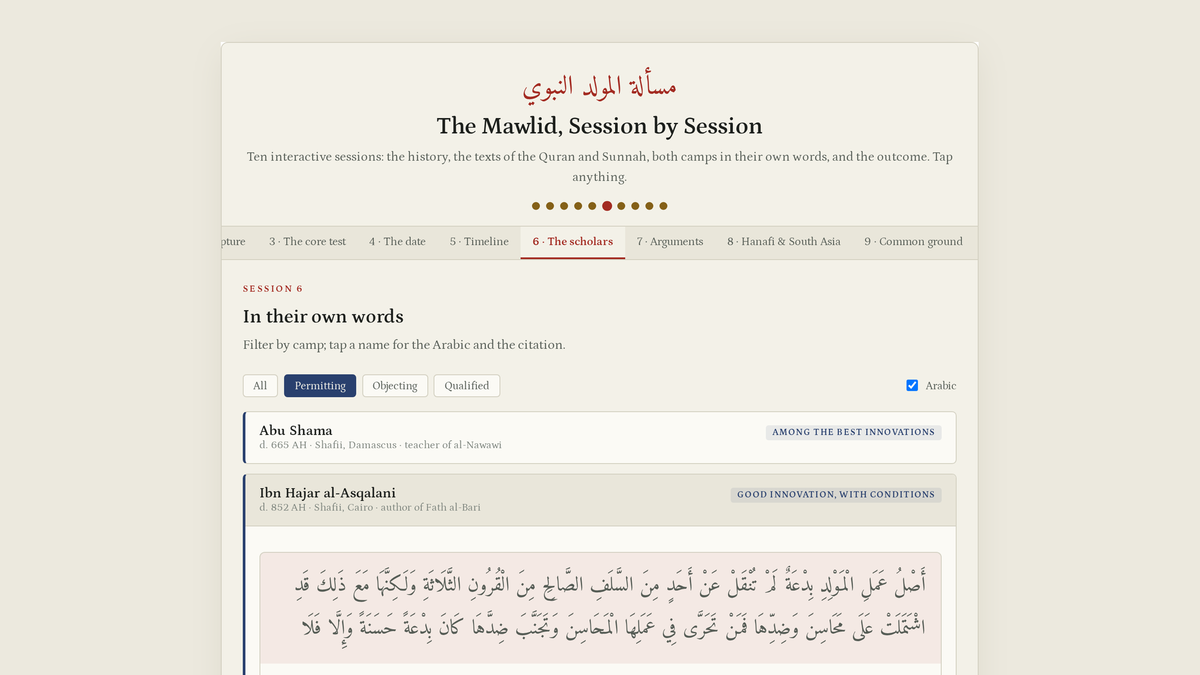
In their own words
Filter by camp; tap a name for the Arabic and the citation.
وَمِنْ أَحْسَنِ مَا ابْتُدِعَ فِي زَمَانِنَا مَا يُفْعَلُ كُلَّ عَامٍ فِي الْيَوْمِ الْمُوَافِقِ لِيَوْمِ مَوْلِدِهِ صَلَّى اللهُ عَلَيْهِ وَسَلَّمَ مِنَ الصَّدَقَاتِ وَالْمَعْرُوفِ وَإِظْهَارِ الزِّينَةِ وَالسُّرُورِ
Among the finest of what has been newly begun in our time is what is done each year on the day of his birth: charity, kindness, adornment and joy, indicating love and reverence for him and gratitude to God.
Source al-Baith ala Inkar al-Bida, a book written to attack innovations2839
وَاللهُ قَدْ يُثِيبُهُمْ عَلَى هَذِهِ الْمَحَبَّةِ وَالِاجْتِهَادِ لَا عَلَى الْبِدَعِ... فَإِنَّ هَذَا لَمْ يَفْعَلْهُ السَّلَفُ مَعَ قِيَامِ الْمُقْتَضِي لَهُ وَعَدَمِ الْمَانِعِ مِنْهُ لَوْ كَانَ خَيْرًا
God may reward them for the love and the striving, not for the innovations... for the salaf did not do this, though the motive was present and nothing prevented it, had it been good. (2:123)29
Source Iqtida al-Sirat al-Mustaqim, chapter on innovated temporal festivals
فَتَعْظِيمُ الْمَوْلِدِ وَاتِّخَاذُهُ مَوْسِمًا قَدْ يَفْعَلُهُ بَعْضُ النَّاسِ وَيَكُونُ لَهُ فِيهِ أَجْرٌ عَظِيمٌ لِحُسْنِ قَصْدِهِ
Honouring the Mawlid and taking it as a season: some do this, and there may be a great reward in it for him, for his good intention and his reverence for the Messenger of God. (2:126)30
Source Same work, three pages later. At 2:124 the real charge: the zealous are often lukewarm about his actual commands. At 2:125: never strip an innovation away without substituting a lawful good. Anyone quoting only half of this passage, in either direction, is not reporting Ibn Taymiyyah. Objectors reply that the reward at 2:126 belongs to the good intention of someone who does not know the practice is an innovation.44
لَا أَعْلَمُ لِهَذَا الْمَوْلِدِ أَصْلًا فِي كِتَابٍ وَلَا سُنَّةٍ وَلَا يُنْقَلُ عَمَلُهُ عَنْ أَحَدٍ مِنْ عُلَمَاءِ الأُمَّةِ
I know of no basis for this Mawlid in the Book or the Sunnah, nor is it transmitted from any of the scholars of the Ummah. Rather it is an innovation of idlers.
Source al-Mawrid fi Amal al-Mawlid. Al-Suyuti's reply: "I know of no basis" describes the speaker's knowledge, not the law.3135
أَصْلُ عَمَلِ الْمَوْلِدِ بِدْعَةٌ لَمْ تُنْقَلْ عَنْ أَحَدٍ مِنَ السَّلَفِ الصَّالِحِ مِنَ الْقُرُونِ الثَّلَاثَةِ وَلَكِنَّهَا مَعَ ذَلِكَ قَدِ اشْتَمَلَتْ عَلَى مَحَاسِنَ وَضِدِّهَا فَمَنْ تَحَرَّى فِي عَمَلِهَا الْمَحَاسِنَ وَتَجَنَّبَ ضِدَّهَا كَانَ بِدْعَةً حَسَنَةً وَإِلَّا فَلَا
The basis of the Mawlid is an innovation not transmitted from the first three centuries; nevertheless it contains good things and their opposite. Whoever seeks the good and avoids its opposite, it is a good innovation; and if not, then not.
Source His fatwa, transmitted by al-Suyuti in Husn al-Maqsid. Basis: the Ashura analogy. Content confined to recitation, feeding, charity, and poetry that moves hearts to good. He approved a restricted content set, not "the Mawlid"; both camps routinely quote half.34
وَعِنْدِي أَنَّ أَصْلَ عَمَلِ الْمَوْلِدِ... هُوَ مِنَ الْبِدَعِ الْحَسَنَةِ الَّتِي يُثَابُ عَلَيْهَا صَاحِبُهَا لِمَا فِيهِ مِنْ تَعْظِيمِ قَدْرِ النَّبِيِّ صَلَّى اللهُ عَلَيْهِ وَسَلَّمَ
In my view the basis of the Mawlid, which is that people gather, recite Quran, relate the reports of his coming, then eat and disperse with nothing added, is among the good innovations for which the doer is rewarded.
Source Husn al-Maqsid fi Amal al-Mawlid. Note how narrowly he defines what he defends; the definition is the argument.35
Claim and reply
Each argument as its proponents make it. Read the claim, then reveal the strongest answer, then the rejoinder where one exists. Nothing here is a straw man.
The Hanafi picture is not a simple yes or no
The most consequential modern version of this dispute is between two Hanafi schools that share the same law and disagree about facts on the ground.
People who happen to be together for some other lawful reason, not specially invited, hear his life and character from sound sources. In Islah al-Rusum Thanwi says this kind is بلانکیر جائز بلکہ مستحب و سنت, “permissible without objection, indeed mustahabb and sunnah”, because the Prophet himself described his own life and qualities in this way. An affirmative ruling, though a narrow one: it covers only a gathering free of every customary fixture.41
Fabricated narrations, singing, mixing, unlawful wealth, waste, ostentation, or the belief that the Prophet attends in person. Forbidden for what is in it, not for the name on the door.
Fixed date, customary fixtures, treated by the masses as essential, with effort outstripping the obligatory prayers. Here Thanwi's restriction bites: prohibitively disliked, on grounds of consequence, not content. A ruling about a condition, arguable on the facts, not a timeless verdict on a category.41
Barelvi
- Following Ahmad Rida Khan: recommended, indeed “among the greatest of the recommended acts” in his fatwas.49
- Defends the qiyam as spontaneous reverence, explicitly not a claim of bodily presence.
- Reads the Deobandi restriction as conceding the law then withdrawing the practice on sociology.
Deobandi
- Following Gangohi and Thanwi: seerah teaching is good; the institutionalised form is not.
- Objects to the qiyam as practised and to any hint of hadir wa nazir.
- Softer in practice than the polemics: seerah conferences in Rabi al-Awwal are normal in Deobandi institutions.
Both are Hanafi. Both accept the same principles. They differ on an empirical judgement about what these gatherings do to ordinary believers, a question honest people answer differently in different communities.
What nobody disputes
The shared territory is much larger than the contested strip.
- Loving him is obligatory and must exceed love of family, all mankind and one's own self (Bukhari 15, 6632).13
- Salawat is commanded by the Quran (33:56)6, at all times, in abundance.
- Teaching the seerah is virtuous in any month; neither camp disputes it.
- No annual observance existed in the first three generations. Conceded by the permitters in the same breath as their permission.
- Neither side holds it obligatory. None of the scholars quoted in these sessions calls it wajib: its defenders call it a good innovation (Ibn Hajar, al-Suyuti) or recommended (the Barelvi position), which is not a claim of obligation.3435
- The abuses are condemned by both camps: mixing, extravagance, fabrication, divine attributes in poetry, supplication to him, neglect of the fard.
- Excess veneration is forbidden by his own command (Bukhari 3445).14
- Whether it is a legitimate difference is itself disputed. Al-Suyuti, Ibn Hajar and, today, Egypt’s Dar al-Ifta’ treat the clean gathering as open to scholarly judgement; al-Fakihani, al-Shatibi, Ibn Baz and the Permanent Committee hold that it is an innovation, citing Muslim 867 and Bukhari 2697 / Muslim 1718a.35343931333747
What rests on what. The Quran and sound hadith establish love of him above family, mankind and one's own self (Bukhari 15, 6632), blessings on him (33:56), the Monday fast for the day of his birth (Muslim 1162b), the two festivals (Abu Dawud 1134, sahih per al-Albani), and the rule that what is introduced into the religion and is not of it is rejected (Muslim 867; Bukhari 2697).136712821 No authentic text mentions an annual observance of the birth, and no report says that he or his Companions celebrated it. Neither camp needs a weak hadith; the one report in the debate that falls short is the Abu Lahab dream at the end of Bukhari 5101, which reaches only as far as the Successor ʿUrwah and is a dream, so careful defenders treat it as a note, not a proof.46 Everything else is reasoning from those texts: on one side Ibn Hajar's analogy with ʿAshura (Bukhari 2004) and the reading of ʿUmar on Tarawih (Bukhari 2010) and Muslim 1017 as room for a good innovation; on the other Ibn Taymiyyah's test of the salaf's abstention and al-Shatibi's definition, which make the fixed annual gathering itself the innovation.34111092933 Neither reading makes the Mawlid a Sunnah of the Prophet ﷺ: its defenders call it a good innovation (Ibn Hajar, al-Suyuti) or a recommended act (Ahmad Rida Khan; al-Azhar), which is a different claim.34354948
What each side says about the stakes. Ibn Taymiyyah, who counted the practice an innovation, still allowed that some who keep it out of love may be rewarded for their good intention (Iqtida 2:126); later objectors read that as excusing the uninformed, not as approving the practice.3044 Ibn Baz rules the celebration one of the innovations brought into the religion and makes no allowance for a clean form.37 Al-Suyuti, for his part, holds the doer of the clean gathering rewarded and calls it a good innovation, not an obligation.35
The outcome, and your three-question test
What the texts establish: he fasted on Mondays and gave as his reason "that is a day on which I was born" (Muslim 1162b), and no report says that he or his Companions celebrated the birthday.734 Past that point it is a scholarly dispute. Al-Suyuti after Ibn Hajar, and Dar al-Ifta’ today, treat the clean gathering as a matter of ijtihad and permit it; if it is one, the hadith of the judge who strives and errs and still has one reward (Bukhari 7352) covers the qualified scholars of both camps.35343919 The objectors (al-Fakihani, al-Shatibi, Ibn Baz, the Permanent Committee) hold that Muslim 867 and Bukhari 2697 / Muslim 1718a already decide it, so for them it is not a matter of ijtihad at all.31333747821 For anyone left unsure: the one who keeps away from doubtful matters protects his religion and his honour (Bukhari 52)20. The three questions below test a gathering against what both camps reject:
ذَاكَ يَوْمٌ وُلِدْتُ فِيهِ
"That is a day on which I was born." One commemoration needs no ijtihad, no analogy and no scholar's permission: the Monday fast, alongside the always commanded salawat, seerah and charity.
Source Sahih Muslim 1162b, verified at sunnah.com.7 A reference, not a ruling: for a verdict binding on you, ask a qualified scholar in your own school.
Sources
The numbers in the sessions open the matching source. Hadith references were re-checked on sunnah.com on 27 September 2026; the fuller Monday wording, “that is a day on which I was born”, is Muslim 1162b (1162e has a shorter version). For every quotation in full, see The Mawlid Sourcebook.
- Qur’an 5:3, quran.com
- Qur’an 10:58, quran.com
- Qur’an 21:107, quran.com
- Qur’an 42:21, quran.com
- Qur’an 57:27, quran.com
- Qur’an 33:56, quran.com
- Sahih Muslim 1162b, Abu Qatadah on the Monday fast (“that is a day on which I was born”). In Sahih Muslim; the shorter wording is at 1162e.
- Sahih Muslim 867a, Jabir, the Friday sermon: “every innovation is misguidance.” In Sahih Muslim.
- Sahih Muslim 1017a, Jarir ibn ʿAbd Allah, “whoever establishes a good practice in Islam”, said on the occasion of a charity appeal.
- Sahih al-Bukhari 2010, ʿUmar on congregational Tarawih.
- Sahih al-Bukhari 2004 and Sahih Muslim 1130a, Ibn ʿAbbas on ʿAshura.
- Sunan Abi Dawud 1134, Anas on the two festivals: graded sahih by al-Albani. Also Sunan al-Nasa’i 1556, graded sahih (Darussalam).
- Sahih al-Bukhari 15 and Sahih al-Bukhari 6632: love of him above family, all mankind and one’s own self.
- Sahih al-Bukhari 3445, ʿUmar: “Do not extol me as the Christians extolled the son of Maryam.”
- Sunan Abi Dawud 4607, al-ʿIrbad ibn Sariyah: graded sahih by al-Albani.
- Sahih al-Bukhari 5063, Anas, the three men who vowed more worship.
- Sahih al-Bukhari 1149 (Bilal), 799 (the added words of praise) and 7375 (the commander and al-Ikhlas).
- Sahih al-Bukhari 4986, Zayd ibn Thabit on the compilation of the Qur’an.
- Sahih al-Bukhari 7352, ʿAmr ibn al-ʿAs: the two rewards of ijtihad.
- Sahih al-Bukhari 52, al-Nuʿman ibn Bashir: “the lawful is clear and the unlawful is clear.”
- Sahih al-Bukhari 2697 and Sahih Muslim 1718a, ʿA’ishah: “whoever introduces into this affair of ours…” Agreed upon.
- Ibn Jubayr, Rihlah, the Mecca section: Arabic Wikisource text.
- Y. Qadhi, same series, part II, the Fatimid observance (13 March 2009): muslimmatters.org.
- N. J. G. Kaptein, Muhammad’s Birthday Festival: Early History in the Central Muslim Lands and Development in the Muslim West until the 10th/16th Century (Leiden: Brill, 1993): Google Books.
- Ibn Khallikan, Wafayat al-Aʿyan, ed. Ihsan ʿAbbas, entry on Muzaffar al-Din, 4:113–121; the festival described at 4:117: Shamela.
- al-Suyuti, Husn al-Maqsid, al-Hawi 1:222: the ruler of Irbil named as the first to hold it, Sibt ibn al-Jawzi’s 300,000 dinars, Ibn Dihya’s book: Shamela.
- Y. Qadhi, same series, part III, Irbil, al-ʿAzafi and al-Suyuti (23 March 2009): muslimmatters.org.
- Abu Shama, al-Baʿith ʿala Inkar al-Bidaʿ wa’l-Hawadith, p. 23, as cited in Dar al-Ifta’ fatwa 6944: dar-alifta.org.
- Ibn Taymiyyah, Iqtida’ al-Sirat al-Mustaqim, ed. Nasir al-ʿAql, 2:123 (chapter on innovated temporal festivals): al-Maktabah al-Shamilah.
- Ibn Taymiyyah, Iqtida’, 2:124–126: 2:124, 2:125, 2:126 (Shamela).
- al-Fakihani, al-Mawrid fi ʿAmal al-Mawlid, preserved in full in al-Suyuti’s reply, al-Hawi 1:223 onwards: Shamela.
- Ibn al-Hajj, al-Madkhal, chapter on the Mawlid and its innovations; “an innovation by virtue of the intention alone” at 2:10 (Shamela); the month of his death at 2:15 (Shamela).
- al-Shatibi, al-Iʿtisam, ed. al-Hilali, 1:47–55, the definition of bidʿah (reference as given by al-Durar al-Saniyyah); full text: Shamela.
- Ibn Hajar al-ʿAsqalani’s fatwa and the ʿAshura analogy, as transmitted in Husn al-Maqsid, al-Hawi 1:229: Shamela.
- al-Suyuti, Husn al-Maqsid fi ʿAmal al-Mawlid, in al-Hawi li’l-Fatawi (Dar al-Fikr), 1:221–230; the question and his verdict at 1:221: Shamela.
- A. Özel et al., “Mevlid”, TDV İslâm Ansiklopedisi 29 (2004): Murad III’s order of 12 Rabiʿ al-Awwal 996 / 10 February 1588: islamansiklopedisi.org.tr.
- ʿAbd al-ʿAziz ibn Baz, “Hukm al-ihtifal bi’l-mawlid al-nabawi”, Majmuʿ Fatawa wa-Maqalat 4:286: binbaz.org.sa.
- Islamweb Fatwa Centre (Qatar), fatwa 1563, 13 September 1999, ruling the Mawlid an innovation: islamweb.net.
- Dar al-Ifta’ al-Misriyyah, fatwa 6944 (Shawqi ʿAllam, 1 December 2016), on feeding people to mark the Mawlid, citing Abu Shama and al-Sakhawi: dar-alifta.org.
- Hatim al-ʿAwni, The ruling of Mawlid (9 November 2019).
- Ashraf ʿAli Thanawi, Mawlid, Deoband and Hanafi fiqh, tr. Muhammad Hamood (Deoband.org): a translation of Islah al-Rusum, section 3, chapter 1 (Dar al-Ishaʿat, Karachi), pp. 107–118, where the first type is called “permissible without any objection. Moreover, it is sunnah and mustahabb” (the translation of that section is by Hanif Kamal, edited). Urdu original checked in Ashraf ʿAli Thanawi, Islah al-rusum mudallal mukammal maʿ damima jadida (Deoband: Kutub Khana Ashrafiyya, Rashid Company, [1950s]), section 3, chapter 1, p. 112, McGill University Library copy: archive.org. The Urdu reads بلانکیر جائز بلکہ مستحب و سنت ہے, “permissible without objection, indeed mustahabb and sunnah”; the translation gives the same verdict with the last two terms reversed.
- Y. Qadhi, “The Birth-Date of the Prophet and the History of the Mawlid”, part I, the dates (MuslimMatters, 11 March 2009): muslimmatters.org.
- Ibn Kathir, al-Bidayah wa’l-Nihayah, 2:260, on the date of the birth, as cited by M. al-ʿAwshan, Ma Shaʿa wa-lam Yathbut fi’l-Sirah al-Nabawiyyah: Shamela.
- M. ibn ʿAbd Allah al-Maqdisi, “Hal ajaza Shaykh al-Islam al-ihtifal bi’l-mawlid?”, the objectors’ reading of Iqtida’ 2:123–126: dorar.net.
- “Mawlid”, Encyclopaedia Britannica: britannica.com.
- Sahih al-Bukhari 5101, Book of Marriage: the Thuwaybah and Abu Lahab dream is added at the end on the authority of ʿUrwah, a Successor, from an unnamed dreamer.
- Permanent Committee for Scholarly Research and Ifta’ (Saudi Arabia), fatwa 20795, Fatawa al-Lajnah al-Da’imah, second collection, 1:454: celebrating the Prophet’s birthday “is not legislated” (ghayr mashruʿ): Shamela.
- Al-Azhar Global Centre for Electronic Fatwa (Markaz al-Azhar al-ʿAlami li-l-Fatwa al-Iliktruniyya), statement on the ruling on celebrating the Mawlid, as reported by ʿAli Shibl, “Al-Azhar li-l-fatwa: al-ihtifal bi-l-mawlid al-sharif min mazahir taʿzim al-nabi”, Masrawy, 18 August 2026 (Arabic): celebrating is “permissible, indeed among the recommended acts” (من الجائز للمسلم، بل من المندوبات له), citing Muslim 1162 and al-Sakhawi: masrawy.com. The Centre’s own page, “Ma hukm al-ihtifal bi-l-mawlid al-nabawi al-sharif?”: azhar.eg.
- Ahmad Rida Khan, al-ʿAtaya al-nabawiyya fi’l-fatawa al-ridawiyya [Fatawa-yi Ridawiyya] (Lahore: Raza Foundation), vol. 23, p. 561: the Mawlid gathering is “among the greatest of the recommended acts” (مجلس میلاد مبارک اعظم مندوبات سے ہے); and p. 731: standing at the mention of the birth is mustahabb, referring to his treatise Iqamat al-qiyama. Scan: archive.org.