EVPN as the Meeting Point VCF Networking and Cisco Nexus One
The open networking strategy stops being an announcement and becomes an interoperability story. For anyone running NSX beside an existing Cisco fabric, this is the direction that decides your next design.
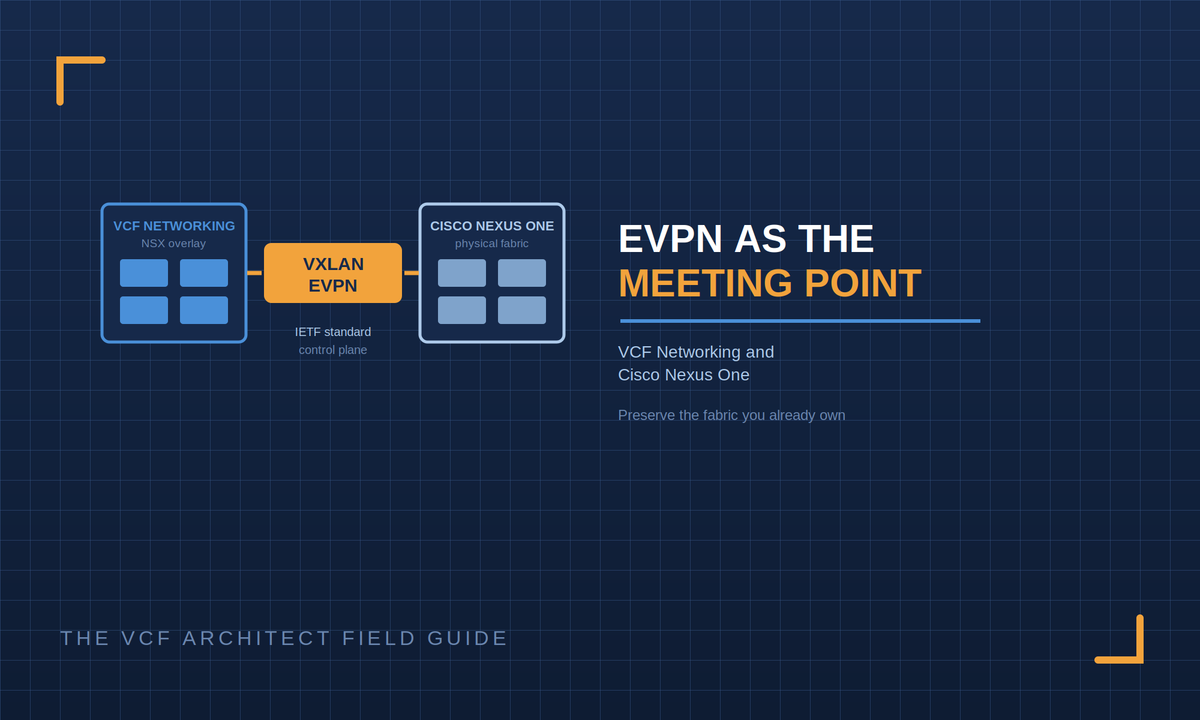
There's a problem most enterprises with a VCF estate recognise immediately. You have NSX doing overlay networking inside the private cloud, and you have a physical fabric underneath it that somebody else designed, operates and refreshes on a different cycle. The two are connected but not coherent, and every workload connectivity question has to be answered twice.
Broadcom's answer is standards-based interoperability rather than replacement, and the Cisco piece published during Explore week shows what that looks like in practice.
The strategy underneath it
This traces back to the open ecosystem announcement in November 2025, where Broadcom set out a strategy to unify network fabrics through standards-based EVPN and BGP networking rather than proprietary integration.
The stated aims: accelerate deployments, enable multi-vendor flexibility, and preserve existing network investments. Customers get VPC-level protection, consistent network operations, routing and visibility across VCF Networking domains and third-party solutions, with end-to-end fabric-driven automation.
That third aim is the one that matters commercially. Preserving existing network investment means the VCF conversation stops requiring a fabric refresh, which removes one of the larger objections to adoption in estates with recent Cisco spend.
Why EVPN is the right meeting point
VXLAN EVPN is an IETF-standardised control plane for overlay networking. Cisco's Nexus One fabric approach implements a standards-based VXLAN EVPN control plane and data plane, and VCF is moving toward EVPN-based interoperability.
So both sides speak the same control plane protocol. That's a materially different integration model from an API bridge between two proprietary systems, because the interoperability is defined by a public specification rather than by a partnership agreement that could change.
Cisco's own framing in the November announcement leaned on their IETF standards authorship in VXLAN EVPN, which is a fair claim and the reason this pairing is more credible than most vendor interoperability stories.
What this changes for design
• The fabric question stops being binary. Previously the choice was often framed as NSX overlay or physical fabric segmentation, with the answer determined by which team won the argument. EVPN interoperability means the two can be designed as one system with a defined boundary.
• Existing Cisco investment becomes an asset rather than a constraint. If your data centre fabric was refreshed in the last three years, that's now compatible with a VCF direction rather than an obstacle to it.
• Operational consistency is the actual benefit. Consistent routing, visibility and automation across NSX domains and third-party fabric means one operational model rather than two teams reconciling state.
• The network team joins the VCF design conversation earlier. That's a good thing, and in most estates it doesn't currently happen until the design is largely fixed.
What to verify before relying on it
This is announced direction with a specific partner implementation, so a few things are worth checking rather than assuming.
• Which VCF version delivers which capability. EVPN interoperability is described as a direction VCF is moving toward, so confirm what's shipping today against what's roadmap.
• Which Nexus platforms and software versions are in scope on the Cisco side.
• What the support model looks like when a problem spans both vendors. Standards-based interoperability is cleaner technically and can still be messy operationally when something breaks at the boundary.
• Whether your existing fabric actually runs VXLAN EVPN today, or runs something older that would need its own migration first. That's a common gap.
The wider pattern
Read this alongside the ODM self-certification programme and the AI ReadyNodes work from the same open ecosystem push, and a consistent strategy shows up. Broaden the hardware and networking envelope, use open standards rather than proprietary lock-in at the boundaries, and compete on the platform layer instead.
For architects that's a good direction, because it means fewer decisions that are expensive to reverse. A design built on EVPN interoperability has more exits than one built on a proprietary integration, and in a five-year platform decision the number of exits matters.
Sources
• Broadcom Advances Open Ecosystem for VMware Cloud Foundation (EVPN strategy, November 2025)
• The Register Broadcom creates a new seal of approval for servers that run AI under VMware