When Your Energy Bill Contradicts Itself: What I Learned From a Months-Long Billing Saga
A few months ago I received a disconnection notice from my energy retailer claiming I owed around $3,000. My account was fully paid. Weeks later, a gas bill landed that appeared to charge me for seven times the gas I'd actually used. I spent hours cross-checking bank statements, invoices and the online portal, fired off a stream of increasingly firm emails, and came within a click of escalating to the ombudsman.
Here's the twist: the gas bill was correct. The "7× overcharge" wasn't an overcharge at all. The retailer's own invoice had simply displayed my usage in a way that made a correct bill look like daylight robbery and I fell for it, hard.
I'm writing this up because the mistakes I made, and the genuine failures on the retailer's side, are things any energy customer could run into. If you take one thing from this: your energy bill can mislead you even when the amount is right, and your own confidence is not evidence.
What actually happened
The saga had three acts.
Act one: a disconnection notice on a paid account. On my electricity account, the online portal showed several old invoices flagged "overdue" some by hundreds of days even though I'd paid them months earlier. The retailer's system had never allocated my payments against those specific invoices, so the money sat as unassigned credit while the invoices sat marked unpaid. The account balance netted to a few dollars, but the disconnection process fired off the un-reconciled line items and threatened to cut me off for ~$3,000. The retailer later confirmed in writing that the notice was issued in error and apologised.
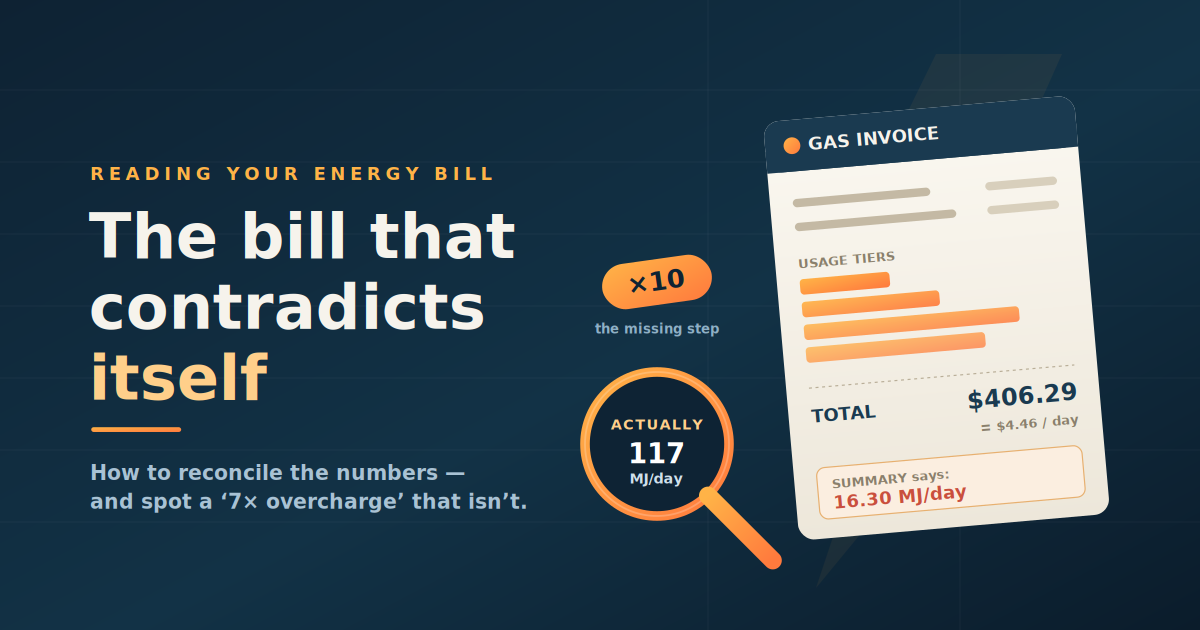
Act two: a gas bill that looked insane. My next gas bill charged for roughly 10,700 megajoules. But the usage summary printed on the same bill said I'd used only about 1,480 MJ a seven-fold gap. The bill literally invites you to "check your actual usage," so I did, found the discrepancy, and concluded I'd been massively overbilled. I demanded a refund. I was certain.
Act three: I was wrong. When I finally got the retailer to send my raw meter reads and transaction history, the picture flipped. One of my two gas meters carries a ×10 multiplier. The bill's charge correctly applied it (10,223 MJ on that meter, plus 460 on the other, ≈ 10,683 MJ). But the bill's usage summary box had left the multiplier out, showing a tenth of my real usage. The charge was right. The summary was wrong. A second check confirmed it: the bill charged about $4.46 a day, and the tiered rates can only produce $4.46 a day at high usage not at the trickle the summary implied.
So the invoice contained two contradictory usage figures, and I'd trusted the wrong one. I withdrew the overbilling claim, paid the balance, and told the retailer plainly where their bill had misled me.
Show your working: how I actually reconciled it
Here's the part that matters most, because it's the method you can reuse on your own bill. The invoice gave me two usage figures that disagreed by 7×. To work out which was real, I used two completely independent methods the trick being that if they agree, the conclusion holds even if any single number on the bill is suspect.
First, what data I could get my hands on:
- The bill's charge lines the four tiered usage quantities, the rates, the supply charge and the total ($406.29)
- The bill's usage summary box "Total 1,482.84 MJ", "16.30 MJ/day", "avg cost $4.46/day" (the misleading part)
- The bill's meter-read table per-meter usage and, crucially, the multipliers
- My meter-read history and transaction history, which I had to ask for
Method 1 Bottom-up from the meters
I have two gas meters. I checked the arithmetic on the simple one first:
Meter 2: 12 units × 38.33 (heating value) × 1.0012 (pressure) = 460.51 MJ matches the bill exactly, so the conversion is sound.
Then the meter that caused the trouble. It carries a ×10 multiplier, and the bill's per-meter column showed 1,022.33 MJ the figure before the multiplier. Apply it:
1,022.33 × 10 = 10,223.3 MJ Total = 10,223.3 + 460.51 = 10,683.8 MJ
Compare that to the sum of the billed tier quantities (1,884.61 + 1,855.49 + 4,487.21 + 2,456.52) = 10,683.83 MJ. They match. The charge was built on my real usage the multiplier was applied to the money, just not to the summary box.
Method 2 Top-down from the dollars
This is the stronger check, because it needs no meter knowledge at all it works backwards from the one number beyond dispute: what I was actually charged.
Daily cost: $406.29 ÷ 91 days = $4.46/day Strip out the fixed supply charge: $4.46 − $0.6951 = $3.77/day of usage charges Test the summary's claim: if I'd truly used 16.30 MJ/day, the usage cost would be about $0.67/day a total bill of roughly $124, not $406.29.
I was charged $406.29. So 16.30 MJ/day is simply impossible the dollar figure alone disproves the summary, without me needing to understand the meter at all.
Working out what usage does produce $3.77/day through the tiers gives ~117 MJ/day and 117 MJ/day spread across the daily tiers reproduces the exact tier quantities on the bill (20.71 × 91 = 1,884.61, and so on).
The verdict
Two independent methods agree on ~10,683 MJ, so the charge is correct. And I could even explain the wrong number: 1,022.33 + 460.51 = 1,482.84 the summary box is just meter 1 without its ×10 multiplier. Not invented; just missing a step.
The principle worth remembering: when a bill's usage summary and its charge disagree, reverse-engineer from the dollar total and the tariff rates. The money charged is the hard fact; the usage summary is only a display. If the dollars only make sense at high usage, your usage was high whatever the summary says.
What to watch out for
These are the specific traps, drawn from real experience:
The bill can contradict itself. A "usage summary" or "average daily usage" figure may not match the usage the charge is actually based on especially where meter multipliers, multiple meters, or unit conversions are involved. If the summary and the charge don't line up, the charge is usually the truth and the summary is the display error, not the other way around.
The portal balance can be misleading. My online balance showed "$0.00 You're all paid up" at moments when I genuinely owed money, because a payment had posted and was about to reverse. A headline balance is a snapshot, not a settled fact.
"Overdue" doesn't always mean owing. Paid invoices can keep showing as overdue for months if the retailer never allocates your payment against them. The scary total is often un-reconciled, not real debt but the same un-reconciled total can trigger disconnection and collection notices automatically.
Automated collections don't pause for your dispute. I received identical 5 a.m. dishonour notices for days, and eventually a debt-collection-agency threat, all while my formal dispute sat open and unanswered by a human. The collections machine runs on its own.
Silent card failures. My card was declined by the retailer's payment gateway several times in a row, with only generic "dishonour" emails and no reason given.
How to manage it
If you're dealing with a billing dispute or just want to stay ahead of one here's what worked:
Keep your own records. Save every invoice, payment receipt and email, and note every ticket or reference number. When it came time to prove the sequence of events, my own file was worth more than anything the retailer could produce.
Ask for your raw meter reads and transaction history early. This single dataset resolved my entire dispute in one email. Don't accept "we've checked, it's correct" ask for the underlying numbers and reconcile them yourself. If I'd insisted on this on day one, I'd have saved weeks.
Reconcile the charge, not the summary. Work backwards from the dollar amount and the tariff rates. If the total charged only makes sense at high usage, then your usage was high regardless of what a summary box says. Watch for meter multipliers.
If your card keeps failing, switch payment methods. BPAY bypassed the gateway that kept declining my card. Then ask your bank why the card was being rejected, so it doesn't trip up other payments.
Know the ombudsman but verify first. Every state has a free, independent energy ombudsman (in NSW it's EWON). They exist to stop improper conduct like collections on a genuinely disputed amount. But before you escalate, make sure the bill actually is wrong. A disputed bill is not automatically an incorrect one as I learned the hard way. Escalating a claim that doesn't hold up costs you credibility.
Be willing to be wrong. This is the uncomfortable one. I was completely certain I'd been overcharged, and I was completely wrong. The moment I got real data that contradicted my theory, the right move was to say so, withdraw the claim, and correct the record not to dig in. Persistence is a virtue; stubbornness in the face of evidence isn't.
What retailers should fix
Not everything here was on me. If any energy retailer is reading: these are the failures that turned a non-issue into a months-long ordeal.
- Make the bill's usage summary match the amount charged. If the charge applies a meter multiplier, the usage summary must too. A bill that displays two different usage figures and invites customers to compare them manufactures disputes.
- Pause automated collections the instant a dispute or complaint is open. No dishonour notices, agency referrals or default listings while a human hasn't yet looked at the case.
- Provide meter and usage data on first request. The data that resolved everything should be available the moment a bill is queried, not after weeks of automated chasing.
- Reconcile the portal balance in real time, so it never says "paid up" while money is owing, and never flags a paid invoice as overdue.
- Generate disconnection and collection notices from the true reconciled balance never from un-allocated line items. A disconnection threat on a paid account is a serious failure.
- Give a real reason when a payment fails, and point the customer to an alternative not the same auto-email on a loop.
The bigger takeaway
Buried under all the billing drama was the thing that actually mattered: my household uses a lot of energy roughly 11,000 kWh of electricity and 40,000-plus MJ of gas a year. No billing dispute was ever going to change that. The real savings were never in the invoice I was fighting; they were in the usage behind it.
So by all means scrutinise your bills, keep records, and hold your retailer to account when they get it wrong I did, and where they were genuinely at fault, they owned it. But save some of that energy for the meter itself. Understand what's actually driving your consumption, check that your plan suits your usage level, and shop around. That's where the money really is.
And when the numbers don't add up, get the raw data before you draw the sword. Sometimes the bill really is wrong. Sometimes it's just badly drawn and the only thing overcharged is your blood pressure.
This is a personal account of my own experience as an energy customer. It isn't legal or financial advice. If you're in a billing dispute, contact your retailer first, and your state's energy ombudsman if it isn't resolved fairly.