VCF 9.1 Fleet Lifecycle Management A Day 0/1/2 Field Guide
The maintenance window has been the most expensive line item in any VCF operational plan. VCF 9.1 changes the math materially.
The maintenance window has historically been the most expensive line item in any VCF operational plan. vCenter on Sunday at 2 AM. Quarterly ESX patch campaigns that consume entire weekends. Patching cadence governed by the slowest cluster in the fleet. VCF 9.1 changes the math materially but the architectural implications run further than the feature list suggests.
The Zero Day Clock context matters here: Broadcom’s May 2026 lifecycle management post notes that average time-to-exploit collapsed from over a year in 2020, to ~21 days in 2025, to under 2 days so far in 2026. Patching cadence is no longer an operational hygiene question it’s a security posture question. The platform has to make rapid patching tractable. VCF 9.1 does, and this piece walks through the design, deployment, and operational implications across Day 0/1/2.
Day 0 Designing for the New Lifecycle Model
Fleet lifecycle in VCF 9.1 is no longer governed by SDDC Manager as the central control plane it is governed by the Fleet Update Service within VCF Operations. That architectural shift is the Day 0 decision that drives everything else: deployment patterns, operational rhythm, even staffing model.
The Day 0 architectural decisions an architect must lock in before any hardware lands:
• Fleet scope single VCF instance (up to 5,000 ESX hosts) vs multi-instance fleet under a single VCF Operations. Drives blast radius and upgrade orchestration boundaries.
• Connected vs disconnected depot model connected pulls patches automatically with 24-hour cadence; disconnected requires HTTP Offline Depot. Air-gapped customers will be disconnected by mandate.
• TPM enablement on ESX hosts ESX Live Patching requires TPM. Without TPM, no Live Patching, no 80% no-reboot benefit. This is a procurement-time decision.
• Component dependency mapping vCenter → VCF Operations → VCF Management Services → ESX → NSX → vSAN. Sequence matters; the VCF 9.1 Upgrade Planning Tool can generate the orchestrated path.
• Backup model Fleet Management backups (Management Nodes, VCF Automation, VCF Identity Broker) configured separately from per-VCF-instance backups. Design both at Day 0.
The maintenance window strategy needs explicit choice. Three patterns are practical: per-cluster (smallest blast radius, longest campaign), per-domain (workload-aware, mid-blast), or per-fleet (largest parallelism, requires VCF Operations governance). Most large enterprises will run per-domain for ESX and per-fleet for vCenter Quick Patches.
Day 1 Deploying for Patchability
Day 1 deployment for fleet lifecycle is not about installing software it’s about installing it correctly so that lifecycle operations work cleanly later. The Broadcom 5.2.x → 9.1 upgrade guide surfaces field experience that’s equally applicable to greenfield deployments.
The pre-deployment hygiene checklist that prevents the majority of Day 1 failures:
• DNS hygiene VCF 9.1 requires strictly lower-case FQDNs. A single upper-case letter in a VCF Operations DNS record will break VCF Management Services integration. Verify before staging.
• Syslog transition unencrypted vCenter syslog on Port 514 is blocked in VCF 9.1. Migrate logging endpoints to TLS-encrypted Port 1514 prior to deployment.
• vCLS deactivated by default management has moved from UI to backend. Architects need to know it’s gone from the cluster view; it’s not broken.
• TPM-enabled ESX confirmed inventory check before deployment. Hosts without TPM cannot participate in Live Patching.
• Identity Broker placement deployed as part of VCF Management Services. Three-node cluster recommended for production. Federation IdP configured Day 1, not Day 2.
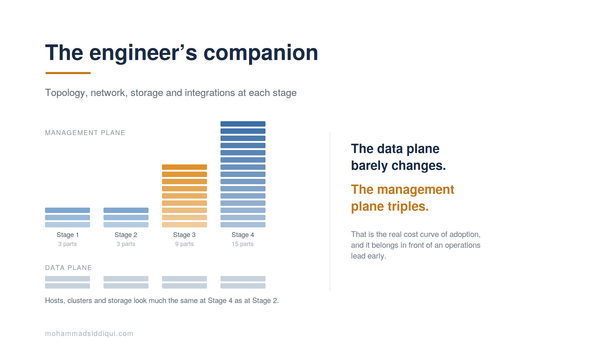
VCF Management Services itself becomes the consolidated layer that hosts License Server, Software Depot, and Salt RaaS. Architects coming from VCF 5.2.x need to internalise this shift: Aria Operations and Aria Automation have transitioned into VCF Operations; standalone Aria appliances are gone. The HLD should reflect the new topology, not the old one.
Lifecycle-related Day 1 configuration that’s frequently missed: register the Fleet Update Service before any patching workflow is needed; configure backup schedules upfront via VCF Operations → Fleet Management → Lifecycle → Settings; enable connected mode if regulatory posture permits (24-hour automated licence refresh is a material operational win).
Day 2 Operating the New Lifecycle Rhythm
Day 2 is where the new model pays off. The three capabilities that reshape the operational rhythm:
vCenter Reduced Downtime
Major vCenter upgrades use a migration-based approach: a new vCenter appliance is deployed alongside the running one, data synchronises while the environment stays operational, and the actual cutover is a brief switchover window measured in minutes. For 24/7 global operations, this turns a high-risk event into a non-event. The HLD impact: vCenter upgrade no longer requires a designated maintenance window; it requires a brief synchronisation event.
vCenter Quick Patch
Sub-5-minute targeted updates for security patches. Quick Patch integrates directly into existing VCF and vCenter workflows and lets the management plane stay current within hours of a CVE disclosure. The architectural shift: vCenter security patching ceases to be a planned event and becomes an automated workflow.
ESX Live Patching
Up to 80% of all ESX patches are now Live Patch enabled, meaning no vMotion evacuation, no host reboot, no cluster maintenance mode dance. The 20% that still require reboot are the deeper kernel changes; for those, Fleet Update Service orchestrates 256 clusters in parallel under the new model.
Operationally, this changes the patching cadence question entirely. Where quarterly patch campaigns were the norm because the cost of each cycle was high, monthly (or even more frequent) cadence becomes tractable. Active Findings in VCF Operations surface security-relevant patches automatically; the architect’s role shifts from “when do we schedule the next campaign” to “which findings trigger an immediate patching workflow.”
The other Day 2 operational shift is that lifecycle management workflows have largely migrated from SDDC Manager to vCenter and VCF Operations. Network pool creation, host commissioning, workload domain deployment, cluster create/expand, backups, DNS/NTP all done through vCenter or VCF Operations now, not SDDC Manager. Operations teams need re-skilling. The 10 specific workflow shifts are documented in Broadcom’s September 2025 post on Day 2 enhancements.
Architect’s Takeaway
Fleet lifecycle in VCF 9.1 stops being a quarterly campaign and becomes a continuous workflow. The maintenance window math changes; the operational rhythm changes; the security posture argument changes. Architects designing new VCF environments should bake in TPM-enabled hosts, connected depot mode where regulatorily acceptable, three-node Identity Broker, and Fleet Update Service registration from Day 1. Architects supporting existing customers should treat the 5.2.x → 9.1 transition as a re-skilling exercise as much as a software upgrade SDDC Manager workflows have moved, and the operations team needs to know where.
Sources
• Broadcom Modernizing the Private Cloud: Why VCF 9.1 Lifecycle Management is a Game Changer
• Broadcom Announcing the VMware Cloud Foundation 9.1 Upgrade Planning Tool
• Broadcom Modernizing Infrastructure: VMware Cloud Foundation 5.2.x to 9.1 Upgrade Guide
• Broadcom 10 VMware Cloud Foundation 9.0 Enhancements: Simplifying Your Day 2 Operations
• Broadcom Announcing VCF 9.1: Modern Private Cloud Built for Efficiency and Resilience
• Broadcom Modernizing Infrastructure Economics with VMware vSphere Foundation 9.1