The Hardware Line Item An Architect’s Guide to ODM Server Economics on VCF 9.1

Every infrastructure budget conversation this year has the same shape: hardware costs up, refresh budgets flat, and the supply environment for GPUs, memory, and NVMe tightening the “2026 hardware crunch” that has its own session track at VMware Explore this month. When the hardware line item grows, it pressures everything adjacent to it in the budget. So it’s worth giving proper architectural attention to a lever that many enterprise estates still rule out by habit: the ODM server class Supermicro, Quanta, and peers alongside the value lines from established OEMs.
The habit deserves re-examination because the facts underneath it have changed. This piece is the evaluation framework I use: what certification actually guarantees, where the ODM class has genuinely matured, what diligence still matters, and the design patterns that make a mixed-vendor estate operable rather than chaotic.
Certification Is the Trust Mechanism Use It Properly
The Broadcom Compatibility Guide (BCG) is the authoritative source for VCF 9.1 server certification, and the certified list includes ODM platforms at genuine scale alongside the tier-1 vendors Broadcom’s own certification review confirms 3,148 server models now listed for ESXi 9.0/9.1 after the majority of 8.x-certified servers were automatically carried forward. ODM configurations make up a meaningful share of that list; check the BCG directly, filtered by vendor, for the current certified count specific to your ODM of choice the number moves as certifications land, so treat any fixed figure as a point-in-time reference rather than a permanent fact. Certification is not a soft signal: a certified configuration has been validated against the platform’s requirements at both component level (CPU family, NICs/DPUs, storage controllers, firmware/driver combinations) and server-model level, which means the “will it work” question historically the first objection to non-tier-1 hardware is answered by the same mechanism that answers it for the tier-1 vendors.
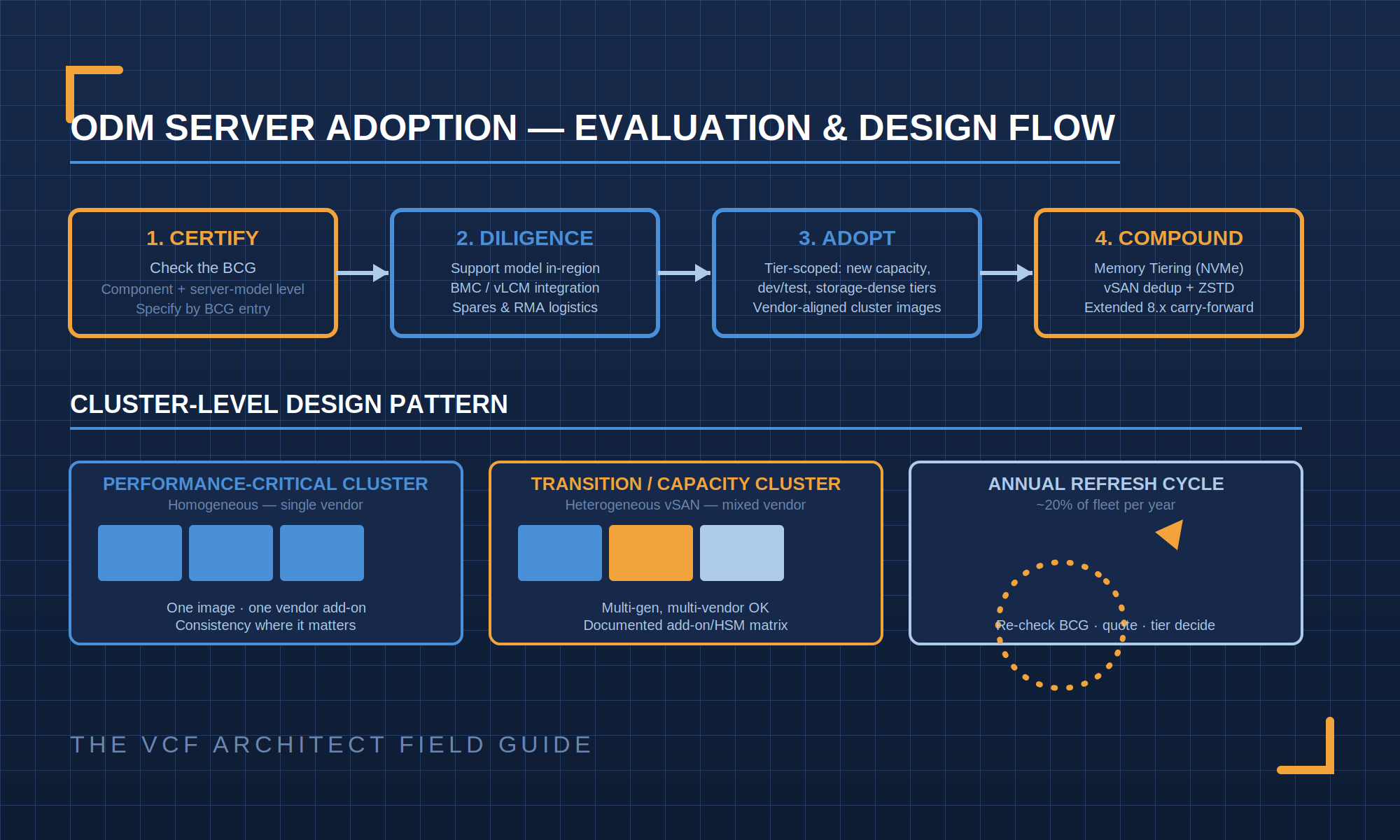
The architect’s discipline: specify by BCG entry, not by vendor brochure. The certified configuration exact model, controller, NIC, firmware baseline is the unit of trust. Deviate from it and you’ve left the certified envelope regardless of whose logo is on the bezel; stay inside it and the platform support position is the same across vendors.
What Actually Changed About the ODM Class
The historical case against ODM servers in the enterprise rested on three gaps: systems management tooling, support organisation, and build quality consistency. The honest current assessment is that these gaps have substantially closed and the driver is the AI infrastructure market. The major ODMs have spent the last several years supplying GPU-dense platforms to AI-focused cloud providers at rack scale, which forced exactly the capabilities enterprises used to find missing: rack-scale system design, serious firmware and management stack investment, AI workload certification programmes, and supply relationships for GPUs and memory that are now among the strongest in the industry. A vendor class that once assembled boards to spec now designs and certifies the platforms that some of the most demanding compute estates on earth run on.
None of which makes diligence optional it changes what the diligence is for. The questions that still matter are operational: what does the support model look like in your geography (response times, parts depots, field engineering); how does the vendor’s management controller integrate with your monitoring and your vLCM firmware workflow; and what does the spares and RMA logistics chain look like at your scale. These are answerable questions with checkable answers which is a different situation from a category-level “not enterprise-grade” objection.
The Economics and the Compounding Levers
Acquisition savings for the ODM class against equivalent tier-1 configurations are commonly cited in the 30–40% range validate against your own quotes, because configurations and discounting vary, but the direction is consistent and the magnitude is material at refresh scale. Since most estates refresh roughly 20% of their fleet annually, this is a lever available every year, not a one-off decision.
The platform then compounds it, because VCF 9.x carries three hardware-economics levers that stack with cheaper acquisition:
• NVMe memory tiering, and how cheap it now is to turn on extending DRAM with NVMe as a Tier 1 layer reduces the most expensive component in the BoM, and VCF 9.1 made enabling it trivial: the entire setup runs through vSphere Configuration Profiles as a guided, point-and-click workflow applied consistently across the cluster no ESX CLI, no scripts, no host-by-host coordination. Minimum viable configuration is one dedicated NVMe device per host; add a second per host for software mirroring (new in 9.1 Tier 1 redundancy with zero additional RAID hardware). Applying the configuration is non-disruptive: hosts enter maintenance mode sequentially, VMs live-migrate off automatically, NVMe partitions are created without CLI or SSH, and no reboot is required. For ODM configurations specifically, this means the memory-tiering saving is nearly friction-free to capture a modest NVMe line item on a cheaper chassis, applied through a workflow that takes minutes to configure and runs unattended.
• vSAN storage efficiency, generally available two enhancements land together in VCF 9.1. New data compression for vSAN ESA moves from LZ4 to zStandard (ZSTD), tuned specifically for vSAN's storage stack to deliver noticeably higher compression ratios at modest CPU overhead compression is now always-on, with structured data (SQL, Oracle integers, dates, repeatable keys) the biggest beneficiary. And vSAN global deduplication previously limited-availability in VCF 9.0 reaches general availability in 9.1, supported on HCI clusters from 3–64 hosts and on vSAN storage clusters, now compatible with vSAN Data-at-Rest Encryption (deduplication post-processing temporarily decrypts blocks in memory to find matches, so encrypted estates don't sacrifice data-reduction ratios). Both are cluster-based features enabled in the UI; existing clusters realise the compression gain progressively as data is read and rewritten, new clusters see it immediately. Note global dedup isn't yet supported on stretched or 2-node topologies. Paired with cheaper ODM acquisition cost, the effective cost-per-usable-TB drop is the compounding case for evaluating storage-dense ODM configurations specifically.
• Extended 8.x server support, verified Broadcom's server certification blog confirms the majority of servers certified for vSphere/vSAN 8.x were automatically carried forward into VCF 9.0, with 3,148 server models now listed in the BCG for ESXi 9.0/9.1. The mechanism matters as much as the outcome: certification is evaluated at both component level (CPU family, NICs/DPUs, storage controllers, firmware/driver combinations) and server-model level, and carry-forward happens automatically where the underlying components remain supported no OEM reapplication required. Three BCG statuses exist: ‘VCF Supported’ (default), ‘VCF Supported. Confirm w/Vendor’ (Broadcom supports the VCF software on that hardware; OEM hardware support needs separate confirmation, sometimes via RPQ), and unlisted (only when a core component is fully end-of-service-life no security or microcode updates available, e.g. Haswell/Broadwell-era CPUs). If your estate runs supported 8.x hardware today, check the BCG before assuming a refresh is required for the 9.x move it may not be.
• vSAN hardware requirements simplified the same 9.0 changes reduced vSAN HCI and storage-cluster hardware requirements by nearly 50%, collapsed into three sizing profiles (Small, Medium, Large), and most vSphere 8.x-certified servers are already vSAN-certified too. Many estates can enable vSAN on existing servers by adding a small number of cost-effective NVMe devices no server refresh at all.
The Multi-Vendor Design Patterns
Full-estate vendor switches are rare and rarely necessary. The practical adoption paths are incremental, and the platform’s support surface makes them workable:
• Tier-scoped adoption introduce the ODM class where the risk calculus is easiest: new capacity clusters, dev/test estates, or storage-dense tiers, while the existing fleet runs out its lifecycle. Each successful tier builds the operational evidence for the next.
• Heterogeneous clusters where they serve you VCF supports vSAN clusters mixing multiple server vendors and multiple hardware generations in the same cluster. That flexibility is genuinely useful for transitions and incremental expansion; use it deliberately, keeping performance-critical clusters homogeneous where consistency matters and letting mixed clusters carry the workloads that tolerate variance.
• Image strategy per vendor in a vLCM world, each vendor in the estate brings its own add-on and firmware path. One image per cluster remains the rule; a multi-vendor estate therefore wants vendor-aligned cluster boundaries where practical, and a documented add-on/HSM matrix where not. This is the operational cost of vendor diversity real, but bounded and manageable if it’s designed rather than accreted.
• Refresh-cycle sequencing the annual ~20% refresh is the natural insertion point. Each cycle: re-check the BCG, quote the certified ODM configurations alongside incumbent options, run the memory-tiering What-If on the target clusters, and let the numbers decide. Repeatable, evidence-based, and zero drama.
The Architect’s Takeaway
The hardware line item is the biggest number on most infrastructure budgets and the one that gets the least architectural creativity. The evaluation framework is straightforward: trust the BCG as the certification mechanism, do the operational diligence that actually matters (support model, tooling integration, logistics), adopt incrementally along tier and refresh-cycle boundaries, and stack the platform’s efficiency levers tiering, dedup, extended 8.x support on top of the acquisition saving. In a year when the supply environment is punishing estates that can’t adapt their hardware strategy, the estates with a working multi-vendor muscle are the ones with negotiating room. Build the muscle on your terms, one refresh cycle at a time.
Sources
• Broadcom Compatibility Guide the authoritative VCF server certification source
• Broadcom More Memory, Less Effort: Configuring Memory Tiering in VCF 9.1 (Dave Morera, 19 May 2026)