Riba: A study in evidence
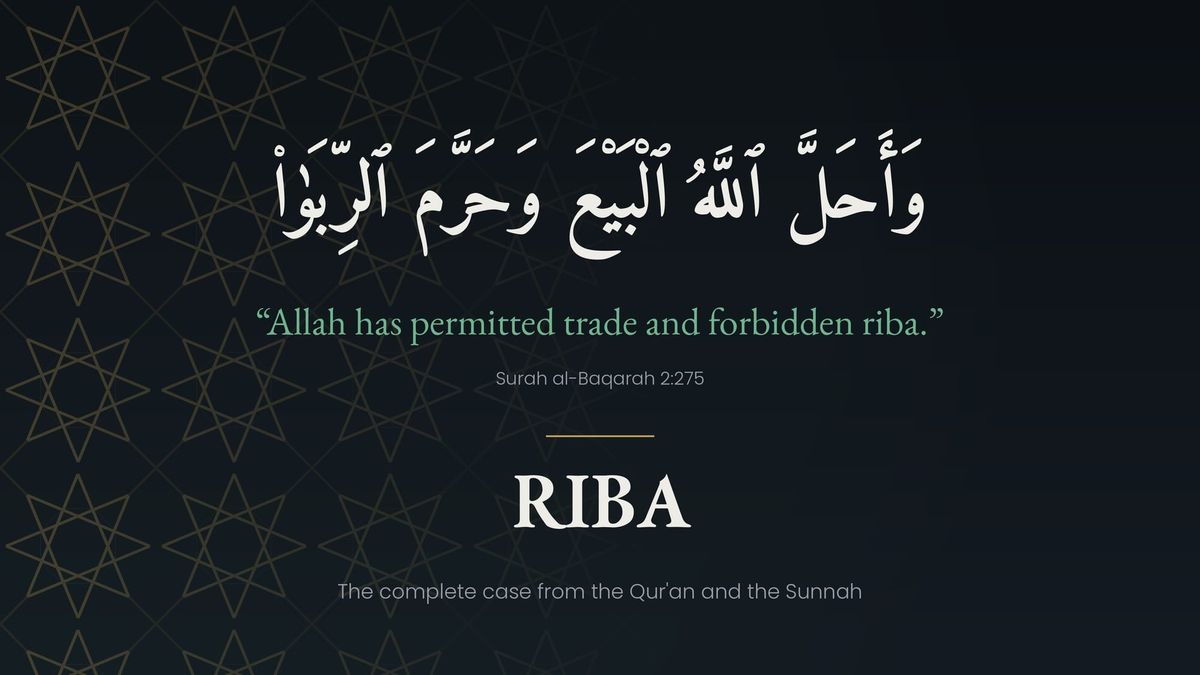
A study in evidence
Riba is the only sin in the Qur'an against which Allah and His Messenger declare war. It is the only major sin whose prohibition arrived in stages across two decades and was completed in the last verses ever revealed. And it is, today, the one major sin that a significant number of Muslims have been persuaded is not a sin at all. This article sets out the entire case: the Qur'an, the Sunnah, the four schools, every serious argument for permissibility and the answer to each, the modern instruments, and a documented investigation into the Australian "Shariah-compliant" finance industry and where its money actually comes from.
The short version
This is a long article. If you read nothing else, read this.
- The prohibition is categorical. It is established in verses revealed last, in narrations of the highest grade, and by the consensus of all four schools. It is the only sin against which Allah and His Messenger declare war.
- Riba is a contractual category, not a judgement about exploitation. Bilal's date exchange had no victim, no debt and a pious motive, and the Prophet ﷺ called it the very essence of riba, twice. Every argument that defines riba by exploitation breaks on that hadith.
- The arguments for permitting bank interest do not hold. "Doubled and multiplied" fails on grammar, context and chronology. "Productive not consumption loans" fails on the historical record. "A deposit is an agency, not a loan" fails on the consensus that a pre-specified return guarantees the capital and destroys the partnership.
- Necessity is real but narrow. The 1999 mortgage dispensations are genuine fatwas, but they concede the transaction is riba, they were opposed by senior scholars including colleagues of the men who issued them, and on the reasoning of one signatory they lapse once genuine alternatives exist.
- The same test cuts both ways. Substance over form condemns the conventional bank, and it has been turned on the Islamic finance industry by its own most senior scholars.
- In Australia specifically: products benchmarked to a bank bill index, priced to be "competitive with the market", documented as regulated credit contracts with comparison rates, and structured so the financier holds a mortgage rather than title. No provider publishes a Shariah audit, a funder's name, a purification figure, or a rate-setting methodology. That is a disclosure finding, not an accusation.
Sections 26 to 37 cover the instruments one by one. Section 49 is five questions to put to any provider before you sign.
Contents
Click a part to expand
Part Three: Every Argument for Permissibility, Answered 12 sections
- "Only compound interest is forbidden" (Al 'Imran 3:130)
- "Only consumption loans, not productive loans"
- "Riba is not the same thing as interest"
- "A deposit is an investment agency, not a loan": Al-Azhar 2002
- The 'Abduh postal-savings fatwa: an attribution that does not hold
- Rashid Rida and al-Sanhuri: what they actually wrote
- "Interest only compensates for inflation"
- "Money is now a commodity with an opportunity cost"
- Necessity, need, and the fiqh of minorities
- The Hanafi dar al-harb argument: the full and honest account
- "Both parties consented, and nobody was exploited"
- The institutional record: 1965 to 2022
Part Four: The Modern Instruments 12 sections
- Savings, term deposits, bonds
- Credit cards, late fees, and buy-now-pay-later
- Mortgages
- Student loans
- Insurance and takaful
- Forex and currency exchange
- Gold, silver and precious metals
- Crypto: lending, staking, stablecoin yield
- Business and tax finance
- Superannuation, pensions, and purification
- Zakat on wealth touched by riba
- Working in a bank; holding bank shares
Part Six: Australia: Following the Money 8 sections
- Why Australian contracts are shaped the way they are
- The providers, one by one
- The funding trail: what is disclosed, what is not
- Benchmarking: the evidence
- EFSOL: what happens when it fails
- The Australian fatwa record: and a conspicuous silence
- Five questions to put to any provider
- What would actually fix this
- Glossary · A note on method, gradings and sources · Sources · Further reading
Part One: The Textual Foundation#
1What riba means#
The Arabic root ر-ب-و carries the sense of growing, swelling, increasing, rising. From it come rabā (to increase), arbā (to make something increase), and rabwah, a hill, ground that has risen above what surrounds it. Riba is, at root, simply increase.
What the Shari'ah prohibits is not increase as such. Profit from trade is increase. Rent from a property is increase. A wage is increase. Dividends from a genuine business are increase. The Qur'an says outright that Allah permitted trade, and trade is nothing if not the pursuit of increase.
What is prohibited is a specific kind of increase, and the jurists define it with precision. The classical definition is an excess stipulated in an exchange, without an equivalent counter-value recognised by the Shari'ah, faḍl khālin 'an 'iwaḍ. That is: money that grows without anyone bearing risk, performing work, or transferring an asset. It is a return extracted purely from the passage of time on a debt, or from an unequal swap of like for like.
Two things follow immediately, and they govern everything else in this article.
First, riba is a contractual category, not a moral temperature reading. It is not defined by how much is charged, whether the borrower felt pressured, or whether the lender is a good person. A 2% loan and a 200% loan are the same category of transaction. Rates change the magnitude of the sin, not its identity. Much of the modern argument for permissibility depends on quietly redefining riba as "exploitation", and then observing, correctly, that most bank lending is not exploitative in any ordinary sense. That is a category substitution, and we will return to it repeatedly.
Second, the prohibition attaches to the contract, not to the label on the brochure. The Shari'ah maxim is al-'ibratu fi'l-'uqud bi'l-maqasid wa'l-ma'ani, la bi'l-alfaz wa'l-mabani: what counts in contracts is their purposes and meanings, not their words and forms. This maxim cuts both ways, and we will use it against conventional banks in Part Three and against parts of the Islamic finance industry in Parts Five and Six. It cannot honestly be deployed in only one direction.
2The four stages of revelation#
The prohibition of riba did not arrive in a single verse. Scholars conventionally group the Qur'anic material into four stages, tracking a movement from moral disapproval to categorical, enforceable prohibition. (This grouping is a scholarly reconstruction from the Makkan/Madinan classification of the surahs, not a narrated report, but it is the standard presentation and it is illuminating.)
Stage one: Makkah: riba is barren
وَمَآ ءَاتَيْتُم مِّن رِّبًا لِّيَرْبُوَا۟ فِىٓ أَمْوَٰلِ ٱلنَّاسِ فَلَا يَرْبُوا۟ عِندَ ٱللَّهِ ۖ وَمَآ ءَاتَيْتُم مِّن زَكَوٰةٍ تُرِيدُونَ وَجْهَ ٱللَّهِ فَأُو۟لَـٰٓئِكَ هُمُ ٱلْمُضْعِفُونَ
Wa mā ātaytum min riban li-yarbuwa fī amwāli'n-nās fa-lā yarbū 'inda'llāh; wa mā ātaytum min zakātin turīdūna wajha'llāhi fa-ulā'ika humu'l-muḍ'ifūn.
"Whatever you give in riba, so that it may increase through other people's wealth, does not increase with Allah. But whatever you give in zakah, seeking the Face of Allah, it is they whose reward is multiplied."
Surah al-Rum 30:39 (Makkan)
Note what this verse does not do: it does not prohibit. It makes a claim about barakah. Riba grows in the ledger and shrinks before Allah; sadaqah shrinks in the ledger and grows before Allah. The moral universe is inverted relative to the accounting one. This is groundwork, laid years before the legal ruling.
Stage two: riba as an inherited sin of earlier communities
فَبِظُلْمٍۢ مِّنَ ٱلَّذِينَ هَادُوا۟ حَرَّمْنَا عَلَيْهِمْ طَيِّبَـٰتٍ أُحِلَّتْ لَهُمْ وَبِصَدِّهِمْ عَن سَبِيلِ ٱللَّهِ كَثِيرًۭا وَأَخْذِهِمُ ٱلرِّبَوٰا۟ وَقَدْ نُهُوا۟ عَنْهُ وَأَكْلِهِمْ أَمْوَٰلَ ٱلنَّاسِ بِٱلْبَـٰطِلِ ۚ وَأَعْتَدْنَا لِلْكَـٰفِرِينَ مِنْهُمْ عَذَابًا أَلِيمًۭا
Fa-bi-ẓulmin mina'lladhīna hādū ḥarramnā 'alayhim ṭayyibātin uḥillat lahum wa bi-ṣaddihim 'an sabīli'llāhi kathīrā · wa akhdhihimu'r-ribā wa qad nuhū 'anhu wa aklihim amwāla'n-nāsi bi'l-bāṭil; wa a'tadnā li'l-kāfirīna minhum 'adhāban alīmā.
"For the wrongdoing of those who were Jews, We forbade them good things that had been lawful to them, and for their barring many from the way of Allah, and for their taking of riba though they had been forbidden it, and for their consuming people's wealth unjustly. And We have prepared for the disbelievers among them a painful punishment."
Surah al-Nisa 4:160–161
Two points. First, these two verses must be read together: 4:161 is grammatically a continuation of the causal clause begun in 4:160, so quoting it alone leaves the sentence dangling. Second, and more substantively: riba was already prohibited to an earlier community, and taking it anyway was among the reasons lawful things were withdrawn from them. The prohibition is presented as old, not novel.
Stage three: the first direct address to the believers
يَـٰٓأَيُّهَا ٱلَّذِينَ ءَامَنُوا۟ لَا تَأْكُلُوا۟ ٱلرِّبَوٰٓا۟ أَضْعَـٰفًۭا مُّضَـٰعَفَةًۭ ۖ وَٱتَّقُوا۟ ٱللَّهَ لَعَلَّكُمْ تُفْلِحُونَ
Yā ayyuha'lladhīna āmanū lā ta'kulu'r-ribā aḍ'āfan muḍā'afah; wa'ttaqu'llāha la'allakum tufliḥūn.
"O you who believe, do not consume riba, doubled and multiplied. And fear Allah, so that you may be successful."
Surah Al 'Imran 3:130
This is the verse on which an enormous amount of modern argument has been built, and section 14 deals with it in full. For now, register only the grammar: aḍ'āfan muḍā'afah is a ḥāl, a circumstantial description of how riba was in fact being practised, not a qayd, a restrictive condition narrowing the prohibition to a subset. We will demonstrate that from the tafsir and from the chronology.
Stage four: Madinah, at the very end: the categorical prohibition
The final stage is al-Baqarah 275–281, treated in full in the next section. Its status is extraordinary. Ibn 'Abbas said:
آخِرُ آيَةٍ نَزَلَتْ عَلَى النَّبِيِّ ﷺ آيَةُ الرِّبَا
Ākhiru āyatin nazalat 'ala'n-Nabiyyi ṣalla'llāhu 'alayhi wa sallam āyatu'r-ribā.
"The last verse revealed to the Prophet ﷺ was the verse of riba."
Sahih al-Bukhari 4544, Kitab al-Tafsir (Book 65, Hadith 67)
And 'Umar ibn al-Khattab (may Allah be pleased with him) added the detail that has echoed for fourteen centuries:
إِنَّ آخِرَ مَا نَزَلَتْ آيَةُ الرِّبَا، وَإِنَّ رَسُولَ اللَّهِ ﷺ قُبِضَ وَلَمْ يُفَسِّرْهَا لَنَا، فَدَعُوا الرِّبَا وَالرِّيبَةَ
Inna ākhira mā nazalat āyatu'r-ribā, wa inna Rasūla'llāhi ﷺ qubiḍa wa lam yufassirhā lanā, fa-da'u'r-ribā wa'r-rībah.
"The last thing revealed was the verse of riba, and the Messenger of Allah ﷺ passed away without having explained it fully to us. So leave riba, and leave whatever is doubtful."
Sunan Ibn Majah 2276, graded sahih by al-Albani (Sahih Ibn Majah 1860) and by al-Busiri; the Darussalam edition marks it weak. Also Musnad Ahmad 246, 350; al-Bayhaqi, al-Sunan al-Kubra 10582.
Sit with the shape of that. A prohibition introduced in Makkah as a spiritual observation, escalated in Madinah, and completed in the final verses ever revealed, after which the Prophet ﷺ died before the last details could be elaborated, leaving 'Umar to counsel avoidance of anything resembling it. This is not a peripheral rule. It is the last legislative word of the revelation.
3Al-Baqarah 275–281, verse by verse#
2:275: the answer to "trade is just like riba"
ٱلَّذِينَ يَأْكُلُونَ ٱلرِّبَوٰا۟ لَا يَقُومُونَ إِلَّا كَمَا يَقُومُ ٱلَّذِى يَتَخَبَّطُهُ ٱلشَّيْطَـٰنُ مِنَ ٱلْمَسِّ ۚ ذَٰلِكَ بِأَنَّهُمْ قَالُوٓا۟ إِنَّمَا ٱلْبَيْعُ مِثْلُ ٱلرِّبَوٰا۟ ۗ وَأَحَلَّ ٱللَّهُ ٱلْبَيْعَ وَحَرَّمَ ٱلرِّبَوٰا۟ ۚ فَمَن جَآءَهُۥ مَوْعِظَةٌۭ مِّن رَّبِّهِۦ فَٱنتَهَىٰ فَلَهُۥ مَا سَلَفَ وَأَمْرُهُۥٓ إِلَى ٱللَّهِ ۖ وَمَنْ عَادَ فَأُو۟لَـٰٓئِكَ أَصْحَـٰبُ ٱلنَّارِ ۖ هُمْ فِيهَا خَـٰلِدُونَ
Alladhīna ya'kulūna'r-ribā lā yaqūmūna illā kamā yaqūmu'lladhī yatakhabbaṭuhu'sh-shayṭānu mina'l-mass. Dhālika bi-annahum qālū innama'l-bay'u mithlu'r-ribā; wa aḥalla'llāhu'l-bay'a wa ḥarrama'r-ribā…
"Those who consume riba will not stand except as one stands who has been driven to madness by Satan's touch. That is because they say: 'Trade is only like riba.' But Allah has permitted trade and forbidden riba. So whoever receives an admonition from his Lord and desists may keep what is past, and his affair rests with Allah. But whoever returns, those are the companions of the Fire; they will abide therein eternally."
Surah al-Baqarah 2:275
This verse contains the objection and the answer in a single breath, and it is worth noticing that the Qur'an takes the objection seriously enough to quote it. "Trade is only like riba" is not a stupid argument. It is the same argument made today in more sophisticated language: both are voluntary, both produce a return, both are priced by a market, so why is one lawful and the other a capital sin?
The Qur'anic answer is not an economic demonstration. It is: wa aḥalla'llāhu'l-bay'a wa ḥarrama'r-ribā. Allah permitted trade and forbade riba. The distinction is a matter of divine legislation, not of derivable economic theory. This is the single most important sentence in the entire subject, because almost every permissive argument in Part Three is, at bottom, an attempt to re-derive the ruling from economic reasoning and then adjust it where the reasoning does not seem to bite. The verse forecloses that method in advance.
The reason is not therefore absent: the jurists identify plenty (risk-sharing, the tie between return and real economic activity, the protection of the debtor, the prevention of wealth concentration). But the reason is a wisdom (ḥikmah) illuminating a ruling that stands on the text, not a premise from which the ruling may be re-derived and then trimmed.
2:276: the ledger inverted
يَمْحَقُ ٱللَّهُ ٱلرِّبَوٰا۟ وَيُرْبِى ٱلصَّدَقَـٰتِ ۗ وَٱللَّهُ لَا يُحِبُّ كُلَّ كَفَّارٍ أَثِيمٍ
Yamḥaqu'llāhu'r-ribā wa yurbi'ṣ-ṣadaqāt; wa'llāhu lā yuḥibbu kulla kaffārin athīm.
"Allah obliterates riba and causes charity to grow. And Allah does not love any ungrateful sinner."
Surah al-Baqarah 2:276
Yamḥaqu is a strong verb: to wipe out, to efface, the root behind maḥq, the waning of the moon to nothing. The Makkan observation of 30:39 returns in Madinah as a legal-theological statement. It is also the textual basis, as we will see in section 35, for the doctrine that riba-derived money must be disposed of rather than enjoyed.
2:278–279: the ultimatum
يَـٰٓأَيُّهَا ٱلَّذِينَ ءَامَنُوا۟ ٱتَّقُوا۟ ٱللَّهَ وَذَرُوا۟ مَا بَقِىَ مِنَ ٱلرِّبَوٰٓا۟ إِن كُنتُم مُّؤْمِنِينَ فَإِن لَّمْ تَفْعَلُوا۟ فَأْذَنُوا۟ بِحَرْبٍۢ مِّنَ ٱللَّهِ وَرَسُولِهِۦ ۖ وَإِن تُبْتُمْ فَلَكُمْ رُءُوسُ أَمْوَٰلِكُمْ لَا تَظْلِمُونَ وَلَا تُظْلَمُونَ
Yā ayyuha'lladhīna āmanu'ttaqu'llāha wa dharū mā baqiya mina'r-ribā in kuntum mu'minīn · Fa-in lam taf'alū fa'dhanū bi-ḥarbin mina'llāhi wa Rasūlih; wa in tubtum fa-lakum ru'ūsu amwālikum, lā taẓlimūna wa lā tuẓlamūn.
"O you who believe, fear Allah and give up what remains of riba, if you are believers. And if you do not, then take notice of a war from Allah and His Messenger. But if you repent, you may have your principal sums; you do no wrong, and you are not wronged."
Surah al-Baqarah 2:278–279
Three things in these two verses decide most of the modern debate, and each deserves its own paragraph.
"Give up what remains" (mā baqiya). Not "stop taking new riba": surrender the outstanding accrued amount that is already owed to you and that you are legally entitled to under the contract. Existing rights are extinguished. This is a retroactive clawback of the sort the Shari'ah almost never imposes.
"If you are believers" (in kuntum mu'minīn). The conditional attaches faith itself to compliance. The rhetorical force is unmistakable.
"You may have your principal sums" (ru'ūsu amwālikum). This is the operative legal clause of the entire subject, and it is why the "excessive interest only" reading collapses. The permitted recovery is defined as the head of the wealth: the principal, and nothing beyond it. There is no threshold, no percentage, no allowance for a "reasonable" return. The Qur'an sets the entitlement at exactly the sum lent. And then it defines the wrong: lā taẓlimūna wa lā tuẓlamūn: anything above the principal is the ẓulm; taking less than the principal from a debtor unable to pay would be ẓulm in the other direction. The verse does not say "do not exploit and then charge what you like." It defines exploitation as the excess.
2:280: the alternative to foreclosure
وَإِن كَانَ ذُو عُسْرَةٍۢ فَنَظِرَةٌ إِلَىٰ مَيْسَرَةٍۢ ۚ وَأَن تَصَدَّقُوا۟ خَيْرٌۭ لَّكُمْ ۖ إِن كُنتُمْ تَعْلَمُونَ
Wa in kāna dhū 'usratin fa-naẓiratun ilā maysarah; wa an taṣaddaqū khayrun lakum in kuntum ta'lamūn.
"And if the debtor is in difficulty, then postpone until a time of ease. And that you forgive it as charity is better for you, if only you knew."
Surah al-Baqarah 2:280
This is the precise inversion of the Jahiliyyah mechanism. Where the pre-Islamic creditor said to a defaulting debtor "pay or increase", the Qur'an says: extend the term at no cost, and better still, forgive the debt. Default triggers mercy, not compounding. Read against section 7 below, the verse is legislating directly against the practice it replaces.
2:281: the closing
وَٱتَّقُوا۟ يَوْمًۭا تُرْجَعُونَ فِيهِ إِلَى ٱللَّهِ ۖ ثُمَّ تُوَفَّىٰ كُلُّ نَفْسٍۢ مَّا كَسَبَتْ وَهُمْ لَا يُظْلَمُونَ
Wa'ttaqū yawman turja'ūna fīhi ila'llāh, thumma tuwaffā kullu nafsin mā kasabat wa hum lā yuẓlamūn.
"And fear a Day when you will be returned to Allah; then every soul will be paid in full for what it earned, and they will not be wronged."
Surah al-Baqarah 2:281, held by many to be the final verse of the Qur'an revealed
One structural observation worth more than it first appears. The riba passage runs 275–281. Immediately after it comes 2:282, ayat al-dayn, the verse of debt, the longest verse in the Qur'an, an exhaustive protocol for documenting a debt in writing, with a scribe, with witnesses, with precision about the term. The Qur'an closes the door on riba and, in the very next breath, opens the door on lending, documented and enforceable. The prohibition is not a prohibition of credit. It is a prohibition of charging for time.
4The declaration of war#
It is worth pausing on fa'dhanū bi-ḥarbin mina'llāhi wa Rasūlih, because there is nothing else like it in the Qur'an.
The Qur'an prohibits a great deal. It prohibits murder, theft, fornication, intoxicants, gambling, the consumption of the orphan's property, false testimony, backbiting. For each it prescribes consequence: legal punishment, or divine displeasure, or the Fire. For one category of transaction it announces a state of war between the offender and Allah and His Messenger.
The verb fa'dhanū is an imperative from i'dhan: be notified, take formal notice. In the variant reading fa-ādhinū it means "announce". Either way, this is the language of a declaration served on a party. And the sin that triggers it is not apostasy, not killing, not sorcery, but a category of financial contract.
Any serious reading of the modern debate has to reckon with this asymmetry. A person may hold that the modern banking contract is a novel arrangement outside the scope of the prohibition. That is an argument, and Part Three engages it on its merits. But the person holding it should be conscious of the stakes of being wrong, and should notice that the argument's practical effect is to declare peace where the Qur'an declared war. As 'Umar's counsel puts it: fa-da'u'r-ribā wa'r-rībah, leave riba, and leave what is doubtful.
5The Sunnah: the evidence corpus#
The Prophet ﷺ did not leave the category undefined. What follows are the sound narrations, with references. I have kept them in the order in which they build the picture.
5.1: Riba among the seven destroyers
اجْتَنِبُوا السَّبْعَ الْمُوبِقَاتِ … الشِّرْكُ بِاللَّهِ، وَالسِّحْرُ، وَقَتْلُ النَّفْسِ الَّتِي حَرَّمَ اللَّهُ إِلَّا بِالْحَقِّ، وَأَكْلُ الرِّبَا، وَأَكْلُ مَالِ الْيَتِيمِ، وَالتَّوَلِّي يَوْمَ الزَّحْفِ، وَقَذْفُ الْمُحْصَنَاتِ الْمُؤْمِنَاتِ الْغَافِلَاتِ
Ijtanibu's-sab'a'l-mūbiqāt … ash-shirku bi'llāh, wa's-siḥr, wa qatlu'n-nafsi'llatī ḥarrama'llāhu illā bi'l-ḥaqq, wa aklu'r-ribā, wa aklu māli'l-yatīm, wa't-tawallī yawma'z-zaḥf, wa qadhfu'l-muḥṣanāti'l-mu'mināti'l-ghāfilāt.
"Avoid the seven destructive sins … associating partners with Allah; sorcery; killing a soul which Allah has forbidden except by right; consuming riba; consuming the property of an orphan; fleeing from the battlefield; and slandering chaste, unaware, believing women."
Sahih al-Bukhari 2766 (Kitab al-Wasaya) · Sahih Muslim 89 (Kitab al-Iman). Narrated by Abu Hurayrah. Note the ordering of the fourth and fifth items differs between the two collections.
Riba is placed in a list with shirk, murder and sorcery. Not as an equal in gravity, but in the same class of ruin.
5.2: The curse on all five parties
عَنْ جَابِرٍ قَالَ: لَعَنَ رَسُولُ اللَّهِ ﷺ آكِلَ الرِّبَا وَمُوكِلَهُ وَكَاتِبَهُ وَشَاهِدَيْهِ، وَقَالَ: هُمْ سَوَاءٌ
'An Jābirin qāl: la'ana Rasūlu'llāhi ﷺ ākila'r-ribā wa mūkilahu wa kātibahu wa shāhidayh, wa qāla: hum sawā'.
Jabir ibn 'Abdillah said: "The Messenger of Allah ﷺ cursed the one who consumes riba, the one who pays it, the one who records it, and its two witnesses, and he said: they are all alike."
Sahih Muslim 1598 (Kitab al-Musaqah, Book 22, Hadith 132)
The legal significance of "they are all alike" is enormous and almost always underplayed. The curse does not fall only on the one who profits. It falls on the borrower who pays, on the clerk who prepares the documentation, and on the witnesses who attest. This is why a Muslim's exposure to riba is not limited to what he earns from it. It extends to what he signs, what he processes, and what he certifies. Section 37 takes this up in the context of employment.
5.3: The Farewell Sermon: the abolition, starting at home
وَرِبَا الْجَاهِلِيَّةِ مَوْضُوعٌ، وَأَوَّلُ رِبًا أَضَعُ رِبَانَا رِبَا عَبَّاسِ بْنِ عَبْدِ الْمُطَّلِبِ، فَإِنَّهُ مَوْضُوعٌ كُلُّهُ
Wa riba'l-jāhiliyyati mawḍū', wa awwalu riban aḍa'u ribānā ribā 'Abbāsi'bni 'Abdi'l-Muṭṭalib, fa-innahu mawḍū'un kulluh.
"And the riba of the Jahiliyyah is abolished. And the first riba I abolish of our riba is the riba of 'Abbas ibn 'Abd al-Muttalib: it is abolished in its entirety."
Sahih Muslim 1218a, the long Farewell Pilgrimage narration of Jabir ibn 'Abdillah
Consider the setting. The Prophet ﷺ is standing at 'Arafah in the final year of his life before the largest gathering of Muslims ever assembled in his lifetime, abolishing a category of wealth, and the first account he cancels is his own uncle's. Not a stranger's. Not an enemy's. He begins with the family ledger.
5.4: The six commodities
الذَّهَبُ بِالذَّهَبِ وَالْفِضَّةُ بِالْفِضَّةِ وَالْبُرُّ بِالْبُرِّ وَالشَّعِيرُ بِالشَّعِيرِ وَالتَّمْرُ بِالتَّمْرِ وَالْمِلْحُ بِالْمِلْحِ، مِثْلًا بِمِثْلٍ سَوَاءً بِسَوَاءٍ يَدًا بِيَدٍ، فَإِذَا اخْتَلَفَتْ هَذِهِ الْأَصْنَافُ فَبِيعُوا كَيْفَ شِئْتُمْ إِذَا كَانَ يَدًا بِيَدٍ
Adh-dhahabu bi'dh-dhahab, wa'l-fiḍḍatu bi'l-fiḍḍah, wa'l-burru bi'l-burr, wa'sh-sha'īru bi'sh-sha'īr, wa't-tamru bi't-tamr, wa'l-milḥu bi'l-milḥ, mithlan bi-mithl, sawā'an bi-sawā', yadan bi-yad. Fa-idha'khtalafat hādhihi'l-aṣnāfu fa-bī'ū kayfa shi'tum idhā kāna yadan bi-yad.
"Gold for gold, silver for silver, wheat for wheat, barley for barley, dates for dates, salt for salt, like for like, equal for equal, hand to hand. But if these classes differ, then sell as you wish, provided it is hand to hand."
Sahih Muslim 1587c (Kitab al-Musaqah, Book 22, Hadith 102), from 'Ubadah ibn al-Samit
This single narration generates an entire branch of the law. Read it carefully, because its structure is precise:
- Same commodity for same commodity (gold for gold): two conditions: equality of amount and immediacy of exchange.
- Different commodities within the ribawi class (gold for silver, wheat for barley): one condition: immediacy only. Amounts may differ freely.
- Outside the ribawi class entirely (gold for cloth): no conditions from this hadith.
The same ruling comes through Abu Sa'id al-Khudri in a genuinely muttafaq 'alayh narration:
لَا تَبِيعُوا الذَّهَبَ بِالذَّهَبِ إِلَّا مِثْلًا بِمِثْلٍ، وَلَا تُشِفُّوا بَعْضَهَا عَلَى بَعْضٍ، وَلَا تَبِيعُوا الْوَرِقَ بِالْوَرِقِ إِلَّا مِثْلًا بِمِثْلٍ، وَلَا تُشِفُّوا بَعْضَهَا عَلَى بَعْضٍ، وَلَا تَبِيعُوا مِنْهَا غَائِبًا بِنَاجِزٍ
Lā tabī'u'dh-dhahaba bi'dh-dhahabi illā mithlan bi-mithl, wa lā tushiffū ba'ḍahā 'alā ba'ḍ… wa lā tabī'ū minhā ghā'iban bi-nājiz.
"Do not sell gold for gold except like for like, and do not give more of one than the other; and do not sell silver for silver except like for like, and do not give more of one than the other; and do not sell any of it absent for present."
Sahih al-Bukhari 2177 · Sahih Muslim 1584a
5.5: Bilal's dates: the loophole closed before it opened
This narration is, for our purposes, the most important hadith in the entire corpus, and it is routinely mis-cited.
جَاءَ بِلَالٌ إِلَى النَّبِيِّ ﷺ بِتَمْرٍ بَرْنِيٍّ، فَقَالَ لَهُ النَّبِيُّ ﷺ: «مِنْ أَيْنَ هَذَا؟» قَالَ بِلَالٌ: كَانَ عِنْدَنَا تَمْرٌ رَدِيٌّ، فَبِعْتُ مِنْهُ صَاعَيْنِ بِصَاعٍ لِنُطْعِمَ النَّبِيَّ ﷺ. فَقَالَ النَّبِيُّ ﷺ عِنْدَ ذَلِكَ: «أَوَّهْ أَوَّهْ، عَيْنُ الرِّبَا عَيْنُ الرِّبَا، لَا تَفْعَلْ، وَلَكِنْ إِذَا أَرَدْتَ أَنْ تَشْتَرِيَ فَبِعِ التَّمْرَ بِبَيْعٍ آخَرَ ثُمَّ اشْتَرِهِ»
Jā'a Bilālun ila'n-Nabiyyi ﷺ bi-tamrin barniyy… fa-qāla'n-Nabiyyu ﷺ 'inda dhālik: "Awwah awwah! 'Aynu'r-ribā, 'aynu'r-ribā! Lā taf'al. Wa lākin idhā aradta an tashtariya fa-bi'i't-tamra bi-bay'in ākhara thumma'shtarih."
Bilal brought the Prophet ﷺ some barni dates. The Prophet ﷺ said: "Where is this from?" Bilal said: "We had some poor-quality dates, so I sold two sa' of them for one sa', to feed the Prophet ﷺ." At that the Prophet ﷺ said: "Oh no! Oh no! That is the very essence of riba, the very essence of riba! Do not do it. Rather, if you want to buy, sell the dates in a separate sale, then buy [with the proceeds]."
Sahih al-Bukhari 2312 (Kitab al-Wakalah, Book 40) · Sahih Muslim 1594a
Everything about this narration matters.
The transaction had no victim. Both parties consented. Both got what they wanted. Bilal was not exploited, and he did not exploit. There was no debt, no deferment, no compounding, no distress, no market power. And the purpose was to feed the Prophet ﷺ himself. If ever a transaction had a defence on grounds of intention and outcome, this was it.
The Prophet ﷺ called it 'aynu'r-ribā, riba itself, twice. Not "resembles riba", not "leads to riba". The very substance of it. This single response demolishes the entire family of arguments that define riba by exploitation, by hardship, by unequal bargaining power, or by consequence. The category is contractual. It applies to a same-day, consensual, benevolent barter of dates.
And then he gave the remedy, and it is not a workaround. Sell the poor dates for money. Take the money. Buy the good dates. Two genuine, complete, independent sales. The economic outcome is nearly identical; the contractual form is entirely different; and the Prophet ﷺ himself taught it. Which raises the question that Part Five of this article is built around: what separates the Prophet's own remedy from a modern hilah? The answer, as we will see, is that in his remedy each sale is real, unconditional, separable, and carries genuine price risk between the two legs: the seller genuinely might not be able to buy the good dates at the price he hoped. Where a modern structure removes that risk by pre-arranging both legs and binding them together, it has removed precisely the feature that made the Prophet's remedy lawful.
6The reports that are weak: and why honesty matters#
Riba attracts terrifying narrations, and many of the most quoted are not sound. Circulating them does the argument no favours: an audience that discovers one citation is fabricated will discount the sound ones with it. So here is the honest position on the four you will see most often.
"Riba has seventy-three doors, the least of which is like a man having intercourse with his mother"
There are three variants with three different numbers. The strongest chain is the Ibn Mas'ud route in Sunan Ibn Majah 2275 ("riba is seventy-three doors"), graded hasan, but that version does not contain the aysaruhā clause. The full version with the clause is in al-Hakim, al-Mustadrak 2/43, where al-Hakim declared it sahih by the criteria of the two Shaykhs and al-Dhahabi agreed. But al-Bayhaqi held: isnāduhu ṣaḥīḥ wa'l-matnu munkar, the chain is sound but the text is objectionable, and Ibn al-Jawzi rejected the whole family. Al-Albani authenticated routes of it. Al-Tabarani's al-Awsat has "seventy-two".
Fair use: quote it if you wish, from the Ibn Mas'ud route, and disclose that al-Bayhaqi accepted the chain but declared the text munkar. Do not present it as uncontested.
"A dirham of riba is worse than thirty-six acts of zina"
Narrated from 'Abdullah ibn Hanzalah in Musnad Ahmad, al-Daraqutni and al-Tabarani. Al-Haythami said Ahmad's narrators are those of the Sahih; al-Albani graded it sahih (in Ghayat al-Maram p. 172; also commonly cited as Sahih al-Jami' 3375 and Silsilat al-Ahadith al-Sahihah 1033; the grading is confirmed, the reference numbers vary between citations). However, a serious body of criticism holds that the chain is sound as a mawquf statement and that raising it to the Prophet ﷺ is defective, with the substance traceable to Ka'b al-Ahbar.
Fair use: "graded sahih by al-Albani, though al-Daraqutni, Ibn al-Jawzi and Shu'ayb al-Arna'ut treat the marfu' form as weak."
"A time will come when everyone consumes riba, or its dust"
Da'if in both collections. Sunan Abi Dawud 3331 has "its vapour" (bukhārihi); Sunan Ibn Majah 2278 has "its dust" (ghubārihi). Al-Albani weakened the first; Darussalam weakens the second. This may be the single most-quoted riba hadith on the internet and it is almost never flagged. Do not build on it.
"Every loan that brings a benefit is riba"
This is a legal maxim, not a hadith. The marfu' chain runs through Sawwar ibn Mus'ab al-Hamdani, who is matruk (abandoned); Ibn Hajar records in Talkhis al-Habir that "its chain contains Sawwar ibn Mus'ab, and he is matruk" (pagination varies by edition: 3/34 in some printings, 3/997 in others); al-Albani weakened it in Irwa' al-Ghalil 5/235. Ibn 'Uthaymin's formulation is exactly right: "it is a weak hadith, but its meaning is sound."
What is authentic is the mawquf report from Fadalah ibn 'Ubayd in al-Bayhaqi, al-Sunan al-Kubra 5/350, in the softer wording kullu qarḍin jarra manfa'atan fa-huwa wajhun min wujūhi'r-ribā, "one of the faces of riba", with parallel reports from Ibn Mas'ud, Ubayy ibn Ka'b, 'Abdullah ibn Salam and Ibn 'Abbas. And the principle carries consensus; al-Qurtubi, Ibn Qudamah and Ibn Taymiyyah all affirm it, resting it on the Qur'an and ijma' rather than on this text. Section 12 sets out how it actually operates.
7What riba al-jahiliyyah actually was#
Almost every permissive argument depends, somewhere, on a claim about what the Arabs were doing before Islam: usually that it was uniquely brutal compounding on consumption loans to the destitute, and that nothing in modern banking resembles it. So the historical record matters, and it is well documented in the classical tafsir.
Ibn 'Atiyyah, on 2:275:
وَغَالِبُهُ مَا كَانَتِ الْعَرَبُ تَفْعَلُهُ مِنْ قَوْلِهَا لِلْغَرِيمِ: أَتَقْضِي أَمْ تُرْبِي؟ فَكَانَ الْغَرِيمُ يَزِيدُ فِي عَدَدِ الْمَالِ وَيَصْبِرُ الطَّالِبُ عَلَيْهِ
"Most of it was what the Arabs used to do, saying to the debtor: will you pay, or will you increase? The debtor would then increase the sum, and the creditor would wait."
Ibn 'Atiyyah, al-Muharrar al-Wajiz, on 2:275
Ibn 'Ashur gives the formula in its bare form, immā an taqḍiya wa immā an turbī, "either you pay or you increase", and defines the practice as ziyādah 'ala'd-dayn li-ajli't-ta'khīr, an increase on the debt on account of deferment.
Al-Tabari, on 3:130, transmits from 'Ata' that "Thaqif used to lend to Banu al-Mughirah in the Jahiliyyah; when the term fell due they would say: we will increase you, and you defer", and from Zayd ibn Aslam that the creditor would ask at maturity taqḍīnī aw tazīdunī?, with the debt doubling annually if unpaid.
But the fullest and most consequential description is Fakhr al-Din al-Razi's, and it deserves to be read slowly:
أَمَّا رِبَا النَّسِيئَةِ فَهُوَ الْأَمْرُ الَّذِي كَانَ مَشْهُورًا مُتَعَارَفًا فِي الْجَاهِلِيَّةِ، وَذَلِكَ أَنَّهُمْ كَانُوا يَدْفَعُونَ الْمَالَ عَلَى أَنْ يَأْخُذُوا كُلَّ شَهْرٍ قَدْرًا مُعَيَّنًا، وَيَكُونُ رَأْسُ الْمَالِ بَاقِيًا، ثُمَّ إِذَا حَلَّ الدَّيْنُ طَالَبُوا الْمَدْيُونَ بِرَأْسِ الْمَالِ، فَإِنْ تَعَذَّرَ عَلَيْهِ الْأَدَاءُ زَادُوا فِي الْحَقِّ وَالْأَجَلِ
"As for riba al-nasi'ah, it was the practice well known and customary in the Jahiliyyah. They would advance capital on terms that they take a fixed amount each month while the principal remained outstanding; then when the debt fell due they would demand the principal from the debtor, and if he could not pay, they would increase both the sum owed and the term."
Fakhr al-Din al-Razi, Mafatih al-Ghayb, on 2:275
Read that description again and then read a bank loan statement.
Capital advanced. A fixed periodic amount taken while the principal stays outstanding. Principal demanded at maturity. On inability to pay, the sum and the term both increased. That is not an approximation of a modern interest-bearing loan with a default rollover; it is a description of one, written in Persia in the twelfth century about seventh-century Arabia. Al-Razi is describing a monthly coupon on outstanding principal, which is what an interest payment is.
So the claim that "the riba of Jahiliyyah was nothing like modern banking" fails at the first hurdle. The mechanism is the same. What has changed is the scale, the paperwork, and the respectability.
Part Two: The Fiqh#
8The two categories: nasi'ah and fadl#
The jurists divide riba into two, and the distinction organises everything that follows.
Riba al-nasi'ah (also: riba al-duyun, riba al-Qur'an, riba al-jahiliyyah)
An increase charged for time on a debt. This is the riba of the Qur'anic verses, established by explicit text, subject to unanimous consensus, and the gravest of the two. Its scope is simple: any stipulated excess over the principal in a loan, whether fixed at the outset or added on default. Every conventional loan, deposit, bond, credit-card balance and margin facility falls here.
Riba al-fadl (also: riba al-buyu', riba al-Sunnah)
An unequal exchange of two quantities of the same ribawi commodity in an immediate barter. This is the riba of the six-commodities hadith and of Bilal's dates. It is established by the Sunnah rather than by explicit Qur'anic text, and the schools differ on how far it extends by analogy, but all four affirm it exists.
Riba al-fadl matters more than it looks, for two reasons. First, because it is what makes gold, silver and currency exchange a regulated activity, and, once fiat money was brought within the ribawi class (section 11), what makes foreign exchange, gold trading and a good deal of financial engineering subject to rules. Second, because it is the doctrinal proof that riba is not defined by exploitation. There is no exploitation in Bilal's date swap. The category is formal.
A number of modern writers (Rashid Rida among them, following Ibn al-Qayyim) hold that riba al-fadl is prohibited only as sadd al-dhari'ah, a preventive block on the road to riba al-nasi'ah, rather than as an evil in itself. That is a respectable classical position. But note what it does not license: a preventive prohibition is still a prohibition. And note what happens when it is used as a lever, if riba al-fadl is merely preventive, it can be relaxed on need; if it can be relaxed on need, then currency exchange rules relax; and once those relax, a great deal follows. This is the load-bearing move in several of the arguments in Part Three, and it is worth watching for.
9The 'illah across the four madhahib#
The six commodities are agreed. The question that divides the schools is the 'illah: the effective cause that lets the ruling extend by analogy to things not named. This is genuinely technical, and it is unavoidable, because the 'illah you adopt determines what counts as money and therefore what the riba rules reach.
| School | 'Illah for riba al-fadl | Practical reach |
|---|---|---|
| Hanafi | Qadr (measurability by volume or weight) + jins (same genus) | The broadest. Any fungible sold by weight or volume, exchanged within its own genus, is ribawi: iron, cotton, cement, not only food and money. |
| Shafi'i | Thamaniyyah (being a price/medium of exchange) for gold and silver; ta'am (edibility) for the rest | Captures all foodstuffs, measured or not, storable or not. |
| Maliki | Thamaniyyah; and for food, iqtiyat (staple sustenance) + iddikhar (storability) | Narrower for riba al-fadl; but for riba al-nasi'ah edibility alone suffices, so deferment is barred even in non-storables. |
| Hanbali | Multiple narrations from Ahmad: (i) measurability alone; (ii) edibility with measurement; (iii) the Maliki formulation | The internal debate was never resolved into one settled school position. |
For a Hanafi reader, two consequences follow, and they pull in opposite directions.
The reach is wider. The Hanafi 'illah catches commodity and industrial barter that the other schools release. A Hanafi has more, not fewer, transactions to think about.
But the fulus problem is sharper. Fulus (copper token coinage) were not gold or silver, so not ribawi by thamaniyyah; and they were traded by count ('adadi), not by weight or volume, so not obviously ribawi under the Hanafi qadr criterion. Yet they functioned as money by convention (istilah). The Hanafi authorities divided over whether they become ribawi when the parties treat them as currency. Paper money inherits exactly this problem, which brings us to section 11, and to an observation that deserves more attention than it gets.
10"There is no riba except in deferment": reconciling the texts#
One narration is used, more than any other, to argue that riba al-fadl is not really a category:
لَا رِبًا إِلَّا فِي النَّسِيئَةِ
Lā ribā illā fi'n-nasī'ah.
"There is no riba except in deferment."
Sahih al-Bukhari 2178–2179 · Sahih Muslim 1596a (as innama'r-ribā fi'n-nasī'ah), from Usamah ibn Zayd
The narration is sound. The question is what it means, and there are four standard answers:
- Hasr idafi, a relative restriction. The construction restricts rhetorically, for emphasis, meaning "the gravest and most consequential riba is that of deferment", not "no other kind exists." Arabic uses this construction constantly.
- The contextual reading, which is the strongest. Usamah's statement concerns exchanges of different genera (gold for silver, wheat for barley), where excess is permitted but deferment is not. And that is precisely what the six-commodities hadith itself says: "if these classes differ, sell as you wish, provided it is hand to hand." On this reading the two narrations are not in tension at all; Usamah is reporting one half of a rule whose other half 'Ubadah reports. This resolution is internal to the texts and requires no abrogation.
- Abrogation. Usamah's report reflects an earlier ruling superseded by the more explicit and more widely-narrated six-commodities hadith, transmitted by 'Ubadah, Abu Sa'id, Abu Hurayrah, 'Umar, Bilal and Abu Bakrah.
- The historical point. Ibn 'Abbas did hold that only deferment constitutes riba, and, in the very narration in Bukhari and Muslim, when Abu Salih asked him whether he had it from the Prophet ﷺ or from the Book of Allah, he answered that he had it from Usamah ibn Zayd. Reports transmitted from Abu Sa'id indicate Ibn 'Abbas later retracted. No other major Companion is reported to have held the position, and the jumhur (all four schools) affirm both categories.
Al-Nawawi in Sharh Sahih Muslim and Ibn Hajar in Fath al-Bari both discuss the reconciliation at the relevant chapters, and reading (2) is the one to lean on, because it does not require declaring any narration superseded.
11How paper money entered the riba rules#
Here is a question with real teeth. Gold and silver are named in the hadith. Australian dollars are not. Gold has intrinsic value; a polymer banknote is a promise. So on what basis do the riba rules apply to a bank account denominated in AUD?
This was genuinely contested in the twentieth century, and it had to be settled before anything else could be said about modern banking. It was settled decisively:
OIC International Islamic Fiqh Academy, Resolution No. 21 (9/3), 3rd Session, Amman, Jordan, 8–13 Safar 1407 / 11–16 October 1986.
Paper currencies "are considered a legal form of money, possessing all the characteristics of value," and are "subject to the rulings prescribed by Shari'ah for gold and silver with regard to riba, zakah, salam and all other transactions."
Each national currency constitutes a separate genus (jins mustaqill). The operative 'illah identified is absolute thamaniyyah: the quality of being a medium of exchange by social acceptance.
This is the hinge on which the entire modern discussion turns. Without it, nothing in a bank is ribawi. With it:
- AUD for AUD must be equal and immediate, so a deposit returning more than was placed is riba al-fadl and riba al-nasi'ah at once.
- AUD for USD may be unequal but must be spot, which is why leveraged forex and forward currency contracts are a problem (section 31).
- Zakah is due on cash holdings at the gold/silver nisab.
- Gold bought with money must be taken possession of immediately, which is why gold savings apps and unallocated gold accounts are contested.
An observation for Hanafi readers that is not made often enough. The 'illah on which the contemporary consensus rests (mutlaq al-thamaniyyah, being a medium of exchange by social convention) is closer to the Maliki and Shafi'i criterion for gold and silver than to the Hanafi qadr. The Hanafi school reached the same practical outcome, but the modern global settlement on paper money was reached on a substantially non-Hanafi effective cause. This is worth knowing, because it means a Hanafi who wants to reason about novel monetary instruments from first principles cannot simply run the classical qadr test and stop. (I offer this as an observation on the resolution's stated reasoning, not as a sourced claim of any particular scholar.)
12Every loan that brings a benefit#
Section 6 established that kullu qardin jarra manfa'atan fa-huwa riba is a maxim resting on consensus rather than a sound hadith. Here is how it actually functions, because the popular version of it is cruder than the fiqh.
The Hanafi rule is precise: a benefit to the lender vitiates the loan where it is stipulated in the contract, or established by custom ('urf). A benefit that is neither stipulated nor customarily expected (a genuinely spontaneous gift from a grateful borrower afterwards) does not make the loan riba, and the Prophet ﷺ himself repaid a debt with better than he borrowed and praised the man who repays best.
The custom limb does a great deal of work in modern conditions. Consider:
- A bank sign-up bonus for opening a savings account. Your deposit is a loan to the bank. The bonus is advertised, therefore customary, therefore stipulated in substance. Riba.
- Credit-card cashback and points. Where the card is a credit facility, you are the borrower and the issuer is the lender, so the benefit flows the wrong way for this maxim to bite directly. The riba question on cards is different and is dealt with in section 27.
- "Interest-free" loans with a mandatory "administration fee" scaled to the amount or the term. A flat fee genuinely reflecting the cost of service is permissible; a fee that varies with size or duration is interest wearing a different hat.
- Staking and DeFi "rewards" where your tokens are transferred to another entity's wallet, used by it, and an equivalent is owed back. That is a loan with a stipulated increase (section 33).
Mufti Muhammad ibn Adam al-Kawthari's formulation in the Darul Iftaa Leicester answer on bank incentives is a useful working rule: where the gift is foreseeable, advertised or arranged, it is riba and must be given away; where it is genuinely spontaneous, it may be accepted.
13The scope of consensus#
Before turning to the arguments for permissibility, it is worth being exact about what is and is not subject to ijma', because both sides overstate.
Under consensus:
- That riba is prohibited and is among the major sins.
- That riba al-nasi'ah (a stipulated increase over the principal of a loan) is the core prohibited case.
- That the prohibition applies whether the increase is small or large.
- That riba al-fadl exists as a category in the six named commodities.
- That a stipulated benefit to the lender in a loan is prohibited.
Genuinely disputed among qualified scholars, historically and now:
- The 'illah of riba al-fadl and therefore its analogical reach (section 9).
- Whether riba al-fadl is prohibited in itself or as sadd al-dhari'ah.
- Whether riba applies between a Muslim and a non-Muslim in dar al-harb (section 23), a real classical dispute, though the settled fatwa position even within the Hanafi school is impermissibility.
- Whether hiyal such as 'inah and organised tawarruq are valid (Part Five).
- The application of the rules to novel instruments (student loans, crypto staking, insurance), where scholars differ on the characterisation of the contract, not on the prohibition itself.
Notice what is not on the disputed list: whether a fixed return on a bank deposit is riba. That question has been answered the same way by every major collective juristic body in the modern period, with one significant institutional exception, which we come to now.
Part Three: Every Argument for Permissibility, Answered#
What follows is the serious case for permissibility, argument by argument, stated as its proponents state it, not as a caricature, followed by the response. Where I think an argument has genuine force I say so. Where the response is decisive I say that too.
14"Only compound interest is forbidden": Al 'Imran 3:130#
The argument
Al 'Imran 3:130 prohibits riba aḍ'āfan muḍā'afah, "doubled and multiplied". The qualifier must mean something; the Qur'an does not use redundant words. Therefore what is prohibited is exorbitant, compounding, ruinous interest, of the sort that destroyed pre-Islamic debtors. Modest simple interest at 5% on a home is not "doubled and multiplied" and is not what the verse addresses. This reading is associated in the modern period with Muhammad Asad's commentary, with a range of reformist writers, and it is the single most common argument you will hear from ordinary Muslims.
The response
Four independent answers, any one of which is sufficient.
(i) The grammar. Aḍ'āfan muḍā'afah is a hal, a circumstantial accusative describing the state in which the action was occurring, not a qayd, a restrictive qualifier limiting the scope of the prohibition. Arabic marks these differently, and Arabic does not treat a hal as carrying a mafhum al-mukhalafah (an implied contrary meaning for the unstated case). Compare the parallel construction in 4:29, "do not consume your wealth among yourselves unjustly", which nobody reads as permitting consumption of wealth justly in the manner prohibited. Justice Taqi Usmani's formulation in the Pakistan Supreme Court judgment is exact: the words "are not restrictive in their meaning" but "refer to the worst form of riba widespread at the time."
(ii) The context of revelation. Section 7 established, from al-Tabari on this very verse, that the Arabs' practice at maturity was "we will increase you and you defer" with the debt doubling annually. The phrase describes what was happening. Al-Tabari's own reports on 3:130 are the strongest evidence that the phrase is descriptive rather than restrictive: the mufassir supplies the referent.
(iii) The chronology, which is decisive. Al 'Imran 3:130 was revealed around 3 AH. Al-Baqarah 275–279 was revealed at the very end of the Prophet's life, Ibn 'Abbas: "the last verse revealed was the verse of riba" (Bukhari 4544). The later passage contains no qualifier at all. It says: repent and you may have ru'usu amwalikum, your principal sums. Whatever restrictive force one might have read into the earlier verse, the final and completing legislation removes it and fixes the entitlement at the principal. On any coherent theory of progressive revelation, the last word governs. The "only compound interest" reading requires the earlier, qualified verse to control the later, unqualified one, which inverts the whole logic of gradual legislation that the same argument depends on elsewhere.
(iv) The Farewell Sermon settles it in practice. "The first riba I abolish is the riba of 'Abbas ibn 'Abd al-Muttalib: it is abolished in its entirety" (fa-innahu mawdu'un kulluh). Not "the compounded portion of it". Not "the excessive part". All of it. And al-'Abbas was not a predatory moneylender preying on the destitute; he was a Makkan financier of trade.
Shaykh Muhammad Mutawalli al-Sha'rawi rejected this reading in exactly these terms, pointing to 2:279 and its lakum ru'usu amwalikum as the answer. Ibn Hazm reports consensus that riba is forbidden in lending in everything.
15"Only consumption loans, not productive loans"#
The argument
The Qur'an prohibits lending at interest to a person in need who borrows to eat: the loan of desperation, where the lender extracts from the weak. It does not address lending to a business that borrows to build a factory and profits from the capital. The prohibited case is exploitative; the modern case is productive and mutually beneficial. This distinction is associated with Ma'ruf al-Dawalibi, and (in a related but distinct form) with Fazlur Rahman, whose 1964 article in Islamic Studies argued that "the bank-interest of today is a separate kind of system" and that it "cannot be argued that bank-interest of today also stands condemned." It has been argued in court: counsel for the Federation of Pakistan ran a version of it before the Supreme Court in June 2002.
The response
Justice Taqi Usmani's judgment sets out four grounds, and they hold.
(i) Contracts are validated by their own nature, not by the borrower's balance sheet. Nothing else in Islamic commercial law makes the validity of a contract turn on the financial standing of the counterparty. A sale is a sale whether the buyer is rich or poor. To make riba the exception is ad hoc.
(ii) The Qur'an draws no such distinction. Not in 2:275–281, not in 3:130, not in 30:39, not in 4:161. The distinction has to be imported.
(iii) The historical premise is false. This is the argument's fatal defect. Commercial and productive lending was common in Arabia at the time of revelation. Makkah was a trading city on the Yemen–Syria caravan route; its economy ran on trade credit. The Prophet's own uncle al-'Abbas, whose riba was cancelled first and in full, was a financier of commerce, not a pawnbroker to the starving. Al-Razi's description in section 7, of capital advanced against a monthly return with the principal outstanding, is a description of investment lending. Usmani documents the point at length. Thaqif lending to Banu al-Mughirah, in al-Tabari's report, is inter-tribal commercial finance.
(iv) The standard of injustice is set by the Lawgiver. This is the deepest point. The argument assumes that zulm is a fact about the world that we can identify independently, and that the prohibition exists to prevent it, so where we cannot see the zulm, the prohibition has no work to do. But 2:279 runs the other way: "you may have your principal sums: you do no wrong and are not wronged." The verse defines the wrong as the excess. It does not test the transaction against an external standard of injustice; it tells us what the injustice is.
And there is a fifth answer that the classical text supplies directly: Bilal's dates. A same-day barter between friends, for a good purpose, with no debt and no exploitation, was called 'aynu'r-riba. If exploitation were the criterion, that ruling is inexplicable.
16"Riba is not the same thing as interest"#
The argument
A cluster of positions, worth separating.
- Fazlur Rahman: riba is "exorbitant increment whereby the capital sum is doubled several-fold, against a fixed extension of the debt": i.e. the specific Jahili rollover, not a modern coupon. He further argued that the hadith corpus on riba is internally inconsistent, that riba al-fadl was a later development unknown to major Companions, and that "no attempt to define riba in the light of Hadith has been so far successful."
- Abdullah Saeed (Islamic Banking and Interest, Brill 1996): an exploitation-centred reading, noting after Rida that none of the authentic hadith attributed to the Prophet ﷺ on riba uses the words qard (loan) or dayn (debt).
- Muhammad Asad: the opprobrium attaches to profits from interest-bearing loans involving exploitation of the economically weak by the strong; the question is ultimately a moral one about equitable sharing of profit and risk. Asad declined to give an exhaustive legal definition.
- 'Ali Gum'ah, former Grand Mufti of Egypt, has publicly endorsed al-Sanhuri's distinction between riba and fa'idah (interest).
The response
On the terminological point (Saeed/Rida). It is correct that the six-commodities hadith is framed in the language of sale rather than loan. But this proves less than it appears. The Qur'anic verses are unmistakably about debt: 2:279 speaks of "your principal sums", 2:280 of "the debtor in difficulty", 2:278 of "what remains" outstanding. The absence of the word qard in a hadith about barter is not evidence that debt-riba is undefined; the Qur'an defines it. And al-Razi, al-Tabari, Ibn 'Atiyyah and Ibn 'Ashur all define riba al-nasi'ah in exactly the debt terms Saeed says are missing.
On the "hadith are inconsistent" point (Rahman). This is the boldest claim and it is answered in section 10: the apparent tension between Usamah's report and the six-commodities hadith dissolves on a contextual reading that requires no abrogation and no discarding of narrations. The claim that riba al-fadl was "unknown to major Companions" sits badly against its transmission by 'Ubadah ibn al-Samit, Abu Sa'id al-Khudri, Abu Hurayrah, 'Umar, Bilal and Abu Bakrah, and against the unanimous affirmation of all four schools.
On the moral reading (Asad). The honest reply is that Asad's instinct about the wisdom of the prohibition (risk-sharing, equity between capital and enterprise) is sound and is shared by the jurists. What does not follow is that the wisdom becomes the operative test. Bilal's dates again: no exploitation, no inequity, no weak party, and 'aynu'r-riba. A rule whose wisdom is X is not thereby a rule that says "do X".
The structural reply to the whole cluster. If riba is redefined as exploitation, then its identification becomes a matter of economic judgement, and economic judgement varies by era, ideology and interest. The category would then have no stable content. What the classical definition gives you is a test any Muslim can apply to a document in front of him: is there a stipulated excess over the principal, or an unequal exchange of like for like? That is knowable. "Was this exploitative?" is not.
17"A bank deposit is an investment agency, not a loan": Al-Azhar 2002#
This is the most institutionally significant permissive position in modern history, and it deserves to be set out precisely.
The argument
On 7 September 1989, Muhammad Sayyid Tantawi, then Grand Mufti of Egypt, published a fatwa in al-Ahram permitting the returns on Egyptian state investment certificates, on the ground that they were "a new type of transaction beneficial to individuals and the nation alike, with no exploitation of one party by another." His extended treatment appeared in Mu'amalat al-Bunuk wa Ahkamuha al-Shar'iyyah (2001).
Then, following a question submitted on 22 October 2002 by Dr Hasan 'Abbas Zaki, the Islamic Research Academy (Majma' al-Buhuth al-Islamiyyah) adopted a fatwa on 28 November 2002, signed and issued by Tantawi as Shaykh al-Azhar on 2 December 2002. Its operative holdings:
- "Investing funds in banks that pre-specify profits is permissible under Islamic Law, and there is no harm therein."
- "This follows from the fact that no Canonical Text in the Book of Allah or the Prophetic Sunna forbids this type of transaction within which profits or returns are pre-specified, as long as the transaction is concluded with mutual consent", citing 4:29, "except that it be trade by mutual consent".
- The characterisation: depositors "forward their funds and savings to the bank as an agent who invests the funds on their behalf", wakalah bi'l-istithmar, not qard.
- Why the return may be fixed in advance: "Non-fixity of profits in this age of corruption, dishonesty and greed would put the principal under the mercy of the agent investing the funds."
The Egyptian Dar al-Ifta has developed the same line, both by treating the matter as one of legitimate khilaf in which "objection is not made" (English fatwas 5870 and 6615, 2013), and substantively in Grand Mufti Shawqi 'Allam's fatwa no. 7836 of 18 May 2023, which offers three alternative characterisations: mudarabah on the premise that "profit follows what the two parties stipulate"; wakalah bi'l-istithmar; or a new unnamed contract under the maxim that the default in contracts is validity.
The response
This fatwa was met with the most comprehensive institutional rebuttal in modern Islamic finance, and the rebuttal is technical rather than rhetorical. Four lines.
(i) The factual premise is false. The OIC International Islamic Fiqh Academy, at its 14th session, Doha, 11–16 January 2003, answers directly: "Banking laws forbid banks from dealing through profit and loss-sharing investment. Banks receive loans from the public in the form of deposits, and restrict their activities to lending and borrowing with interest." A conventional bank is not an investment agent. It is legally prohibited from being one. It takes your money as a liability, guarantees it, and lends it.
(ii) The legal characterisation is wrong in both systems. Same decision: "The religious-law and secular-law characterizations of the relationship between depositors and banks is one of loans, not agency… Banks receive funds from depositors and use them, thus guaranteeing said funds and rendering the contract a loan." Under Australian, English and Egyptian law alike, a bank deposit is a debt owed by the bank to the customer. That has been black-letter banking law since Foley v Hill. The bank does not hold your money; it owes you money.
(iii) The agency framing fails on its own terms. Dr 'Ujayl al-Nashami's rebuttal is the sharpest: "this agency characterisation is entirely invalid, because the jurists are unanimous that the agent works for the principal's benefit and under his direction." A genuine wakil acts under the principal's supervision, bears no loss absent negligence, and the profits belong entirely to the principal. A depositor directs nothing, supervises nothing, and receives a fixed sliver while the bank keeps the entire upside. "What remains is that the relationship between the bank and its clients is one of lending and borrowing, and what is called profit or return is usurious interest."
(iv) The decisive technical point, and it is decisive. The same decision: "Jurists of all schools have reached a consensus over the centuries that pre-specification of investment profits in any form of partnership is not allowed… because such a pre-specification guarantees the principal capital, thus violating the essence of partnerships." The authority cited is Ibn Qudamah, al-Mughni (3/34): "All scholars whose opinions were preserved are in consensus that qirad/mudarabah is invalidated if one or both partners stipulate a known amount of money as profit."
That last point cannot be evaded. Whether you call the deposit mudarabah or wakalah, a partnership in which the capital is guaranteed and the return fixed in advance is not a partnership. It is a loan with a name change. Tantawi's own stated reason for permitting the fixed return (that a floating return "would put the principal under the mercy of the agent") is an admission that the arrangement is designed to eliminate the capital risk that makes a partnership a partnership. The fatwa's justification and its refutation are the same sentence.
(v) And the fatwa addresses only half the bank. Mahmoud El-Gamal's observation is the neatest: the Azhar fatwa deals with the liability side, what banks pay depositors, and leaves the asset side, the interest-bearing loans banks make, entirely untouched and universally condemned. A bank cannot pay a lawful return out of an unlawful business.
Who dissented. Contrary to the usual claim that the Academy passed it by consensus, named public objectors within Al-Azhar and the Academy include Dr Muhammad Ra'fat 'Uthman (an Academy member: "haram absolutely"), Dr Ahmad Taha Rayyan (Dean of the Faculty of Shari'ah), Dr Hamid al-Jami' (the 1965 decision remains authoritative), and Dr 'Abd al-Hamid al-Ghazali. Yusuf al-Qaradawi published a response titled, in effect, "Bank interest is haram even if Al-Azhar's scholars have permitted it," asking what "is new or has changed" since 1965 and attributing the shift to a council "empty of senior scholars", staffed by historians and educationists rather than jurists. The IIFA denounced the fatwa publicly in January 2003 as contradicting its own 1985 resolution and threatening "to undermine Islamic banking from its foundation."
18The 'Abduh postal-savings fatwa: an attribution that does not hold#
You will read, in a great many otherwise serious books, that Muhammad 'Abduh, Grand Mufti of Egypt from 1899 to 1905, issued a fatwa permitting the interest paid by the Egyptian Post Office savings fund, and that this is the origin point of the modern permissive position. It is worth tracing, because the trail is instructive.
The chain runs like this: Tantawi (in Mu'amalat al-Bunuk, 2001) quotes 'Abd al-Wahhab Khallaf (writing in Liwa' al-Islam, 1951), who attributes the quotation to an article in al-Manar vol. 9 (1906), p. 332.
'Abduh died in July 1905. The cited source postdates his death. It is therefore, at best, a posthumous report by Rashid Rida, not a signed fatwa, not a ruling in the Dar al-Ifta registers. A 2019 study working directly from the manuscript ledgers of 'Abduh's sixty-six official fatwas notes that earlier scholarship on his position was written without access to those registers, and I could find no primary text.
Two further points. First, even as reported, the alleged fatwa was narrower than the use made of it: the proposal was that the Post Office should invest depositors' money on a mudarabah basis, so that the return would be a profit share, which is a very different claim from "bank interest is lawful", and which in any case runs into the Ibn Qudamah objection in section 17. Second, this is not a footnote. A very large edifice has been built on a citation that does not bear the weight, and anyone who repeats it should know its provenance.
19Rashid Rida and al-Sanhuri: what they actually wrote#
Both are cited by both camps. Both deserve accuracy.
Rashid Rida, al-Riba wa'l-Mu'amalat fi'l-Islam
Rida held that Qur'anic riba is riba al-nasi'ah, what is taken for postponing a debt; that riba al-fadl is prohibited only as sadd al-dhari'ah, following Ibn al-Qayyim; and (the controversial step) that "the stipulated increase in loans upon their formation is not from prohibited riba, and there is no evidence for its prohibition."
But the same book contains this: Rida rejected necessity as a licence, holding that "it is established by religion necessarily that definitive riba cannot be taken, for charity or otherwise, because drawing near to God does not occur through what He prohibited." Anyone quoting Rida for permissibility should also quote that.
The response to Rida's controversial step is the OIC Fiqh Academy's 1985 resolution, which is drafted precisely to close it: see section 25.
'Abd al-Razzaq al-Sanhuri, Masadir al-Haqq fi'l-Fiqh al-Islami (1954–59)
Al-Sanhuri, the architect of the modern Egyptian Civil Code, held that necessity cannot be conceived on the creditor's side, la yumkin tasawwuruha fi haqq al-da'in: what would compel a lender to lend at interest except greed? He nevertheless allowed that within a capitalist order limited interest might be tolerated "as an exception from the principle of prohibition" (istithna'an min asl al-tahrim), to protect the weaker party. And he attached a contingency: if the economic system changed (for instance to one in which capital sat in the state's hands), the necessity would lapse and "riba returns to its original prohibition."
Note what that concedes. Al-Sanhuri is not arguing that interest is lawful. He is arguing that it is unlawful and temporarily excused. A dispensation that expires when circumstances change is not a ruling of permissibility, and it cannot be used as one.
20"Interest only compensates for inflation"#
The argument
If I lend you $100,000 today and inflation runs at 3%, then in a year the $100,000 you return buys what $97,000 bought when I lent it. I have lost real purchasing power. Requiring me to accept the bare nominal principal is itself zulm against the lender. Interest is not an increase over the principal; it is the maintenance of the principal in real terms. This argument has real intuitive force, and it is the one most often raised by educated Muslims.
The response
The fiqh academies engaged this seriously and answered it substantively rather than dismissively.
IIFA Resolution No. 115 (9/12), 12th session, Riyadh, 23–28 September 2000 (confirming Resolution No. 42 (4/5), Kuwait 1988):
- Debts are settled in the currency of the debt, like for like, not by value. Fixed debts may not be tied to the level of prices.
- Parties may, at the outset, denominate the obligation in gold, silver, a commodity basket, or a more stable currency, provided repayment matches the original obligation precisely.
- Prohibited: linking the repayable amount to a cost-of-living index, commodity prices, GNP growth, or an interest rate, for gharar and jahalah, and because it leads to riba.
- Permitted: indexation of salaries; and indexation clauses in long leases for future periods, provided the rent becomes known at the start of each period.
Beyond the formal ruling, three substantive replies:
(i) Interest is not an inflation adjustment and does not behave like one. A market interest rate bundles at least three things: an inflation expectation, a credit-risk premium, and a real return. Banks lend at fixed rates on stable foreign currencies irrespective of the borrower's domestic inflation. A rate set at contract cannot be an adjustment for an inflation rate not yet known. If interest were genuinely an indexation mechanism, it would be calculated ex post from realised CPI, and it never is.
(ii) The Shari'ah's answer to the lender's real loss is different in kind. 2:280 (postpone, and better still forgive) is not an oversight. A qard in the Shari'ah is a benevolent contract, not an investment. If you want a return on capital, the Shari'ah's instruction is not "charge for time" but "take risk": buy the asset and lease it, enter a partnership, trade. The lender who wants inflation protection has lawful routes: denominate in gold, or in a stable currency, or do not lend at all and invest instead. Resolution 115's second clause is exactly that concession.
(iii) The escape valves are real, and worth noticing honestly. The Academy permits denominating a debt in gold or a commodity basket from the outset. A critic can reasonably say that this achieves indexation by another route and looks like a hilah. The difference the jurists rely on is that the obligation is constituted in that unit from the beginning: you owe an ounce of gold, and you return an ounce of gold, like for like, rather than being constituted in dollars and then adjusted. Whether that distinction bears the weight is a fair question, and it belongs in the same file as Part Five.
21"Money is now a commodity with an opportunity cost"#
The argument
Classical fiqh treated money as a pure medium of exchange with no intrinsic productivity, a measuring stick. Under a modern fiat, capital-market economy, money is a factor of production: it can be deployed to earn a return, and its owner who forgoes that deployment incurs a real opportunity cost. Interest is the price of that cost, and refusing to recognise it means refusing to recognise how capital actually functions.
The response
The premise is half-right and the conclusion does not follow.
It is entirely true that capital has an opportunity cost and that the owner of capital is entitled to a return. Islamic law has never disputed this; it is why mudarabah, musharakah, ijarah and trade exist and are not merely tolerated but encouraged. The dispute is not about whether capital may earn; it is about on what terms.
The Shari'ah's position is: capital earns by bearing risk. Al-kharaj bi'l-daman: entitlement to return follows liability for loss. Put your money into a business and you are entitled to its profits, because you would also have borne its losses. Buy a property and lease it and you are entitled to rent, because you bear the risk of the building burning down. What you may not do is capture the return while transferring the entire risk to someone else. That is not a return on capital; it is a return on the counterparty's obligation.
So the "opportunity cost" argument, examined, is an argument that the lender should receive an equity-like return for a debt-like exposure. That is precisely the arbitrage the prohibition exists to close. And note the practical consequence: if opportunity cost licenses interest, it licenses it at any rate the market bears, in any circumstance, to any borrower, which returns us to a position the Qur'an forecloses in 2:279.
There is also a factual point. Money in a modern economy is not a commodity in the sense the argument needs. It is not produced by labour, it does not depreciate through use, and its supply is a policy variable. Its "productivity" is entirely derivative of the assets it purchases, which is exactly why the Shari'ah routes the return through the asset.
22Necessity, need, and the fiqh of minorities#
This is the argument that matters most in practice for Muslims in Australia, Britain, Canada and the United States, and it deserves careful and sympathetic treatment, because unlike the arguments above, it does not claim that interest is lawful. It claims that a prohibited thing may be done under duress.
The argument
European Council for Fatwa and Research, Resolution 2/4, Fourth Ordinary Session, Dublin, 18–22 Rajab 1420 / 27–31 October 1999, on "the ruling on buying homes via usurious bank mortgages for Muslims outside the Islamic countries". The operative holding:
"There is no harm in turning to this method of an interest-based loan to buy a house needed by a Muslim," subject to three conditions: (1) he does not have another house which suffices him; (2) the house is his main residence; (3) he does not have enough spare wealth to buy it by other means.
Two juristic bases were given: (a) the Hanafi position of Abu Hanifah and Muhammad al-Shaybani permitting otherwise-invalid contracts between a Muslim and a non-Muslim in non-Muslim territory (section 23); and (b) the principle that hajah (need) is treated like darurah (necessity) in permitting the forbidden. The Council was presided over by Yusuf al-Qaradawi, with Faysal Mawlawi as vice-president.
In parallel, the League of Shari'ah Scholars of North America (Detroit, Sha'ban 1420 / October 1999) and the Fiqh Council of North America (reported as 19 November 1999, though some accounts date the FCNA ruling to 2001) reached similar conclusions for the USA and Canada, conditioned on primary residence and the absence of viable Shari'ah-compliant alternatives.
The response
(i) Notice first what this argument concedes. It concedes that the mortgage is riba. It is a rukhsah argument, not a revisionist one. And the man who chaired the Council that issued it, Yusuf al-Qaradawi, is the author of a book titled Fawa'id al-bunuk hiya al-riba al-haram ("Bank interest is the forbidden riba"), in which he defines riba as "every stipulated increase over capital without trade, effort, or risk" and rejects necessity-based exceptions in general. That tension inside one man's output is the honest shape of the issue. Nobody in this debate is arguing that interest is fine.
(ii) The dissent was immediate and came from inside. Objections were published in al-Da'wah magazine no. 1726, 13 Shawwal 1420 / 20 January 2000, arguing that buying houses via usurious loans in Europe "is neither dictated by necessity nor required by a need". Dr 'Ujayl al-Nashami, Dean of Shari'ah at Kuwait, published a paper whose thesis is in its title: what permits riba is necessity, not need. Shaykh Mahmud al-Tahhan registered reservations. Wahbah al-Zuhayli reportedly objected.
(iii) The darurah/hajah distinction is the whole game. Classical usul distinguishes darurah, a threat to one of the five essentials (life, religion, intellect, lineage, property), of the order of starvation, from hajah, a need whose absence causes hardship but not ruin. The maxim al-darurat tubihu'l-mahzurat attaches to the former. Al-hajah tanzilu manzilat al-darurah (need descends to the rank of necessity) is a genuine maxim, but it is classically applied to relax preventive prohibitions and contractual formalities, not qat'i prohibitions established by explicit text and consensus. Al-Zuhayli's threshold for a mortgage was darurah qaswa: genuine risk of homelessness or starvation, after exhausting relocation and rental options.
(iv) The practical premise usually fails on its own terms. Renting is available. Mortgage payments typically equal or exceed rent in the same market. A person who can service a mortgage can, by definition, pay rent. Home ownership is a legitimate and important aspiration: wealth-building, security, dignity, the ability to leave something to one's children, but it is not survival, and the darurah framework is about survival. Notice too that the IIFA had already addressed exactly this case in Resolution No. 50 (1/6), 6th session, Jeddah, March 1990: a house is a basic human need, but "the method of advancing loans on interest… is prohibited."
(v) The strongest structural objection, from Dr Salah al-Sawi (in his 2001 reconsideration of the ECFR fatwa): the fatwa illegitimately mixes two incompatible premises. The Hanafi dar al-harb licence and the darurah dispensation are different arguments with different conditions, and stacking them does not produce a stronger case; it produces an argument neither school would recognise. Al-Sawi adds that the hadith of Makhul underpinning the Hanafi view is rejected by the hadith critics, and, decisively, that the Hanafi licence ran to the Muslim's benefit, whereas a mortgage pays surplus to the non-Muslim institution: the reverse of the case the Hanafis allowed. Section 23 develops this.
(vi) On student loans, the same body of scholars drew the line differently, which is instructive. AMJA (Dr Main Al-Qudah, 22 December 2015) permits subsidised US federal loans where there is genuine need and a reasonable expectation of repayment within the interest-free grace period, borrowing "restricted to what is needed only", but holds unsubsidised loans impermissible, "their impermissibility is clear as they contain interest", and states that university education does not rise to darurah. AMJA expressly rejects the dar al-harb route. Monzer Kahf, a signatory to the 1999 Detroit permission, has since stated that the permission falls away once halal alternatives exist at comparable or lower cost, a point of direct relevance to Australian readers, and one that Part Six will return to.
Where this leaves you. A person who takes a conventional mortgage on the ECFR/FCNA basis is following a real fatwa from real scholars, and is not to be treated as a sinner by his neighbours. But he should know: that it is a dispensation and not a permission; that its conditions are strict and cumulative; that senior scholars including the chair's own colleagues rejected it; that the IIFA had ruled the other way nine years earlier; and that on Kahf's own reasoning it lapses where alternatives exist. Those are the terms on which a dispensation is honestly taken.
23The Hanafi dar al-harb argument: the full and honest account#
This is the most misused doctrine in the subject, and because it is a Hanafi doctrine invoked constantly by Hanafis in Western countries, it deserves the fullest treatment in this article.
What the classical positions actually were
| Authority | Position |
|---|---|
| Abu Hanifah | Riba permitted in dar al-harb between a Muslim and a harbi, and, on the fuller reports, also with a Muslim who has not emigrated to dar al-Islam. |
| Muhammad al-Shaybani | Permitted, but only with non-Muslims. |
| Abu Yusuf | Impermissible, aligning with the other three schools. |
| Malik, al-Shafi'i, Ahmad | Impermissible universally. Ibn Qudamah in al-Mughni: "Riba is haram in dar al-harb just as in dar al-Islam." Al-Nawawi: everything forbidden in Muslim lands is forbidden in polytheist lands, and 2:275 applies absolutely across time, place and person. |
The evidence relied on, and what happened to it
1. The report of Makhul: "La riba bayna al-muslim wa'l-harbi fi dar al-harb." This is the load-bearing text, and it is mursal: Makhul was a Tabi'i, so the chain is broken at the Companion. Al-Shafi'i declared it unproven; al-Bayhaqi and al-Nawawi rejected it; Ibn Hajar said he could not locate it; al-Albani graded it weak.
And there is a grammatical counter-reading worth knowing. Lā ribā bayna… may be normative rather than permissive ("there should be no riba between them"), following exactly the construction of fa-lā rafatha wa lā fusūqa wa lā jidāla fi'l-ḥajj (2:197), which is plainly a prohibition and not a licence. On that reading the text says the opposite of what it is quoted for.
2. The Banu Qaynuqa'/Banu al-Nadir debt-reduction reports: da'if, with problematic transmitters.
3. The al-'Abbas precedent, that the Prophet's uncle continued riba lending after Islam: refuted on chronology. The abolition of al-'Abbas's riba was announced at the Farewell Pilgrimage in 10 AH, years after the conquest of Makkah, and concerned pre-Islamic debts.
4. Al-Shafi'i's structural counter-argument in al-Umm, which dissolves the premise rather than the evidence: a Muslim who enters hostile territory under a guarantee of safety (aman) owes reciprocal security: "they should be safe from him." The doctrine rests on the idea that enemy wealth may lawfully be taken; but a person living under a covenant of protection has no such entitlement.
The two limits that gut the modern use of the doctrine
(i) It permits only taking, never giving. The classical Hanafi permission runs to a Muslim receiving riba from a harbi, on the rationale that the harbi's wealth is taken with his consent. It does not license paying interest. A mortgage is paying. So even on the most generous possible reading, the doctrine reaches at most "a Muslim may accept savings interest from a non-Muslim bank in a non-Muslim land", and does not reach a home loan at all. Salah al-Sawi's objection to the ECFR fatwa is exactly this: a mortgage pays surplus to the non-Muslim, which is the reverse of the case the Hanafis allowed.
(ii) The territorial predicate has failed. Contemporary scholars, Hanafis included, classify Western states as dar al-'ahd or dar al-aman, treaty or security, not dar al-harb. The Deobandi formulation: "if Muslims are generally safe in a land and not in fear, then it cannot be classified as a Dar al-Harb." A fortiori where they have freedom of religion, property rights, the vote, and in most cases citizenship. Australia is not dar al-harb under any serious contemporary classification, and a doctrine whose trigger condition is absent does not apply.
What contemporary Hanafi authorities actually say
- Mufti Muhammad Taqi Usmani / the Deobandi tradition: Abu Hanifah's view existed, but "the majority of Hanafi jurists rejected this view, and the fatwa has always been given on its impermissibility." Usmani's argument is one of universality: just as "drinking or selling wine to non-Muslims in a non-Muslim country is as prohibited as it is in a Muslim country", so with riba. Interest-based loans are impermissible for Western Muslims including for home purchase; the answer is to build genuine Islamic institutions. The detailed treatment within the school is Zafar Ahmad 'Uthmani's Kashf al-Dujja (in Imdad al-Fatawa vol. 3). He does retain the tail of the doctrine: interest received from non-Muslim institutions may be given away to charity and to zakah-eligible recipients, but never used for personal benefit.
- Mufti Ebrahim Desai / Darul Iftaa (Askimam): the same: the fatwa is on Abu Yusuf's view; and "it is from one's taqwa that he or she stays away from any interest in all countries."
- Shaykh Faraz Rabbani: calls the popular claim that Abu Hanifah permitted taking non-Muslim money regardless of origin "at a sharp angle from reality" and "a lie, and a serious one." He also supplies a bibliographic correction worth having: the passage in Reliance of the Traveller at w43 commonly cited for this comes from Shaykh Muhammad al-Hamid, a twentieth-century Syrian Hanafi jurist, not from Ibn al-Naqib al-Misri.
The bottom line for a Hanafi in Australia
The doctrine exists. It is a real transmitted position of Abu Hanifah and al-Shaybani. And it does not help you, for four cumulative reasons: its evidentiary basis is a broken chain that al-Shafi'i, al-Bayhaqi, al-Nawawi and al-Albani all rejected; it is a minority position within the school, against which the school's own fatwa has been given for centuries; it permits receiving, not paying; and its territorial trigger does not obtain. If you have received interest from an Australian bank, the school's own position tells you what to do with it: dispose of it, without seeking reward (section 35).
24"Both parties consented, and nobody was exploited"#
The argument
4:29: "O you who believe, do not consume one another's wealth unjustly, but rather trade by mutual consent." A modern loan agreement is entered freely, with full disclosure, by parties who are not coerced, under consumer-protection law. Mutual consent is the Qur'an's own criterion for lawful dealing. This was the express reasoning of the Al-Azhar 2002 fatwa: permissible "as long as the transaction is concluded with mutual consent."
The response
Al-Nashami's sentence is the complete answer, and it is worth memorising:
التَّرَاضِي عَلَى الْمُحَرَّمِ لَا يُحِلُّ الْحَرَامَ، وَلَوْ كَانَ هَذَا الْقَوْلُ صَحِيحًا لَانْخَرَمَتِ الْأَحْكَامُ
At-tarāḍī 'ala'l-muḥarrami lā yuḥillu'l-ḥarām; wa law kāna hādha'l-qawlu ṣaḥīḥan la'nkharamati'l-aḥkām.
"Mutual consent to the prohibited does not make the prohibited lawful. If that statement were sound, the rulings would collapse."
Three amplifications.
(i) 4:29 has two limbs, not one. It prohibits consuming wealth bi'l-batil and permits trade by mutual consent. Consent is a necessary condition of lawful exchange, not a sufficient one. Riba is precisely a category of batil that the Qur'an names elsewhere: 4:161 places "their taking of riba" and "their consuming people's wealth unjustly" in the same breath. To read 4:29 as licensing riba is to read one verse as repealing another.
(ii) The riba of the Jahiliyyah was itself consensual. Nobody held a sword over the debtor of Banu al-Mughirah. The rollover was a negotiated commercial arrangement between willing parties. If consent cured riba, the Qur'anic prohibition would have had no referent at the moment of its revelation.
(iii) Bilal consented. Enthusiastically. He thought he was doing something good. He was told it was 'aynu'r-riba.
25The institutional record: 1965 to 2022#
It is easy, reading a list of individual scholars, to get the impression that this is an evenly divided question. It is not, and the collective record makes that clear. Here is the institutional history, with dates.
Cairo, 1965: the founding modern consensus
The Second Conference of the Islamic Research Academy, Cairo, Muharram 1385 / May 1965, attended by 85 jurists from 35 countries (some Arabic accounts give a higher headcount; the country figure is consistent). Its first resolution:
al-fa'idah 'ala anwa' al-qurud kulliha riban muharram, "Interest on all types of loans is prohibited riba", with the express statement that there is no difference in this between so-called consumption loans and so-called production loans. That last clause is a direct answer to al-Dawalibi and Fazlur Rahman, delivered a year after Rahman's article.
Jeddah, 1985: the OIC Fiqh Academy
Resolution No. 10 (10/2), 2nd Session, Jeddah, 10–16 Rabi' al-Awwal 1406 / 22–28 December 1985. Preamble: the Qur'an "clearly prohibits riba, be it total or partial, commands us to repent from it, permits us to recover only the loan principal, no more and no less, whether it is a large amount or a small one."
First: "Any increase or interest on a matured debt in exchange for an extension of the maturity date, and in case the borrower is unable to pay, and the increase (or interest) on loan at the inception of its agreement, are both forms of usury, which are therefore prohibited in Shari'ah."
Note that final clause. It is drafted precisely to close Rashid Rida's opening: the claim that an increase stipulated at formation falls outside the prohibition.
Abu Dhabi, 1995: deposits specifically
Resolution No. 86 (3/9), 9th session, Abu Dhabi, 1–6 April 1995: demand deposits are loans in Shari'ah terms; interest-bearing deposits at conventional banks are "prohibited whether they are call deposits (current accounts) or term deposits". This is the direct doctrinal answer to Tantawi's agency characterisation, delivered seven years before he made it.
Pakistan, 1991–2022: the courts
- 14 November 1991, the Federal Shariat Court declares interest-based provisions repugnant to the injunctions of Islam.
- 23 December 1999, the Supreme Court, Shariat Appellate Bench (PLD 2000 SC 225) dismisses 67 appeals by banks and financial institutions. Justice Muhammad Taqi Usmani's concurring opinion (roughly 250 pages of an 1,100-page judgment) is published as The Text of the Historic Judgment on Interest and remains the most thorough judicial treatment of riba in any language. Eight statutes, including the Interest Act 1839, were to cease to have effect from 31 March 2000.
- 2002, United Bank Ltd v Farooq Brothers (PLD 2002 SC 800): the 1999 judgment is set aside for "errors floating on the surface of the record" and remanded to the FSC. In the June 2002 hearings, counsel for the Federation argued that of the three forms of riba only one is prohibited, that qard is distinct from a commercial loan, and, expressly, relied on Shaykh al-Azhar Tantawi's rulings. Usmani had by then ceased to sit on the bench. The case then lay pending for some nineteen years.
- 28 April 2022, the Federal Shariat Court decides it again (Shariat Petition No. 30-L of 1991 and 81 connected matters). At paragraph 9 it lists the very arguments this article has been examining: whether only "doubled and multiplied" interest is prohibited; whether the prohibition covers only personal and not productive loans; "banking is business and business is permissible"; "banking interest is not riba", and re-determines them all against the banks. At paragraph 11(iii) it records that respondents relying on scholars' exceptions "generally failed to produce primary Qur'anic or Sunnaic support." All provisions of the Interest Act 1839 facilitating interest were declared unlawful, with a transition to 31 December 2027.
- 17 March 2023, the State Bank of Pakistan and National Bank withdraw their appeals; some commercial bank appeals remain pending. A constitutional amendment draft has proposed ending riba "as far as practicable by 1 January 2028."
The shape of the record. On one side: the Islamic Research Academy in 1965 (85 jurists, 35 countries); the OIC International Islamic Fiqh Academy in 1985, 1990, 1995 and 2003; the Muslim World League Fiqh Council; the Pakistani judiciary across three decades; and effectively the entire body of specialist scholars in Islamic commercial law. On the other: the Islamic Research Academy again in 2002 under a different Shaykh al-Azhar, reversing its own 1965 position; the Egyptian Dar al-Ifta; and a handful of individual reformist writers. That is not an evenly divided question. It is a settled question with one institutional dissent, and the dissent has been answered in technical detail by the body it broke with.
Part Four: The Modern Instruments#
What follows is instrument by instrument. Where scholars genuinely differ I give both positions; where the mainstream is settled I say so.
26Savings, term deposits, bonds#
The chain of reasoning is short. IIFA Res. 21 (9/3) makes fiat currency subject to the riba rules of gold and silver. A bank deposit is legally and juristically a qard: you lend, the bank guarantees repayment. IIFA Res. 10 (10/2) makes a stipulated increase on a loan riba. Therefore: savings account interest, term deposit interest, bonus interest and bank bonuses are riba.
Government bonds and treasury bills: the same, with an additional problem: IIFA Res. 63 (1/7) prohibits instruments with a guaranteed return, and Res. 30 (5/4) prohibits any guarantee of capital or fixed return in investment certificates. A bond is a loan with a coupon; that it is issued by a state does not change the contract.
Offset accounts deserve a note, because they are common in Australia and often misunderstood. In an offset arrangement the balance in your account reduces the interest charged on your loan rather than earning interest itself. Under a conventional mortgage the whole arrangement is riba regardless. Under an Islamic facility the analysis depends entirely on how the reduction is contractually achieved: whether it is a genuine rebate at the financier's discretion or a stipulated adjustment, and you would need the actual documents to answer it.
What to do with interest already received: section 35.
27Credit cards, late fees, and buy-now-pay-later#
Credit cards
The strictest and most widely-cited collective ruling is IIFA Resolution No. 108 (2/12), 12th session, Riyadh, September 2000:
- Not permissible to issue or use an uncovered credit card whose terms impose usurious interest, even if the holder intends to pay in full before interest accrues. The impermissibility attaches to the contractual stipulation, not to whether interest is actually incurred.
- Permissible without interest, with a fixed issuance or renewal fee as compensation for service, and with merchant commission, provided the merchant's price is identical for cash and card.
- Cash withdrawal is a loan; a flat service charge is permitted but must not be tied to the amount or the duration.
- Prohibited to use such cards to buy gold, silver or currencies, because of the immediate-possession requirement.
This is stricter than many popular Western fatwas, which permit a card paid in full each month on the reasoning that the riba clause is a contingency never triggered. Both positions have scholars behind them. The IIFA position is the more cautious and the better documented; if you follow the other, know that you are following a minority against a collective resolution, and note that AAOIFI's Standard 61 (Payment Cards), superseding the older Standard 2, is the technical reference.
Cashback and rewards: where the card is a credit facility you are the borrower, so the qard jarra naf'an maxim does not bite in the usual direction. The problem is upstream: the contract itself. On a genuinely interest-free charge card, rewards funded from merchant commission are a different question and are more defensible.
Late fees
IIFA Resolution No. 109 (3/12), Riyadh 2000, is titled "The Penalty Clause" (al-shart al-jaza'i), a general contract-law resolution whose relevance here is what it excludes: "It is permissible to include a penalty clause in all financial contracts except when the original commitment is a debt." A late-payment penalty on a debt is "usurious in the strict sense." This is a clean statement of the Jahili mechanism: an increase imposed because the debtor did not pay on time is riba al-jahiliyyah, whatever it is called. It is also the resolution that forces Islamic financial institutions into the device of routing late-payment charges to charity rather than to their own profit and loss, a device that at least removes the institution's benefit, though it does not satisfy every scholar.
Instalment sales and BNPL
Here the ruling runs the other way, and it is important:
IIFA Resolution No. 64 (2/7), 7th session, Jeddah, May 1992: "The instalment sale is permissible in Shari'ah even if the deferred price exceeds the spot price." With two riders: no increase for late payment; and an early-settlement discount (da' wa ta'ajjal) is permitted if not pre-agreed and strictly bilateral.
This answers the natural objection: "isn't a markup just interest by another name?" It is not, because the increase is priced into a sale, fixed at the moment of contract, attached to a real asset, and does not grow with time. Time affects the price once, at the point of sale; it does not accrue.
Applying this to Afterpay/Klarna-style BNPL, the usual analysis disaggregates three relationships: provider↔customer is a qard (an interest-free loan of the purchase price); provider↔merchant is ijarah 'ala al-'amal or ju'alah, a permissible commission for driving the sale; merchant↔customer is a spot sale. On that reading the provider's profit comes from the merchant, not from the customer, so there is no increase on the loan, and the arrangement is permissible.
The late fee is the deal-breaker. A charge for paying late is an increase on a debt for time. Some scholars permit a mandatory charitable penalty from which the creditor derives no benefit; that remains disputed. And a stricter counter-position rejects BNPL outright. Practical upshot: if you use BNPL, never incur a late fee, and understand that some scholars would tell you not to enter a contract that stipulates one at all, on the same reasoning the IIFA applies to credit cards.
28Mortgages#
A conventional mortgage is a loan at interest secured on property. It is riba by the plainest application of 2:275–279, and no serious scholar disputes this. The entire debate is the darurah/hajah debate covered in section 22, and the dar al-harb argument covered in section 23.
The alternatives, and their conditions:
- Murabaha: the financier buys the property and resells it to you at a marked-up deferred price. Valid if the financier genuinely owns and bears the risk of the asset, even briefly, between the two legs. AAOIFI Standard 8.
- Ijarah muntahiyah bi'l-tamlik: the financier buys and leases to you, with ownership transferring at the end by sale or gift. Valid if the financier is a genuine owner-lessor: it must bear the ownership risks, major structural damage, total loss, and the underlying property risk. AAOIFI Standard 9.
- Diminishing musharakah: joint purchase, you pay rent on the financier's share while progressively buying it out. AAOIFI Standard 12. Valid if it is a real partnership, meaning the financier's share genuinely bears loss as well as gain.
The critique that applies to all three, and which Part Six documents concretely for Australia, is that they require genuine ownership, not "conceptual ownership expressed as a lien". Where the financier takes only a security interest and never bears asset risk, the arrangement is charging rent on a claim rather than on a thing, and the Islamic form has become a label.
29Student loans#
This is a live and genuinely contested question, and the two positions are worth stating fairly because the disagreement is about characterisation, not about riba.
The permissive position (associated with Shaykh Haitham al-Haddad and developed on Islam21c in relation to the UK income-contingent loan) argues that such a loan is not a Shari'ah qard at all, for four reasons: repayment is contingent on earnings above a threshold rather than absolute; the "interest" attaches to an arrangement that requires real economic activity without which repayment simply does not arise; the balance is written off after 25 or 30 years and cancelled on death or permanent disability; and the default rule for contracts is permissibility absent clear evidence of prohibition. This is not a necessity argument. It is a claim that the contract is a graduate tax wearing a loan's clothing.
The prohibitive position: the mainstream UK Deobandi/Hanafi muftis, e.g. Darul Ifta Birmingham (answered by Maulana Yusuf Badshah, checked by Mufti Tosir Miah): "the current form of student loan is indeed impermissible." The reasoning is deliberately indifferent to the characterisation debate: the recipient receives a sum and repays a larger sum, and that is riba however the instrument is labelled. The British Fatwa Council and Askimam take the same view.
AMJA's American position splits the difference on a different axis: subsidised federal loans permissible where there is genuine need and a reasonable expectation of repayment inside the interest-free grace period, borrowing restricted to what is needed; unsubsidised loans impermissible.
For Australia, HECS-HELP is the analogous instrument and is a genuinely distinct case. It is income-contingent, has no interest as such, and is indexed to CPI (historically) or to the lower of CPI and WPI (following the 2024 reform, applied retrospectively to 1 June 2023). Whether CPI indexation of a government student contribution is riba or a permissible adjustment of a non-loan obligation turns on exactly the characterisation question above; ANIC's Australian Fatwa Council has issued a fatwa touching HECS. Anyone relying on it should read it directly and put their own circumstances to a scholar, because the instrument's terms have changed materially since 2023.
30Insurance and takaful#
Why conventional insurance is objected to, three grounds, in order of weight:
- Gharar (excessive uncertainty), the primary objection. You pay premiums against an event that may never occur; the exchange of premium for indemnity is indeterminate in existence, timing and amount. IIFA Resolution No. 9 (9/2), Jeddah 1985: the commercial insurance contract with fixed periodic premium "contains major elements of deceit that void the contract."
- Maysir: the payoff structure resembles a wager: a small stake against a large contingent gain.
- Riba, twofold: insurers invest the float in interest-bearing instruments; and where the payout exceeds premiums paid, or the policy contains a savings element, money is exchanged for a different quantity of money with deferment.
The permissive minority is real and should be named: Mustafa al-Zarqa, 'Ali al-Khafif and M. Nejatullah Siddiqi have argued that insurance can be lawful where it delivers genuine certainty and social benefit, terms are clear, and the benefit outweighs the gharar. And compulsory insurance (CTP, workers' compensation, mandatory professional indemnity) is treated as permissible even by many scholars who reject voluntary cover, on the straightforward ground that one is compelled by law.
Takaful works by reclassifying the contribution as tabarru', a donation into a mutual fund, rather than as consideration in a bilateral exchange. Since the classical gharar objection attaches to mu'awadat (commutative contracts) and not to tabarru'at, the objection does not bite. AAOIFI Standards 26 and 41.
The honest internal critique: takaful operators invest pooled funds, charge management fees, and target surpluses in much the way conventional insurers do, and critics, including sympathetic ones, argue the substantive difference is thinner than the structural one. This belongs in the same file as Part Five.
For Australia: there is no meaningful retail takaful market. Health, home, motor and life cover are conventional. Most Australian scholars treat legally-mandated cover as permitted and advise minimising voluntary cover, or treating necessary cover under hajah with the intention of switching when takaful becomes available. Put your specific circumstances to a scholar rather than generalising from this paragraph.
31Forex and currency exchange#
Once fiat is ribawi (section 11), currency exchange is governed by the six-commodities rule:
- Same currency for same currency: equal and spot.
- Different currencies: unequal permitted, but spot required, yadan bi yad.
IIFA Resolution No. 102 (5/11), 11th session, Manama, November 1998: "it is not permissible in Shari'ah to sell currencies by deferred sale, nor to set a date for the exchange of their price." AAOIFI Standard 1 requires bilateral possession before the parties separate; constructive possession suffices.
Consequences: currency forwards and non-deliverable forwards are out; ordinary spot conversion for travel or trade is fine; T+2 settlement in interbank markets is generally accommodated as constructive possession, though not universally.
Retail margin/leveraged forex is prohibited on three independent grounds: (i) the broker's leverage is a loan that brings a benefit to the broker; (ii) reciprocal qabd fails: nobody takes possession of anything; (iii) overnight rollover swaps are explicit interest. Note the implication that retail marketing obscures: a "swap-free Islamic account" cures only the third ground and leaves the first two intact.
32Gold, silver and precious metals#
Section 11 established that fiat currency entered the riba rules on the ground of thamaniyyah. Gold and silver never needed that argument: they are named in the hadith. So every rule in section 5.4 applies to them directly, and the practical consequences are sharper than most people expect.
The two rules. Gold for gold, or silver for silver, must be equal in weight and exchanged immediately. Gold for money, or gold for silver, may be unequal in value but must still be hand to hand. AAOIFI Standard 57 (The Gold Standard, issued 2016) is the modern reference and was written precisely because the retail gold market had outrun the fiqh.
Where this bites in practice
Buying bullion with a credit card or on instalments. One leg of the exchange is deferred, which breaks the immediacy requirement. This is not an inference: IIFA Resolution No. 108 (2/12) states it expressly, prohibiting the use of such cards to buy gold, silver or currencies. Pay for metal with cleared funds.
Allocated versus unallocated. This is the distinction that decides most modern gold questions, and most buyers do not know which they hold.
- An allocated holding means specific, identified, segregated metal is yours, recorded in your name, and you can take delivery of it. Ownership has transferred and constructive possession (qabd hukmi) is real.
- An unallocated or "pool allocated" holding is a claim on the institution for a quantity of metal, not title to any particular metal. In Shari'ah terms that is a debt, not a purchase. You have exchanged money for a promise of gold, with possession deferred, which is the exact thing the immediacy rule forbids. It also puts you behind the institution's creditors if it fails.
Australian bullion depositories generally offer both, at different storage fees, and the cheaper option is usually the unallocated one. Read your product's terms and find out which you have.
Gold ETFs. The question is what the fund actually holds. A fund holding allocated, audited, physical metal with a genuine redemption mechanism is accepted by many contemporary scholars. A fund that gains its exposure through futures, swaps or unallocated positions is not gold at all for these purposes; it is a derivative contract, and section 31's objections apply.
Gold savings apps that pay you a return in gold. If the platform takes your metal, uses it, and owes you back more metal than you deposited, that is a loan of gold repaid with an increase. It is riba twice over: riba al-fadl on the unequal weight and riba al-nasi'ah on the deferment. The marketing language ("earn on your gold") is precisely what section 12's maxim is about.
Jewellery, and a case you will actually face. Buying gold jewellery with cash, taken away the same day, is a straightforward spot exchange of two different genera and is fine. But trading in old jewellery against new is gold for gold. If the weights differ, and they always do, it is riba al-fadl, however the invoice is written and however the making charges are described.
The remedy is the one the Prophet ﷺ himself gave to Bilal in section 5.5: two separate sales. Sell the old piece to the jeweller for a price in dollars, take the money, then buy the new piece as an independent transaction. The economics land in almost the same place; the contract is entirely different. If a jeweller tells you this is the same thing, he is making the argument the Qur'an quotes in 2:275 and answers in the same breath.
33Crypto: lending, staking, stablecoin yield#
This area is moving fast and the positions have hardened recently. Separate two questions.
Is holding crypto itself permissible?
The prohibitive position has just become considerably stronger. A collective fatwa of Darul Uloom Karachi dated 24 Dhul-Hijjah 1447 / 10 June 2026, signed by Mufti Muhammad Taqi Usmani and five other muftis of its Darul Ifta, rules crypto purchases impermissible, on the ground that cryptocurrency is not mal (wealth) in the Shari'ah, being "merely the recording of fictitious numbers in an account." Because it is not mal, the transaction is void and the buyer acquires no ownership. The fatwa is reported as extending to digital goods generally and as admitting no exception for tokenised assets.
Note this is a different and stronger argument than Usmani's earlier and much-quoted position, which objected on grounds of speculation and left room for revision if crypto acquired real economic use. Do not conflate them.
The permissive-but-conditional position is led by Mufti Faraz Adam (Amanah Advisors), who holds that crypto-assets are genuine digital assets functioning as media of exchange within their networks, subject to screening; his 2026 research paper was presented to the Darul Ifta Committee of Darul Uloom Karachi on 14 July 2026. Others in the permissive camp include Shaykh Joe Bradford, Mufti Radha al-Haqq and Shaykh Taha Karaan; in the prohibitive camp, Shaykh Haitham al-Haddad and Shaykh Shawqi 'Allam. The IIFA has not ruled, Resolution No. 237 (8/24), 24th session, Dubai, 4–6 November 2019, expressly deferred.
Is crypto yield riba?
This question is much clearer than the first, and the answer does not depend on resolving it. The best-structured treatment is Faraz Adam's paper for the Shariyah Review Bureau, Crypto Staking: Nodes, Rewards and Sharia Compliance (September 2022), peer-reviewed by Shaykh Muhammad Ahmad Sultan and Mufti Irshad Ahmad Aijaz. It classifies staking into four contractual shapes: ju'alah (tokens stay in your wallet, you validate), shirkat al-a'mal (pooled staking), wakalah (third-party validator on a fee), wadi'ah (custodial holding), and then draws the line:
Staking rewards are riba where the tokens are transferred to another entity's wallet, used by that entity for its own purposes, with an obligation to return the equivalent. That is a loan, and the reward is an increase on a loan. Lock-up for the purpose of validation, with the tokens remaining yours, is not.
By the same logic: crypto lending platforms and stablecoin "yield" are riba wherever your deposit is a qard returning a stipulated increase, which describes essentially every centralised-exchange "earn" product. Yield farming must be disaggregated: liquidity-provider fee income is not riba; lending-protocol interest is.
The practical rule for a Muslim: if the platform can lend out, rehypothecate or otherwise use your coins, and owes you an equivalent plus a return, that is a loan with interest, whatever the interface calls it.
34Business and tax finance#
Everything so far has been consumer finance. Muslims who run businesses face a different and largely unaddressed set of instruments, and several of them are harder to avoid than a credit card.
Debt facilities
Overdrafts and business lines of credit are loans with interest charged on the drawn balance. Riba, straightforwardly, and the fact that the balance fluctuates changes nothing.
Chattel mortgage and equipment finance as ordinarily written in Australia is an interest-bearing loan secured over the asset, with the borrower taking title from the outset. The compliant alternatives are the same as for property: an ijarah where the financier genuinely owns and bears the risk of the equipment, or a murabaha where it genuinely buys and resells it. Apply the four-question test in section 42.
Hire purchase is the interesting case, because its structure is closer to a permissible instalment sale than a loan. It can be sound where the financier genuinely owns the asset, the total price is fixed at contract, and nothing increases with time. It fails where the agreement calculates an interest rate on an outstanding balance, or imposes default interest, which most Australian HP contracts do. Read the schedule, not the brochure.
Receivables and trade
Invoice factoring and invoice discounting are the sale of a debt for a smaller amount of cash. That is money for money, unequal and deferred. AAOIFI Standard 59, clause 9/6/2 rules it out by name, and clause 5/1 states the general rule: "It is not permitted to sell a monetary debt against cash or for a monetary debt." Note that this is one of the points on which AAOIFI and Malaysia's Shariah Advisory Council genuinely diverge (section 40), so a Malaysian-certified product may take a different view. The workable alternatives are a collection agency paid a flat fee for the service rather than a discount on the face value, or financing against the underlying goods rather than the receivable.
Letters of credit and trade finance. Separate the service from the money. Issuing an LC is a wakalah or kafalah, and a genuine fee for that service is permissible and is standard in Islamic banking. The problem arises when the bank finances the payment at interest, or when a usance LC is discounted, which is again the sale of a debt.
Supplier terms. A deferred price higher than the cash price is permissible (IIFA Resolution 64, section 27), so "$100 now or $105 in sixty days" is a lawful instalment sale. An early-settlement discount offered bilaterally is a price reduction and is generally accepted. A late-payment charge is an increase on a debt for time, and is not.
Related-party loans
A director's loan to their own company, or a shareholder loan, is interest-free and unproblematic when it is genuinely interest-free. Charging interest to your own company is still riba: a company is a separate legal person, which is the whole point of using one. Note that Australian tax law can impute interest on some related-party loans (Division 7A), which creates a real tension worth raising with both your accountant and a scholar rather than resolving from an article.
Tax debt and the ATO
This is the most common riba exposure for a Muslim small-business owner in this country, and almost nothing has been written about it.
The ATO's General Interest Charge accrues daily on unpaid tax, including on amounts inside a payment plan. The Shortfall Interest Charge works similarly on amended assessments.
How to think about it. The GIC is not a loan you contracted for. You did not agree to borrow from the ATO at a rate; a statute imposes a charge because a debt you already owed was not paid on time. Most scholars treat a compelled statutory penalty differently from a riba contract you voluntarily entered, in the same way that legally mandated insurance is treated differently from voluntary cover (section 30). That is a reason not to despair if you have incurred it. It is emphatically not a licence to use the ATO as a credit facility, which is exactly what a payment plan is, and which is what many businesses do deliberately because it is cheaper than a bank.
The practical rule follows from that distinction: treat tax as a debt to be paid on the day it falls due, put the GST and PAYG aside as it accrues rather than spending it as working capital, and do not plan around the ATO's interest. If you are already carrying GIC, pay the tax debt down as a priority, in the same way section 52 treats a credit-card balance.
35Superannuation, pensions, and purification#
This section matters more for Australian readers than almost any other, because superannuation is compulsory.
The doctrine of takhallus
Riba-derived income must be disposed of, takhallus, "extrication", the removal of a stain, and specifically not given as reward-seeking sadaqah. The Hanafi articulation is the most precise and rests on four textual pillars:
- 2:279 by allusion (isharat al-nass): "you may have your principal sums" implies that anything above the principal is forfeit to the one holding it.
- 2:267 by indication: "spend from the good things" excludes impure wealth from charitable elevation.
- 2:276 explicitly: "Allah obliterates riba."
- The hadith: "Indeed Allah is Pure, and accepts only what is pure."
Ibn 'Abidin warns that giving unlawful wealth while hoping for reward amounts to treating as lawful what Allah forbade. The Majalla, Article 93: "What is unlawful to take is unlawful to give." Any reward attaches to the original owner, not to the one extricating himself. So the correct intention when disposing of riba money is: I am removing something that is not mine and must not remain with me, not I am giving charity.
Practical questions
Who may receive it? The poor and needy. It may not be used for anything from which you personally benefit, not your mosque's building fund if you pray there, not a service you use.
May a poor person keep it? Islamweb, citing al-Nawawi, permits a person who is himself poor to spend riba proceeds on himself and his dependants, on the reasoning that he fits the description of an eligible recipient. This is a real dispensation and not a loophole; it is also not available to most readers of this article.
May it pay tax or fines? Genuinely contested. Islamweb permits it in limited cases; others hold that discharging a personal liability with it is a benefit to yourself and therefore impermissible. SeekersGuidance carries answers on both sides. If your position is uncertain, the cautious route is to dispose of it to the poor and pay tax from lawful money.
How to calculate it in a mixed fund? Quantify the riba component and give away an equivalent amount from other money, Islamweb Fatwa 288526 accepts this, citing Ibn Taymiyyah on the mixing of lawful and unlawful. You do not need to trace specific dollars.
Australian superannuation specifically
Compulsory contributions, made by your employer under law, into a fund you did not choose to be in. Most scholars treat the compulsion as removing sin from the contribution itself while leaving the obligation to purify the impermissible portion of the returns, and to move to the most compliant available option. That is the standard answer given by Hanafi muftis to Australian questioners.
Concretely, three duties follow: choose the most compliant fund available to you; within it choose the most compliant investment option; and purify what remains impure. Part Six examines what "most compliant available" actually looks like in the Australian market, and, importantly, what the funds themselves do and do not disclose about purification.
36Zakat on wealth touched by riba#
Purification (section 35) and zakat are different obligations, they are calculated differently, and confusing them causes people either to pay twice or to pay on money that was never theirs. This section sets out how they interact. Zakat is a large subject in its own right and what follows is only the part that touches riba.
The governing principle
Zakat is due on lawful wealth that you own. Riba proceeds are not lawful wealth and, on the reasoning in section 35, are not yours to keep. So the order of operations is:
- Identify and remove the impermissible portion (takhallus).
- Then calculate zakat on what remains.
You do not pay 2.5% on riba you are about to dispose of. Nor does disposing of it discharge your zakat, because it was never zakatable in the first place. They are two separate transfers with two separate intentions.
Money in an interest-bearing account
Zakat is due on your principal, at the normal rate, once it has been held for a lunar year and the total is above nisab. The interest credited is not part of the zakatable base; it is removed under section 35. The account being non-compliant does not exempt the money in it from zakat.
Debts you owe, and the mortgage question
This is the point on which most people get their calculation badly wrong, usually in their own favour.
The classical rule allows a debtor to deduct debts from the zakatable base. Applied naively to a thirty-year mortgage, that wipes out the zakat liability of almost every homeowner in Australia for three decades, which is plainly not what the rule was for. The dominant contemporary position, adopted by most modern fiqh bodies and zakat institutions, is therefore that you deduct only the instalments falling due in the coming year, not the entire outstanding balance of a long-term debt.
A minority permits deducting the full amount, and some hold that long-term debt secured on a non-zakatable asset is not deductible at all. Pick a position with a scholar and apply it consistently year to year rather than choosing whichever is cheapest in a given year.
Superannuation, which is the hard Australian case
Super is difficult because zakat presumes complete ownership (milk tamm): wealth you own and can actually dispose of. Superannuation is legally yours, but you cannot touch it until preservation age, and you did not choose to contribute. Scholars divide, and both positions are held seriously:
- Zakat is payable annually on the vested balance, because the money is legally yours and the restriction is external rather than a defect in ownership. Some who hold this permit deferring payment until funds are accessible while the liability accrues.
- Zakat is not payable until it is accessible, because ownership is incomplete. Within this view there is a further split on what happens at access: some require zakat for a single year on receipt, others for all the past years.
The practical differences are large, so this is worth a specific conversation rather than a guess. Two things are agreed regardless of which view you take: the impermissible portion is removed first, and if your fund does not publish a purification figure you cannot discharge that duty by assuming they have done it for you, which is precisely the disclosure gap section 44 documents.
Gold, and crypto
Gold and silver are zakatable on their weight at market value once above nisab, whether held as bullion, in an allocated account, or as jewellery on the majority view. Note that the nisab thresholds are themselves defined in gold and silver, which is why the dollar figure moves every year: use a current calculator rather than a number you remember.
Crypto divides along the same line as section 33. Those who treat it as mal generally treat it as a zakatable trade or investment asset at market value. Those who follow the June 2026 Darul Uloom Karachi position that it is not mal reach the opposite conclusion, since something that is not wealth cannot be zakatable wealth. Your answer here follows from your answer there.
37Working in a bank; holding bank shares#
Two clearly opposed positions, and both are held by serious scholars.
The strict position (the Saudi Permanent Committee, Ibn 'Uthaymin, IslamQA) prohibits employment in a riba-based bank in any role. The evidence is the hadith of Jabir (Muslim 1598) cursing the consumer, the payer, the scribe and the two witnesses, "they are all the same"; and 5:2, "do not help one another in sin and transgression." The Permanent Committee holds that "there is no section in the riba-based bank that is exempt from this ruling," extending it to guards, cleaners, drivers and systems engineers on the reasoning that employment signals approval.
The permissive position (the Egyptian Dar al-Ifta) permits bank employment precisely because of the ikhtilaf over the nature of banking: an employee may follow a permitting opinion without sin. Notably, that fatwa does not counsel the stricter route or recommend transitioning out.
A workable middle, which is what most careful muftis actually give in practice, distinguishes by proximity: roles that directly effect riba contracts (loan officer, credit documentation, treasury dealing in interest instruments) are the clearest application of the hadith of Jabir; roles genuinely remote from the contract (cleaning, catering, general IT infrastructure) attract the weaker objection of general assistance, which several scholars treat as tolerable where alternative employment is not readily available, with an intention to move. That is not a licence; it is a triage. Anyone in this position should put their actual job description to a scholar.
Shareholding is cleaner. IIFA Resolution No. 63 (1/7): it is prohibited to hold shares in a company whose main activity is interest-based, even if secondary activities are lawful. This is the doctrinal root of modern equity screening: a company is excluded if its core business is impermissible, and if its incidental interest income falls below threshold, that portion is purified. AAOIFI Standard 21 governs; the common screening thresholds (interest-bearing debt to assets, impure income to revenue) are conventions built on it, and Part Six looks at how Australian funds apply them.
Part Five: The Islamic Finance Industry Judged by Its Own Standard#
Everything to this point has argued that riba is prohibited categorically and that the arguments for permitting bank interest do not hold. It would be dishonest to stop there. Because the same maxim that condemns the conventional bank (what counts in contracts is substance, not form) is the maxim under which a significant part of the Islamic finance industry has been indicted by its own most senior scholars.
This section is not an attack on Islamic finance. It is the industry's internal critique, made by the people who built it.
38Hiyal: the classical argument about legal tricks#
A hilah (plural hiyal) is a device: a sequence of formally valid acts arranged to reach an outcome the law forbids reaching directly. The classical debate about them is old, sophisticated, and directly relevant.
The Hanafis are the school most associated with defending them, and the key text is al-Shaybani's Kitab al-Makharij fi'l-Hiyal. But note al-Shaybani's own distinction: he separates hiyal from makharij, "exits", legitimate escape routes that serve a genuine jurisprudential purpose, typically to relieve hardship in a specific case. Al-Sarakhsi defends them as permissible concessions for particular social exigencies. The school was not unanimous on 'inah: some permitted it under conditions, others were sceptical of its use as a financial norm rather than an exceptional remedy, and that distinction is the one that matters for modern banking.
Al-Shafi'i's own position on 'inah (that it is two distinct sales, each satisfying every contractual requirement, and therefore valid, with intention left to God) is the doctrinal foundation of the Malaysian position discussed below. Note it is a position about the limits of judicial competence to inquire into intention, not an endorsement of the device.
The Malikis and Hanbalis reject hiyal via sadd al-dhara'i' and the doctrine that intention vitiates an otherwise valid form.
Ibn Taymiyyah wrote a book against them (Bayan al-Dalil 'ala Butlan al-Tahlil), arguing from the gap between outward form and underlying meaning, invoking maqasid al-Shari'ah to show that hiyal defeat the law's intent. Ibn al-Qayyim devoted major treatments to refuting them in I'lam al-Muwaqqi'in and Ighathat al-Lahfan. Al-Shatibi supplied the systematic teleological framework.
The historical observation that matters most, and it comes from the academic literature on hiyal, not from polemic, is that the hiyal of riba were originally conceived as substitutes for philanthropy and transitory concessions: devices to relieve a particular person in a particular bind, not commercial tools and certainly not normative doctrine. Modern Islamic banking has taken exceptional remedies and made them the default product. That transformation, rather than the validity of any single device, is the heart of the critique.
39'Inah, tawarruq, murabaha: the anatomy of a synthetic loan#
Understand these three and you can read any Islamic finance product.
Bay' al-'inah
I sell you an item for $11,000 payable in a year. I then immediately buy it back from you for $10,000 cash. You now have $10,000 and owe me $11,000 in a year. The item never moved. This is a $10,000 loan at 10% wearing two sale contracts. The Hanafis (variably), Malikis and Hanbalis reject it; al-Shafi'i's formal analysis permits it; the OIC Fiqh Academy has condemned its functional twin bay' al-wafa' in Resolution No. 66 (4/7) as "in fact a loan which generates a benefit; therefore, it is a fraudulent practice of riba."
Tawarruq
The same thing with a third party inserted. I sell you a commodity for $11,000 deferred; you sell it to someone else for $10,000 cash. Classically (where you find your own buyer and the commodity is real), this is permitted. The modern banking version, tawarruq munazzam (organised tawarruq), is different: the bank arranges both legs, appoints itself or an affiliate as your agent to sell the commodity onward, and the entire round trip in London Metal Exchange aluminium completes in seconds without anyone seeing metal.
OIC International Islamic Fiqh Academy, Resolution No. 179, 19th session, Sharjah, 26–30 April 2009: organised and reverse tawarruq are impermissible, because of "collusion between financer and finance seeker… to make a trick for obtaining present cash for a larger amount in future debt, which is riba."
(The Academy's own English page renders the number as 179 (5/19); other translations render it 179 (19/5). Cite it as Resolution 179, 19th session, 2009.)
And here is the unreconciled divergence the industry does not advertise. AAOIFI's Standard 30 (Monetization/Tawarruq) permits tawarruq under conditions: the institution may not act as the client's agent in the onward sale, the two contracts may not be joined, the client must obtain constructive possession, and it should be used "in limited scope" where musharakah and ijarah are unavailable. The IIFA prohibits the organised form outright. These are the two most-cited standard-setters in the field, and they do not agree. Anyone who tells you "the fiqh academies have approved this" is compressing a live disagreement.
Murabaha
The workhorse: the financier buys an asset and resells it to you at cost plus a disclosed markup, payable in instalments. Perfectly lawful in principle, and it is reported to constitute 80–90% of Islamic finance transactions globally (a widely repeated figure worth attributing rather than asserting).
Its validity turns on one thing: whether the financier genuinely owns the asset and bears its risk, however briefly, between buying and selling. Usmani's own warning is the best statement of the danger: murabaha is "a border-line transaction" where "a slight departure from the prescribed procedure makes it step into the prohibited area of interest-based financing." The US Office of the Comptroller of the Currency, examining it as a regulator rather than a jurist, concluded that murabaha is "functionally equivalent to… secured real estate lending."
40Where the standard-setters disagree#
It is worth being blunt: there is no single global Islamic finance authority, and the two poles differ materially.
| Issue | AAOIFI / Gulf | Malaysia (Shariah Advisory Council, BNM) | OIC IIFA |
|---|---|---|---|
| Bay' al-'inah | Rejected | Permitted, approved Dec 1998 for the Islamic Interbank Money Market and April 2001 for Islamic credit cards, on al-Shafi'i's two-distinct-sales analysis | Condemned by principle (Res. 66 on bay' al-wafa') |
| Bay' al-dayn (sale of debt at a discount) | Prohibited, Standard 59 §5/1: "not permitted to sell a monetary debt against cash or for a monetary debt"; §9/6/2 rules out invoice discounting | Permitted, underpins Islamic Accepted Bills, negotiable instruments, and secondary sukuk trading | n/a |
| Organised tawarruq | Permitted under Standard 30's conditions | Widely used | Prohibited (Res. 179, 2009) |
In fairness to Malaysia, it has tightened materially: BNM circular BNM/RH/CIR 008-21 of 19 December 2012 imposed on 'inah two clearly separate agreements in distinct documentary sets, no term creating any repurchase obligation, staggered execution at different intervals with time-stamped evidence (simultaneous signing voids the contracts), a prescribed sequence of offer and acceptance, and effective transfer of ownership, with board attestation by 1 January 2013 or the product must be withdrawn. The practical effect has been a large migration from 'inah to tawarruq, which the IIFA prohibits in its organised form. That irony is the industry in miniature.
41The sukuk reckoning#
In November 2007, at an Islamic banking conference in Bahrain, the chairman of AAOIFI's own Shari'ah Board told Reuters that roughly 85% of Gulf sukuk did not comply with the Shari'ah. The chairman was Mufti Muhammad Taqi Usmani.
Usmani's three substantive criticisms, from the paper itself:
- Sukuk assets are often shares conferring no true ownership, only a right to returns, a disguised sale of debt.
- "Virtually all of the sukuk issued today guarantee the return of principal at maturity" via a purchase undertaking at face value, mimicking a bond and removing the risk-sharing that makes the instrument Islamic.
- Returns are distributed as fixed percentages benchmarked to LIBOR rather than to actual enterprise profit.
AAOIFI's Shari'ah Board responded formally on 13–14 February 2008 in Bahrain with five resolutions: sukuk must represent ownership of real, legally tradable assets, with the manager certifying transfer of ownership in its books; sukuk may not represent receivables or debts; the manager may not promise loans to cover shortfalls; the manager may not undertake to repurchase assets at nominal or face value at maturity (market or fair value is permitted); and Shari'ah Supervisory Boards must review actual implementation, not merely issue structural fatwas. The market fallout was substantial.
Set this beside everything in Part Three. When Al-Azhar declared bank interest permissible, the reply came from the Fiqh Academy. When the sukuk market drifted, the reply came from the chairman of the Shari'ah board that had certified it. That second event is the more encouraging one, and it is the reason this article's critique of Islamic finance is offered in the same spirit as its critique of conventional banking rather than as an argument for giving up.
42Shari'a arbitrage and the black box#
Mahmoud El-Gamal (Islamic Finance: Law, Economics and Practice, Cambridge, 2006) named the phenomenon: Shari'a arbitrage, a species of regulatory arbitrage in which practitioners reengineer conventional products for observant Muslims, using conventional instruments as building blocks and interposing intermediaries and special-purpose vehicles to separate the Islamic customer from the underlying debt.
His sharpest move is to show a progression of separation: from a plain loan, to a same-item resale ('inah), to a multi-party transaction (tawarruq), where each added degree of separation obscures, but does not alter, the interest-bearing economic reality. He explicitly likens the structure to the placement/layering/integration pattern of money laundering, and argues this exposes the industry to regulatory suspicion, his "worldly danger". His "religious danger" is subtler and, I think, more serious: competition drives profit-seeking Islamic banks toward conventional efficiency, so the industry drifts away from Islamic principles even as its formal compliance improves.
His central charge is that the industry follows "medieval juristic forms rather than eternal legal principles", that "this approximation is form-based rather than substance-based," in defiance of the foundational maxim that what matters in contracts is substance and not wording and form.
Others in the same tradition:
- Yusuf Talal DeLorenzo, the "Black Box Syndrome": "We have no need of 'black boxes'… sacrificing the spirit of the Shari'ah to the letter of the law." Aimed at structured products whose compliant wrapper delivers a return referenced to a non-compliant underlying.
- Saleh Kamel, founder and chairman of Dallah al-Baraka (valuable precisely because he built the industry), acknowledged in 1996 that Islamic banks had adopted conventional banking's "central essence", and that "many so-called Islamic banking products and services are not actually Islamic."
- Ahmad Alkhamees (A Critique of Creative Shari'ah Compliance, Brill 2017) defines creative Shari'ah compliance as "compliance with the letter but not the objectives of Shari'ah," achieved by "multiple complex contracts and sub-agreements branded with Arabic names" that break "the overall questionable transaction into two segments whose combination ends up recreating the overall effect of the forbidden transaction." He notes it escaped academia into Saudi television satire and newspaper accusations of tadlis, fraud.
- Feisal Khan, quoted by Alkhamees: Islamic banking "replaces conventional banking terminology with terms from classical Arabic and offers near-identical services… at a higher cost."
The test that comes out of all this, and which you can apply yourself. Return to Bilal's dates. The Prophet ﷺ gave a two-sale remedy that reached almost the same economic result by a different contractual road, so a two-step structure is not per se a trick. What made his remedy lawful was that each sale was real, unconditional, separable, and carried genuine risk between the legs: Bilal genuinely might not have got the good dates at the price he hoped.
So ask of any Islamic product: (1) Does the financier ever really own the asset? (2) Does it ever really bear a risk it could lose money on? (3) Are the legs genuinely separable, or is each one conditional on the other? (4) If you strip the Arabic vocabulary out of the documents, what is left?
Where the answers are ownership, risk, separability and a real asset: the structure is doing what it claims. Where the answers are a lien, no risk, binding pre-arrangement, and a loan at a rate: the Arabic is a label.
Part Six: Australia: Following the Money#
This part is different in kind from what precedes it. It is not fiqh; it is documentary investigation. Everything asserted here is sourced to public documents: product disclosure statements, audited accounts, regulator releases, court records, and where I could not verify something I say so. Nothing here alleges wrongdoing by anyone. A gap in public disclosure is a gap in public disclosure; it is not evidence of a breach, and readers should not treat it as one.
43Why Australian contracts are shaped the way they are#
Two features of Australian law have shaped every Islamic finance product in this country, and you cannot assess the fiqh without knowing them.
Double stamp duty
A genuine murabaha or ijarah requires the financier to take title to the property and then transfer it to you. In Australia, that means two dutiable transfers and therefore two lots of stamp duty: on a $900,000 Sydney house, tens of thousands of dollars in extra cost.
Victoria is the state that fixed it. The Duties Act 2000 (Vic) contains a purpose-built series at ss 57A–57E, headed (verbatim) "Land sold initially to financial institution and natural person and then leased to natural person"; "Land sold initially to financial institution and then re-sold to natural person"; "Land sold initially to financial institution and then leased to natural person"; "Land sold initially to natural person, beneficial interest then transferred to financial institution"; and "Change of financial institution", plus s 55A, "Shared equity arrangements", with matching State Revenue Office evidentiary requirements and a "change of financial institution" exemption. I could not establish an equivalent in NSW or in the other states, and secondary sources consistently describe murabaha as effectively available only in Victoria. Treat the position outside Victoria as unresolved rather than settled.
The consequence is visible in every Australian product. To avoid the second transfer, providers leave legal title with the customer and take a mortgage instead. Amanah states it explicitly: "legal title to the property remains with the Customer." Islamic Money Australia states it explicitly: the property is "purchased in your name only with us taking a mortgage." The Australian Federation of Islamic Councils' own industry guide states the reason outright: "You will own the legal title for the property, to avoid double stamp duty."
The National Credit Code
Under the National Consumer Credit Protection Act 2009 (Cth), consumer finance secured over residential property is regulated credit. Australian Islamic providers hold Australian Credit Licences: MCCA 388808, ICFAL 465922, Amanah 461889, Ijarah Finance 387688, Sharia Finance 543479, and their products are documented as credit contracts with a disclosed annual percentage rate and comparison rate. MCCA publishes a comparison rate calculator on its own website. A comparison rate is a creature of the National Credit Code; it exists to express the annualised percentage cost of credit.
And the Australian state's own view of the substance
The Board of Taxation's Review of the Taxation Treatment of Islamic Finance (2011) is decisive on principle, and its language is worth quoting:
"The tax treatment of Islamic finance products should be based on their economic substance rather than their form."
Recommendation 1 proposes that, for arrangements whose main purpose is raising or providing debt finance, the "finance gain or loss is treated the same as interest on a conventional borrowing." The report urged the states to relieve duty "where there is a synthetic disposal or acquisition": the word synthetic is the Board's own.
So Australian tax policy, having examined murabaha, tawarruq, ijarah muntahiyah bi'l-tamlik and sukuk in detail, concluded that these are debt and the return is interest. Fifteen years on, the recommendations remain substantially unimplemented, which is itself a finding, and part of why the market is small and expensive.
There is a symmetry here worth sitting with. MCCA's audited accounts book a "finance charges" expense while carrying a note that "MCCA Co-operative does not deal in interest; the use of the term 'interest' in this disclosure is mandated by the requirements of the AIFRS." The accounting standards say interest; the entity says not interest. Which description is the substance and which is the form is precisely the question this whole article is about.
44The providers, one by one#
MCCA: the most documented, and the one with a genuine answer on funding
Entities: Muslim Community Co-operative (Australia) Limited (ACN 107 186 498); MCCA Ltd (ACL 388808); MCCA Asset Management Limited (AFSL 291356); MCCA Income Fund (ARSN 138 726 931); MCCA Property Fund (ARSN 116 851 980). Auditor: KPMG.
Structure: Ijarah Muntahiyah Bi'l-Tamlik, lease-to-own, with ownership transferred by hibah (gift) at the end.
On funding, MCCA gives the clearest and most favourable disclosure in the sector. The Income Fund PDS states: "The Fund does not utilise bank debt facilities provided by Australian or any other banks. All Shariah compliant financing is made with funds contributed by Investors." And: "Investors will not earn interest on investment monies held on deposit with a bank either directly or through a Custodian." The September 2023 portfolio update confirms the responsible entity "does not have current borrowings and does not intend to borrow on behalf of the scheme." That is a genuine, documented rebuttal of the "funded by conventional warehouse lines" thesis, at least for the Income Fund.
Two things sit awkwardly beside it, and both should be reported.
First, the FY2025 audited accounts of the parent co-operative disclose a bank overdraft with ANZ of $204,457 secured against a Lakemba property (FY23: $250,000 drawn against a $500,000 limit, plus a $20,000 business credit card), and a "finance charges" expense of $115,806 for FY25. In fairness: this sits at the small parent entity (total assets around $5.1m) and is working capital, not the funding of the home-finance book. It is not evidence that customer ijarah contracts are bank-funded. But it is on the record.
Second, and more significant: the MCCA Income Fund is explicitly benchmarked to the Bloomberg AusBond Bank Bill Index, a pure interest-rate index derived from bank bill yields. Returns reported: 4.47% FY24 against a 4.28% benchmark; 3.78% FY23; 2.39% FY22. The PDS separately targets returns "commensurate with or above Australian bank 1–5 year term deposits."
The open question. MCCA claims to have financed over $1 billion cumulatively; the Income Fund is around $94m. The AFIC industry guide lists MCCA's funding basis as "MCCA income fund, third party funders." Those third-party funders are not identified in any public MCCA document I could find. That is a material disclosure gap and a fair question to put to MCCA on the record.
Shariah advisers: Dr Ibrahim Abu Muhammad and Dr Shabbir Ahmed, named in the fund PDSs (Property Fund fatwa dated 30 September 2020). No published Shariah audit report; no qualifications disclosed.
Hejaz
Entities: Hejaz Financial Advisers Pty Ltd (AFSL 517686); Hejaz Asset Management Pty Ltd (AFSL 550009); Hejaz Funds Management Pty Ltd (AFSL 339583); Hejaz Capital Pty Ltd (corporate authorised representative); plus a Bahrain entity licensed by the Central Bank of Bahrain. Group CEO and co-founder Hakan Ozyon; co-founder Muzzammil Dhedhy.
Shariah governance is described three different ways across three group-associated websites: one names a board of three individual scholars with no qualifications listed; one says the external board is provided by a consulting firm and claims AAOIFI institutional membership; a third names a different advisory firm and chair, promising "on-going Sharia oversight and annual auditing". No Shariah audit report is published on any of them, and I could not confirm the corporate relationship between the third site and the group.
Funding: in April 2025 Hejaz announced a €100 million funding facility from an unnamed "UAE-based private wealth group". The counterparty is not named and no terms, pricing or structure are disclosed. For a retail-facing Islamic finance provider, that is a significant disclosure gap, and it is precisely the point at which a reader would want to know whether the upstream money is itself riba-derived.
Funds: the Hejaz Equities Fund (ARSN 653 786 273, ASX: ISLM) has Equity Trustees Limited as responsible entity and Deloitte as auditor. Its FY2025 annual report shows dividend income and net gains with no interest income line, good, but also no Shariah board named and no purification disclosure anywhere in the audited accounts. The fund is described as applying "an ethical overlay" and endeavouring to invest "in compliance with Sharia ethical investment principles", language notably softer than a compliance guarantee. The Islamic Super & Pension offering is currently paused to new members.
Regulatory record: nothing adverse found. I searched ASIC media releases, AustLII and news reporting and found no investigation, enforcement action or judgment involving Hejaz or its directors. That is an absence of evidence, not a clearance, and it should be reported as such.
And the sharpest line in this entire investigation comes from Hejaz's own co-founder. Muzzammil Dhedhy, quoted in YourMortgage: "a big red flag is when a product uses conventional interest rates behind the scenes but rebrands it with Islamic terminology." That is the correct test, and it is worth putting to every provider in the market, including his own.
ICFAL
Islamic Co-operative Finance Australia Limited (ACL 465922), operating since 1998. Structure: diminishing musharakah, "ICFAL joins you as a partner in owning the house… We then rent out our side of the ownership to you." Funding: member-funded (lifetime membership; minimum shareholding; 10–20% deposit).
ICFAL makes the most interesting pricing claim in the Australian market: that "rent and profits paid under our Musharaka financing model are calculated based on the actual rent and property prices using an independent valuer", i.e. benchmarked to property rental values rather than to a money-market rate. If accurate and verifiable, that is the least interest-linked pricing model available here, and it is exactly what the fiqh would want. I could not verify it: no rate methodology document is published.
Shariah board: not disclosed. And see section 48: ICFAL is the one Australian provider to have received an explicitly adverse published fatwa.
Amanah Islamic Finance
Amanah Islamic Finance Australia Pty Ltd (ACL 461889), Brunswick, Victoria. Self-describes as "a Mortgage Manager with an Australian Credit Licence", which is the key phrase. A mortgage manager originates and services loans funded by someone else's balance sheet. The AFIC guide lists Amanah's funding basis as "Non-bank lender", unnamed.
The contract structure is the most transparently documented in the market, a three-contract chain: wakalah (the financier appoints you as its agent to buy the property), ijarah (the lease, with rent covering principal recovery plus profit), and wa'd (the financier promises to sell its interest for a nominal $635; you promise to buy on early termination). Legal title remains with the customer throughout, with the financier holding its interest through a mortgage. How the rent is set is not disclosed: no benchmark, no review mechanism, no statement on variability.
On Shariah audit, Amanah is better than its peers on process and weaker on publication: Imam Uzair Akbar conducts a monthly internal audit of all Shariah contracts, and Amanah publishes his direct mobile number. But no external board is named, no qualifications given, and no audit reports published. Transparency offered by phone call rather than by document.
Islamic Bank Australia → Islamic Money Australia
Granted a Restricted ADI licence by APRA in July 2022, the first Islamic bank licence in Australian history, and surrendered it on 1 March 2024, revoked 7 March 2024. APRA's statement: "Islamic Bank had not launched any products and had no customers and zero deposits." No depositors were harmed. The reason was capital: the chair cited "challenges in raising the necessary capital"; the company held around A$10m and needed A$20m more. Some 14,000 people were on the waitlist.
Its own submission to APRA of 31 October 2025 is a candid and rather sobering primary document: the licence application took nearly four years (September 2018 to July 2022); the checklist ran to 196 items at an estimated $1–2 million to satisfy; and "in practice, IMA did not find that the Restricted ADI authorisation assisted substantively with capital raising": investors read a restricted licence as less attractive than a full one. The company now needs to raise $40 million and is targeting home finance and a bank launch in the following years.
Its disclosed ijarah design is legally revealing: the property is "purchased in your name only with us taking a mortgage"; a variable rental rate; 20% deposit; "we're aiming for our rental rates to be competitive with other finance options available in the market." Customer holds title, financier takes a mortgage, rate is variable and set by reference to the market.
Crescent Wealth → Salaam, and halal superannuation
On 30 August 2023 APRA notified the trustee that three Crescent Wealth super products (Conservative, Balanced, Growth) failed the annual performance test. The fund closed in May 2024 and members were transferred to the Salaam division of the Russell Investments Master Trust. Note that this was not a transfer to an unrelated competitor: the manager entity has the same ABN under a new name: it was a rebrand.
And there is a hard, sourced point here: reporting of APRA's position indicates the transferred products, being externally managed, "are not currently classified as trustee-directed products and therefore are not captured by the performance test." Members of a fund that failed the performance test were moved into products outside the performance test. That is a legitimate regulatory outcome, and it is also worth knowing.
Salaam publishes the clearest purification statement in the Australian market: "If a small amount of impure income arises, for example, unavoidable bank interest, it is identified and removed from the investment return and donated to charity." The Russell/Salaam investment guide adds that prohibited income "is distributed… in support of Australian registered charities," applies AAOIFI screening, and uses a 30% debt-to-assets threshold. Shariah adviser: Dar Al Sharia (Dubai Islamic Bank group), individual scholars not named.
What no Australian halal super fund discloses: the dollar amount purified, the percentage of income purified, which charities received it, or a published Shariah audit report. Crescent's FY2021–22 annual report showed $20,153,913 of cash held with unnamed authorised deposit-taking institutions, with no statement about whether that cash earned interest or how any such income was treated. The sector admits that unavoidable bank interest arises and says it purifies it. Nobody publishes the number.
Read that against section 35. The Hanafi doctrine of takhallus imposes a duty of extrication that is quantified: you must know the amount in order to remove it. A member who relies on a fund to discharge that duty on his behalf, and cannot find out how much was removed or where it went, is relying on an undocumented assurance.
The brokers
Several of the best-known names in Australian "Islamic finance" do not lend anything. Sharia Finance states plainly: "We've partnered with multiple Islamic Finance lenders who help you apply for their products." Afiyah Capital operates as an Australian Credit Representative, an authorised representative of an unnamed licensee, not a licensee. Meezan Finance is an authorised credit representative of another licensee. Ijarah Finance is a subsidiary of a conventional mortgage broking group. One provider I examined advertises "100% Sharia Certified" and "our panel of Islamic scholars" while publishing no ABN, no credit licence number, no scholar names and no funders, the weakest disclosure I encountered.
This matters for a simple reason. A broker does not fund anything. The money comes from somewhere upstream, and the customer never sees the name. If you are relying on Shariah compliance, you are relying on it at a link in the chain you cannot inspect.
NAB: and the most useful sentence in the whole sector
NAB is the only major Australian bank with a live product: Islamic commercial finance from 2014, extended to construction and property finance from 2021. Minimum $3 million, commercial only. There is no Shariah-compliant retail home loan from any Australian major bank, and no Islamic "windows" exist despite more than twenty approved foreign banks operating here.
NAB's own description of what its product does is worth quoting in full, because it is the most candid statement any market participant has made:
"Islamic finance changes the structure, not the economics, providing a compliant alternative with comparable pricing."
That is either a reassurance or an indictment, depending on your view of Part Five. NAB says its solutions are "signed off by globally recognised advisors who are a part of industry leading bodies such as AAOIFI and the IFSB." No adviser is named.
45The funding trail: what is disclosed, what is not#
You asked where the money comes from. Here is the honest answer.
| Provider | Disclosed funding basis | Named counterparty? |
|---|---|---|
| MCCA | Income Fund (no borrowings, no bank debt, documented in the PDS) plus "third party funders" | No |
| ICFAL | Member funded | n/a |
| Amanah | "Non-bank lender" | No |
| Ijarah Finance | "Banks, finance houses, etc." | No |
| Hejaz | €100m facility from a UAE private wealth group (April 2025) | No |
| Islamic Money Australia | Raising equity; not yet lending | n/a |
| Brokers (Afiyah, Sharia Finance, Meezan, others) | None, they do not fund | No lender named |
| NAB | Own balance sheet | n/a, it is a conventional bank |
The finding, stated precisely. I could not establish that Australian Islamic finance providers borrow at BBSW from conventional banks and on-lend under an Islamic wrapper. Nor could I rule it out. The disclosure does not exist to decide it either way.
Not one Australian Islamic finance provider publishes a warehouse facility counterparty, a securitisation programme, a trust deed, or a wholesale funder's name. There is no Islamic RMBS programme in Australia that I could locate. That is the finding, and it is a finding about disclosure, not about compliance.
Two things can be said with confidence, though.
MCCA's Income Fund disclosure is a real answer, and MCCA deserves credit for it: an explicit statement in a regulated PDS that no bank debt facilities are used and that investors will not earn bank interest even on cash held by the custodian. That is the standard the rest of the sector should be held to.
And the gap between a $94m fund and a claimed $1bn+ book is the single most important unanswered question in Australian Islamic finance. It is not an accusation. It is an arithmetic observation with an obvious follow-up: who are the third-party funders, and where does their money come from?
46Benchmarking: the evidence#
Applying Muzzammil Dhedhy's own test (does the product use conventional interest rates behind the scenes?), here is what the documents show.
- MCCA Income Fund is benchmarked to the Bloomberg AusBond Bank Bill Index, an interest-rate index derived from bank bill yields, and targets returns "commensurate with or above Australian bank 1–5 year term deposits." Documented repeatedly in the PDS and quarterly updates.
- The ABC reported in May 2026 that in Australian murabaha the "profit rate" "benchmarks to market interest rates and can be fixed or variable."
- NAB: "changes the structure, not the economics… comparable pricing."
- Islamic Money Australia: a "variable rental rate" aimed at being "competitive with other finance options available in the market."
- MCCA publishes a comparison rate calculator, the National Credit Code apparatus for expressing an annualised interest cost.
What I could not obtain: a time series of any provider's rate card against the RBA cash rate. No Australian Islamic provider publishes rate-change announcements the way banks do, and I could not find a single Islamic-provider rate change tied to an RBA decision. So "moves in lockstep with the cash rate" is not proven. What is documented is that the products are variable-rate, priced to market, and at least one is formally benchmarked to bank bills.
ICFAL is the sole provider claiming a genuinely non-monetary benchmark: independent property valuations, and that claim is unverified. If a provider wanted to distinguish itself in this market decisively, publishing a rate-setting methodology tied to rental yields, with the valuations, would do it.
47EFSOL: what happens when it fails#
The one Australian Islamic finance matter that reached a criminal court deserves its own section, because its lesson is not about fiqh at all.
Equitable Financial Solutions Pty Ltd (EFSOL) sold Shariah-compliant investment and lending products to Australian Muslims using a diminishing musharakah structure. Its sole director, Usman Siddiqui, transferred approximately $1.75 million from company accounts to personal and overseas accounts between May and October 2019. He pleaded guilty to two counts under s 184(2)(a) of the Corporations Act 2001 (Cth), with a third offence taken into account, and was sentenced on 6 August 2026 to six years and six months' imprisonment, with a non-parole period of three years and three months.
The company entered liquidation on 26 November 2019. At the relevant time clients were awaiting around $11.3 million in refunds; the company ultimately owed creditors over $20 million. Earlier reporting documented at least 161 clients owed around $14.7 million, and 54 complaints to AFCA with 38 determinations against EFSOL, totalling over $1 million. A Federal Court order restrained Siddiqui from leaving Australia in November 2022.
The lesson, and it is the most practically important thing in this entire Part. Thirty-eight AFCA determinations against a collapsed provider are worth very little when the provider has no money. There is no Financial Claims Scheme protection for non-bank Islamic finance in Australia. The government guarantee that covers up to $250,000 per account holder per authorised deposit-taking institution covers banks. It does not cover a co-operative, a managed investment scheme, or a mortgage manager.
This is why the failure of Islamic Bank Australia's licence in March 2024 mattered so much, and why the fact that it had zero deposits and harmed nobody was the one piece of good news in it. Until an Islamic ADI exists in this country, every Australian Muslim choosing a compliant product is also choosing to sit outside the depositor protection regime. That is a real cost and it should be weighed consciously, not discovered afterwards.
48The Australian fatwa record: and a conspicuous silence#
There is one published, product-by-product fatwa on the Australian providers, and every Australian Muslim considering these products should read it: Askimam / Darul Iftaa fatwa 102986, 30 October 2016, answered by Shaykh Ismail Desai. Its findings:
| Provider | Structure assessed | Ruling |
|---|---|---|
| MCCA | Ijarah Muntahiyah Bi'l-Tamlik | Generally Shariah compliant, but the mufti requested the actual contract documentation before a definitive ruling |
| Amanah | Wakalah + Ijarah + Wa'd | Generally compliant, with an express concern about contract separability, and specifically whether the customer retains a legal claim if the financier refuses to sell the asset. Documentation requested. |
| ICFAL | Diminishing musharakah | "The product is not Shariah Compliant", stated flatly, with a note that the mufti was in discussions with ICFAL management to resolve the issues |
| EFSOL | Diminishing musharakah | Ruling withheld, the website was insufficiently clear; full documentation requested |
Two qualifications, in fairness. The fatwa is nine years old and providers may well have changed their contracts since; and I could find no published ICFAL response to it. Note also that the concern raised about Amanah (contract separability, and whether the wa'd gives the customer an enforceable claim) is exactly the question section 42's test asks, arrived at independently.
And the silence
The Australian National Imams Council established an Australian Fatwa Council in 2019, and ANIC operates an "Islamic Finance Advisory" service. The Fatwa Council has published rulings on zakat for Muslim organisations, COVID-19 matters, online prayer, and HECS.
I could find no published ANIC fatwa on riba, on conventional mortgages in Australia, or on any Australian Islamic finance product.
That silence, from the peak imams' body of a country where an entire industry markets itself on religious authority, is itself a finding. Australian Muslims are being asked to rely on Shariah assurances issued by companies about their own products, certified by scholars whose names are frequently not published, audited by processes whose results are never published, and the national scholarly body has not, publicly, assessed any of it.
On the darurah route for conventional mortgages, Australian Islamic sites generally republish the European Council for Fatwa and Research ruling (section 22) with its strict conditions, insisting that halal alternatives such as murabaha be pursued first. I found no Australian scholar publicly permitting conventional mortgages on the Abu Hanifah / dar al-harb basis, which is consistent with section 23.
And the cost, which is real
The ABC's May 2026 headline is literally "Why some people pay more for Islamic financing to avoid conventional home loans." Islamic financing in Australia is "usually a bit more expensive." The premium is attributed to Islamic legal documentation fees, annual compliance certification from specialist firms in Dubai and Malaysia, and higher funding costs from the market's small size. Deposits are typically 10–20% against 5% conventional, with lenders mortgage insurance still payable below 20%; Hejaz and ICFAL require 20%.
There is no independent, like-for-like published cost comparison of Australian Islamic home finance against conventional mortgages. Every "comparison" I could find was published by a market participant. That gap deserves to be stated loudly, because the premium is precisely what a Muslim family is being asked to pay for the assurance, and the assurance is the thing that is not documented.
49Five questions to put to any provider#
You do not need to be a scholar to ask these. Ask them in writing, and keep the answers.
- "Do you take legal title to the property at any point? If not, what asset risk do you actually bear, and what happens if the property is destroyed or the market falls below the outstanding balance?" This is the ownership question from section 42, applied to the Australian structure described in section 43.
- "How is my rent or profit rate set? What does it reference? Please provide your rate-setting methodology in writing." If the answer references a cash rate, a bank bill index, or "market rates", you have your answer to Dhedhy's own red-flag test.
- "Who funds this facility? Name the funder, and tell me the basis on which they provide the money." If the answer is that the funder is confidential, that is an answer too.
- "Please send me your most recent Shariah audit report, and the names and qualifications of your Shariah supervisory board." Not the fatwa certifying the structure, the audit of the actual transactions. Section 41's fifth AAOIFI resolution requires Shariah boards to review actual implementation, not merely issue structural fatwas.
- (For super and funds) "How much impure income was identified and purified in the last financial year, what percentage of total income was that, and which charities received it?" Section 35 makes this your obligation, not theirs; you cannot discharge a duty of extrication with a number nobody will give you.
And two questions for yourself:
- Am I outside the Financial Claims Scheme, and have I accepted that consciously? (Section 47.)
- Have I compared the total cost, over the full term, against the alternatives, including continuing to rent and invest the difference in genuinely compliant assets? Monzer Kahf's point in section 22 cuts both ways: a dispensation lapses when a real alternative exists, and an expensive product is not automatically a compliant one.
If a provider answers all five of these in writing, promptly and specifically, that tells you something important about them. If they do not, that tells you something too.
50What would actually fix this#
It would be easy to read Part Six as a list of failures by six or seven small companies. That would be the wrong reading. Most of what is wrong with Islamic finance in Australia is structural, and the providers are operating inside constraints they did not create and cannot individually escape. So it is worth being precise about what would need to change, and by whom.
1. Duty relief outside Victoria
A genuine murabaha or ijarah requires the financier to take title. In every state but Victoria that appears to trigger a second lot of stamp duty, which is why every Australian product leaves title with the customer and takes a mortgage instead, and why the fiqh crux in section 43 exists at all. Victoria solved this in 2000 with ss 55A and 57A to 57E of the Duties Act. NSW, Queensland and Western Australia could copy those provisions more or less verbatim. This is the single highest-leverage change available, it costs the revenue almost nothing because it removes a duplicate charge rather than a real one, and it would let Australian providers build products that actually pass the ownership test.
2. Implement the Board of Taxation's 2011 recommendations
Australia commissioned a serious review of the tax treatment of Islamic finance, it reported in 2011, and fifteen years later it is substantially unimplemented. The Board identified interest withholding tax access, duty on asset-backed products, and general income tax uncertainty as the three impediments. Nothing about that analysis has aged badly. It is sitting on a shelf.
3. A licensing pathway an Islamic bank can actually clear
Islamic Bank Australia's own submission to APRA is the most useful document in this whole area, because it is a post-mortem written by the people who failed. Four years from application to restricted licence. A checklist of 196 items at an estimated $1 to $2 million to satisfy. And the finding that matters most: the restricted licence made capital raising harder, not easier, because investors read it as less credible than a full authorisation. Fourteen thousand people were on the waitlist. The demand was demonstrated; the pathway defeated it. APRA does not need to lower prudential standards to fix that, but it does need to notice that its restricted-ADI route has now failed the one applicant that most needed it.
4. A disclosure standard, which the industry could adopt tomorrow
This one requires no legislation and no regulator. The Islamic Finance and Investments Association, launched in June 2025, could adopt a code of practice requiring every member to publish, annually:
- the Shariah audit report, not merely the fatwa certifying the structure;
- the names and qualifications of the Shariah supervisory board;
- the identity of the funder and the basis on which funds are provided;
- the rate-setting methodology and what it references;
- for funds and superannuation, the purification figure in dollars, as a percentage of income, and the recipients.
Every one of these already exists internally. Publishing them costs a page. The AAOIFI resolution of February 2008 discussed in section 41 already requires Shariah boards to review actual implementation rather than issue structural fatwas, so a member firm claiming AAOIFI alignment is arguably committed to most of this already. Until someone publishes, "trust us" is the product being sold alongside the finance.
5. Tell customers they are outside the safety net
Section 47 sets out what happened to EFSOL's clients. There is no Financial Claims Scheme protection for a non-bank Islamic finance provider, and most customers do not know that. Either extend an equivalent protection, or require prominent, plain-language disclosure at the point of sale. The second costs nothing and is overdue.
And one thing that is not the government's job
The Australian National Imams Council established an Australian Fatwa Council in 2019 and operates an Islamic Finance Advisory. It has published on zakat for organisations, on COVID-19 matters, on online prayer and on HECS. It has published nothing, so far as I can find, assessing any Australian Islamic finance product.
An independent, published, product-by-product assessment by the peak imams' body, refreshed as contracts change, would do more for Australian Muslims than any of the four reforms above. It would also relieve providers of the awkward position of being the only source of religious assurance about their own products. The last serious attempt was a mufti in South Africa, working from websites, nine years ago, who had to ask the providers for their contracts and in one case ruled a product non-compliant. That should not still be the most authoritative document available.
Part Seven: Living Without It#
51Repentance, and what to do with what you already hold#
If you have read this far and concluded that you are exposed to riba (a mortgage, a credit card balance, a savings account, a superannuation fund, a job), the first thing to say is that the Qur'an addressed people in exactly that position, and its tone was not despair.
فَمَن جَآءَهُۥ مَوْعِظَةٌۭ مِّن رَّبِّهِۦ فَٱنتَهَىٰ فَلَهُۥ مَا سَلَفَ وَأَمْرُهُۥٓ إِلَى ٱللَّهِ
Fa-man jā'ahu maw'iẓatun min Rabbihi fa'ntahā fa-lahu mā salafa wa amruhu ila'llāh.
"So whoever receives an admonition from his Lord and desists may keep what is past, and his affair rests with Allah."
Surah al-Baqarah 2:275
What is past is forgiven on desisting. The Companions who had riba on their books when the verses came down were not required to unwind years of accumulated gain; they were required to stop, and to surrender what was still outstanding and owed to them. That is the model.
The practical rules that follow from Part Four:
- Stop taking new riba. This is the immediate and non-negotiable step, and for most people it is achievable this week: switch cash out of interest-bearing accounts, turn off bonus-interest features, stop rolling term deposits.
- Riba already received is not yours. Dispose of it to the poor and needy, without the intention of charity and without expecting reward (section 35). You are removing something, not giving something. If a mixed fund makes tracing impossible, calculate the amount and give an equivalent sum from other money.
- Riba you have paid is a different matter. There is nothing to dispose of; there is repentance, and there is getting out.
- Getting out of a debt takes time, and that is expected. A person who resolves to exit a mortgage and takes five years to do it is in a materially different position from one who has not resolved anything. Make a plan with dates.
- Do not compound one problem with another. Refinancing out of a conventional mortgage into a product you have not examined is not obviously progress. Section 49's five questions apply.
52A practical order of operations#
Ordered by ease and by weight, not by how satisfying they feel.
- Cash. Move savings out of interest-bearing accounts. This is the easiest step with the clearest ruling and most people can do it today. Where a transaction account pays no interest, that account is not a problem.
- Credit cards. If you carry a balance, clear it as a priority: that is live riba accruing monthly. On whether to hold a card at all, section 27 sets out the two positions; at minimum, never carry a balance and never incur a late fee.
- Superannuation. Compulsory, so the contribution is not your sin, but the choice of fund and option is yours, and so is the duty to purify (section 35). Compare the available Islamic options on cost, performance and disclosure, and ask them question 5 from section 49.
- Insurance. Keep what the law compels. Review what it does not.
- Investments. Screen out companies whose main business is interest-based (section 37); purify incidental impure income.
- Employment. If your role directly effects riba contracts, plan a transition. Section 37's triage applies, and this is a conversation for a scholar who knows your circumstances, not for an article.
- The mortgage. The hardest and usually the last. Options in order of preference: pay it down aggressively; move to a genuinely compliant facility after asking the five questions; consider whether renting and investing the difference is better than either. Note honestly that in Australia the compliant options are more expensive, less protected, and less transparently disclosed than the conventional ones, which is a real cost that a family may nonetheless decide is worth paying.
Two closing practical notes. Interest-free lending to each other is the missing institution. The Qur'an prohibits charging for time and, in the very next verse, gives an exhaustive protocol for documented lending. Qard hasan between Muslims (properly documented under 2:282, with witnesses and written terms, and with the mercy of 2:280 on default) is not charity and not naivety; it is the actual alternative the text prescribes, and it is almost entirely absent from Muslim community life in Australia. A community that built a functioning qard hasan fund would have done more for this problem than a hundred articles.
What that would actually take. The objection is usually that it is impractical. It is not, and the components are unremarkable:
- A written deed and a committee. Who may borrow, up to what amount, on what repayment schedule, who decides, and what happens on default. 2:282 is the instruction: document it, in writing, with witnesses.
- Capital that is given, not lent, to the fund. A revolving pool of donated capital which is then lent interest-free and recycled. This is what distinguishes it from an investment scheme, and it is what keeps it simple.
- A genuine flat administration fee, if any. A fee that reflects the actual cost of administering the loan is permissible. A fee that scales with the size of the loan or the length of the term is interest under another name, and section 12 is the test.
- The mercy clause built in. 2:280 is not optional decoration: extend the term for a borrower in difficulty at no cost, and treat forgiveness as the better outcome. A fund that forecloses is not doing this.
- Legal advice before you start. In Australia, lending money to consumers for personal, domestic or household purposes can engage the National Consumer Credit Protection Act and its licensing regime. Genuinely interest-free lending with no fees or charges generally falls outside the National Credit Code, but the exemptions are technical, they turn on the detail of what you charge, and getting this wrong is a serious matter. Get advice specific to your structure before you lend a dollar.
Some existing Australian co-operatives already run member benevolent and savings accounts of this general shape, so this is not unprecedented here. What is missing is scale, and scale is a matter of will rather than of fiqh.
And: ask a scholar about your actual circumstances. Not a website, not a company's marketing page, not this article. A person who knows your income, your family, your options and your local market.
53Conclusion#
Six things, if you retain nothing else.
One. The prohibition of riba is established by the Qur'an in verses revealed last, by the Sunnah in narrations of the highest grade, and by the consensus of every school. It is the only sin against which Allah and His Messenger declare war.
Two. Riba is a contractual category, not a moral temperature reading. Bilal's date swap had no victim, no debt, no deferment and a pious motive, and the Prophet ﷺ called it 'aynu'r-riba, twice. Every argument that defines riba by exploitation founders on that hadith.
Three. The arguments for permitting bank interest have been examined here at length and on their merits. The "doubled and multiplied" reading fails on grammar, context and chronology. The "productive versus consumption loans" distinction fails on the historical record: al-'Abbas was a financier of trade, and al-Razi describes a monthly coupon on outstanding principal. The "deposit is an agency, not a loan" argument fails on Ibn Qudamah's report of consensus that a pre-specified return guarantees the capital and destroys the partnership. The 'Abduh fatwa fails on its own citation chain. Mutual consent fails because the riba of the Jahiliyyah was consensual too. And the dar al-harb route fails four times over: a broken chain, a minority view against its own school's fatwa, a permission to receive rather than to pay, and a territorial trigger that does not obtain in Australia.
Four. Necessity is a real category and the ECFR and FCNA mortgage dispensations are real fatwas from real scholars. But they are dispensations, conceded to be riba, opposed by senior scholars including colleagues of the men who issued them, contradicted by the OIC Fiqh Academy nine years earlier, and, on the reasoning of one of the 1999 signatories himself, lapsing once genuine alternatives exist at comparable cost. Anyone taking that route should take it on those terms.
Five. The same maxim that condemns the conventional bank (substance over form) has been turned on the Islamic finance industry by its own most senior scholars. Taqi Usmani said 85% of Gulf sukuk did not comply while chairing the board that certified them. The OIC Academy prohibited organised tawarruq that AAOIFI permits. And in Australia specifically, the documented record shows products benchmarked to a bank bill index, priced to be "competitive with the market", documented as regulated credit contracts with comparison rates, structured so that the financier holds a mortgage rather than title, with, at the time of writing, no provider publishing a Shariah audit report, a funder's name, a purification figure, or a rate-setting methodology. None of that is evidence of wrongdoing. All of it is evidence that a sector selling on religious assurance publishes less about that assurance than it does about its awards.
Six. None of this is a reason for despair, and it is certainly not a reason to conclude that since nothing is perfectly clean, nothing matters. The Shari'ah does not ask for a purity you cannot achieve; it asks for a direction you actually travel in. Move your cash this week. Clear the card. Choose the better super fund and ask it the questions. Make a plan for the mortgage with dates on it. And when a provider tells you a product is compliant, ask them the five questions in section 49, because the person who will answer for your contracts is you, not them.
وَإِن تُبْتُمْ فَلَكُمْ رُءُوسُ أَمْوَٰلِكُمْ لَا تَظْلِمُونَ وَلَا تُظْلَمُونَ
Wa in tubtum fa-lakum ru'ūsu amwālikum, lā taẓlimūna wa lā tuẓlamūn.
"But if you repent, you may have your principal sums; you do no wrong, and you are not wronged."
Surah al-Baqarah 2:279
The door is left open in the same verse that declares the war. That is the mercy in it.
Glossary#
| Term | Meaning |
|---|---|
| 'Aynu'l-riba | "The very essence of riba", the Prophet's ﷺ description of Bilal's date exchange |
| Bay' al-'inah | Sale and immediate buy-back at a different price, a synthetic loan; rejected by most schools, permitted in Malaysia on Shafi'i reasoning |
| Bay' al-dayn | Sale of debt; prohibited by AAOIFI Standard 59, permitted in Malaysia |
| Darurah / hajah | Necessity (threat to life, religion, intellect, lineage, property) / need (hardship short of ruin) |
| Gharar | Excessive uncertainty in a contract's subject matter or terms |
| Hilah (pl. hiyal) | A legal device reaching a forbidden outcome by formally valid steps |
| Ijarah muntahiyah bi'l-tamlik | Lease ending in ownership transfer, the dominant Australian home finance structure |
| 'Illah | The effective cause of a ruling, which permits extension by analogy |
| Maysir | Gambling; a payoff structure resembling a wager |
| Mudarabah | Partnership of capital and labour, profits shared by ratio, losses borne by the capital provider |
| Murabaha | Cost-plus sale, the financier buys and resells at a disclosed markup |
| Musharakah mutanaqisah | Diminishing partnership, joint ownership progressively bought out |
| Qard / qard hasan | Loan / benevolent interest-free loan |
| Riba al-fadl | Unequal exchange of like ribawi commodities in immediate barter |
| Riba al-nasi'ah | An increase charged for time on a debt, the riba of the Qur'an |
| Sadd al-dhara'i' | Blocking the means, prohibiting a lawful act because it leads to an unlawful one |
| Takaful | Mutual insurance based on donation rather than exchange |
| Takhallus / tathir | Extrication / purification, disposing of impermissible income without seeking reward |
| Tawarruq | Buy on credit, sell to a third party for cash. Classical form permitted; the organised form prohibited by the OIC Fiqh Academy |
| Thamaniyyah | The quality of being a medium of exchange, the 'illah on which fiat money was brought within the riba rules |
| Wa'd | A unilateral promise, used in modern structures to bind a future sale |
| Wakalah | Agency |
| Zulm | Wrongdoing, injustice, defined in 2:279 as the taking of anything above the principal |
A note on method, gradings and sources#
Hadith numbering. Sahih Muslim and Sunan Ibn Majah numbers follow the 'Abd al-Baqi scheme used by sunnah.com. Muslim's 1587 requires a letter suffix: the canonical six-commodities formula is 1587c; the 'Ubadah-versus-Mu'awiyah narration is 1587a. Ibn Majah differs between the 'Abd al-Baqi numbering (where 'Umar's report is 2276) and the Dar al-Risalah al-'Alamiyyah edition (where it is 2359). Musnad Ahmad numbers given are Maymaniyyah; the Mu'assasat al-Risalah edition differs.
Gradings. Where scholars disagree on a grading I have given both verdicts rather than choosing. In particular: the "seventy-three doors" report (sound chain per al-Hakim and al-Dhahabi, munkar text per al-Bayhaqi, rejected wholesale by Ibn al-Jawzi); the "thirty-six acts of zina" report (sahih per al-Albani, contested as mawquf); 'Umar's report on the last revealed verse (sahih per al-Albani and al-Busiri, weak per the Darussalam edition); and the "dust of riba" report (weak in both Abu Dawud and Ibn Majah). I have flagged four widely-circulated citation errors: the five-party curse is Muslim 1598 alone and not muttafaq 'alayh; Bilal's dates were barni not janib, in Kitab al-Wakalah; "every loan that brings a benefit" is a maxim, not a hadith; and the 85% sukuk figure is from a 2007 Reuters interview, not from Usmani's paper.
What I could not verify, and have therefore not asserted. The al-Jassas definition of riba al-jahiliyyah; the 1951 Paris provenance of al-Dawalibi's thesis; a primary text or register entry for 'Abduh's postal savings fatwa; al-Sanhuri's alleged simple/compound distinction; the Muslim World League Fiqh Council's currency resolution text; any Barelwi position on dar al-harb; a named-imam Hanafi position on fulus; the exact volume and chapter of I'lam al-Muwaqqi'in's hiyal discussion; a claim about MCCA's wholesale funding partners made in a single competitor-authored source; ICFAL's independent-valuer rate methodology; and any provider's rate card time series against the RBA cash rate.
On the Australian section specifically. Every factual assertion is drawn from public documents: product disclosure statements, audited financial statements, ASIC and APRA releases, court records, regulator and Treasury reports, and provider websites. Where a provider's own disclosure answers a question favourably, I have said so (notably MCCA's Income Fund PDS). Where information is absent I have described it as a disclosure gap, which is what it is: not evidence of any breach of Shariah, of law, or of good faith. No provider named here has been found by any regulator or court to have done anything wrong, and I found no adverse regulatory record against any of them other than EFSOL, whose director's criminal conviction is a matter of public record.
Directly re-verified before publication. The Qur'anic verse numbers and content; every hadith reference above against sunnah.com; every OIC Fiqh Academy resolution number, session, city and date against the Academy's own published resolutions; APRA's statement that Islamic Bank Australia "had not launched any products and had no customers and zero deposits"; NAB's statement that "Islamic finance changes the structure, not the economics, providing a compliant alternative with comparable pricing" and its $3 million minimum; and the exact section headings of ss 55A and 57A–57E of the Duties Act 2000 (Vic). Where a check produced a discrepancy I have corrected the text or flagged the discrepancy in place rather than smoothing it over.
Right of reply. If any provider named here can supply a Shariah audit report, a funder identity, a rate-setting methodology or a purification figure, I will publish it in full and amend this article accordingly.
Sources#
Every substantive claim in this article is traceable to one of the following. Links were live at the time of writing. Where a source could not be reached or verified, the relevant passage says so in place.
1. Qur'an and tafsir 5 entries
- Qur'anic text and translation: quran.com 2:275 · 2:276 · 2:278 · 2:279 · 2:280 · 2:281 · 2:282 · 3:130 · 4:29 · 4:160–161 · 30:39
- Fakhr al-Din al-Razi, Mafatih al-Ghayb, on 2:275: quran-tafsir.net
- Ibn 'Atiyyah, al-Muharrar al-Wajiz, on 2:275: quran-tafsir.net
- Ibn 'Ashur, al-Tahrir wa'l-Tanwir, on 2:275: quran-tafsir.net
- Al-Tabari, Jami' al-Bayan, on 3:130: quran-tafsir.net
2. Hadith 10 entries
- Seven destructive sins: Bukhari 2766 · Muslim 89
- The five-party curse (Jabir): Muslim 1598. Consumer and payer only: Bukhari 2086; Ibn Mas'ud: Muslim 1597
- Farewell Sermon: Muslim 1218a
- Six commodities ('Ubadah): Muslim 1587c; the 'Ubadah–Mu'awiyah narration: Muslim 1587a
- Abu Sa'id, gold for gold: Bukhari 2177 · Muslim 1584a
- Bilal and the barni dates: Bukhari 2312 · Muslim 1594a. The Khaybar governor and the janib dates: Bukhari 2201–2202
- Last verse revealed (Ibn 'Abbas): Bukhari 4544. 'Umar's report: Ibn Majah 2276
- "No riba except in deferment" (Usamah): Bukhari 2178–2179 · Muslim 1596a
- The contested reports: seventy/seventy-three doors, Ibn Majah 2274 and 2275; "dust/vapour of riba", Abu Dawud 3331 and Ibn Majah 2278 (both weak)
- Gradings cross-checked at dorar.net. Takhrij of "every loan that brings a benefit": alukah.net; takhrij of the "seventy-three doors" family: alukah.net
3. Fiqh academies and standards 7 entries
- OIC International Islamic Fiqh Academy, official English resolutions: Res. 9 (insurance) · Res. 10 (bank interest) · Res. 21 (paper currency) · Res. 30 (muqaradah certificates) · Res. 42 (currency value) · Res. 63 (financial markets) · Res. 64 (instalment sale) · Res. 66 (bay' al-wafa') · Res. 86 (bank deposits) · Res. 102 (currency trading) · Res. 108 (credit cards) · Res. 109 (penalty clause) · Res. 115 (indexation) · Res. 179 (organised tawarruq) · Res. 237 (electronic currencies)
- The Academy's full compilations: Resolutions 1–255 (Oct 2021 official edition, PDF) · 2024 edition (PDF)
- Res. 179 full recommendation text on organised tawarruq: PDF
- AAOIFI Shari'ah Standards index: aaoifi.com. Standard 17 (Investment Sukuk): PDF. Standard 59 (Sale of Debt): PDF
- AAOIFI Shari'ah Board sukuk resolutions, 13–14 February 2008: PDF
- Bank Negara Malaysia circular on bai' 'inah, 19 December 2012: PDF. BNM Shariah Advisory Council resolutions: PDF
- The 'illah of riba across the schools: dorar.net and dorar.net
4. The permissive case, and the replies to it 13 entries
- Mahmoud El-Gamal, "Interest" and the Paradox of Contemporary Islamic Law and Finance — the source for the translated text of the Al-Azhar 2002 fatwa and of the Fiqh Academy's January 2003 reply: PDF
- Al-Azhar fatwa on bank deposit interest: sukuk.com summary
- Egyptian Dar al-Ifta: Fatwa 5870, investment certificates · Fatwa 6615, receiving bank interest
- Yusuf al-Qaradawi's reply to the Al-Azhar fatwa: al-qaradawi.net; his book Fawa'id al-bunuk hiya al-riba al-haram: al-qaradawi.net
- Dr 'Ujayl al-Nashami's rebuttal of the Al-Azhar fatwa: dr-nashmi.com
- Rafiq Yunus al-Misri's critical studies of Rashid Rida and of al-Sanhuri on riba: on Rida · on al-Sanhuri
- Fazlur Rahman, "Riba and Interest", Islamic Studies 3:1 (1964): JSTOR · archive.org
- Abdullah Saeed, Islamic Banking and Interest (Brill, 1996): Brill · archive.org
- European Council for Fatwa and Research, first collection of fatwas (including the 1999 mortgage fatwa): PDF
- Salah al-Sawi, "A Polite Reconsideration of the Fatwa Permitting Interest-Based Mortgages" (2001), tr. Usama Hasan: PDF
- Comparative study of the Western mortgage fatwas and their critics: Journal of Fatwa Management and Research
- Monzer Kahf's fatwa archive on house purchase and mortgages: PDF
- AMJA on student loans (Dr Main Al-Qudah, 22 December 2015): amjaonline.org
5. The Pakistan judgments 4 entries
- Justice Muhammad Taqi Usmani, The Text of the Historic Judgment on Interest (PLD 2000 SC 225): albalagh.net · PDF
- Federal Shariat Court judgment of 28 April 2022, Shariat Petition 30-L of 1991: official PDF
- Reporting: Dawn, 2022 judgment · Dawn, "Not all forms of Riba are prohibited: counsel" (2002) · Dawn, 2023 withdrawal of appeals
- Analysis of the 2002 review and remand: Islamic Law Blog
6. Modern instruments 8 entries
- Bank incentives and qard jarra naf'an (Mufti Muhammad ibn Adam al-Kawthari): Darul Iftaa Leicester
- Student loans, the permissive case: Islam21c. The prohibitive case: Darul Ifta Birmingham · islamqa.org (Hanafi)
- Margin and leveraged forex: Islamweb Fatwa 262402. Industry treatment: Shariyah Review Bureau (2018)
- Crypto staking and the riba line: Mufti Faraz Adam, Crypto Staking: Nodes, Rewards and Sharia Compliance (Shariyah Review Bureau, Sept 2022): PDF. His 2026 research paper: Amanah Advisors
- Darul Uloom Karachi collective fatwa on cryptocurrency (June 2026), reported: Dawn · Geo
- Buy-now-pay-later under a Shari'ah lens: Adl Advisory
- Purification (takhallus), the Hanafi textual basis: SeekersGuidance. Purifying a pension account: Islamweb Fatwa 288526. Paying tax or penalties from riba proceeds: Islamweb Fatwa 387454. Australian superannuation specifically: Askimam
- Bank employment, the strict position: IslamQA 26771 · IslamQA 21113. The Egyptian Dar al-Ifta position analysed: Islamic Law Blog
7. Dar al-harb, hiyal, and the critique of Islamic finance
- Riba in dar al-harb, the evidence and its critics: IslamQA 126056. The Hanafi fatwa position: Albalagh (Usmani) · Askimam · Shaykh Faraz Rabbani. Applied to mortgages: Halalworthy
- Muhammed Huseyin Ismail, Legal Stratagems (Hiyal) and Usury in Islamic Commercial Law (PhD, Birmingham, 2010): academia.edu
- Mahmoud El-Gamal, Islamic Finance: Law, Economics and Practice (Cambridge, 2006): "Beyond Shari'a Arbitrage" · "Limits and Dangers of Shari'a Arbitrage"
- Muhammad Taqi Usmani, Sukuk and their Contemporary Applications: PDF. The 85% remark as originally reported (Reuters, 22 November 2007): Arabian Business
- Ahmad Alkhamees, A Critique of Creative Shari'ah Compliance in the Islamic Finance Industry: academia.edu
- The bay' al-'inah controversy in Malaysian Islamic banking: academia.edu
- Muhammad Ayub on distortions in practice: PDF
8. Australia: regulators, courts and public records 5 entries
- ASIC media release 26-187MR, Former NSW director Usman Siddiqui jailed for dishonest use of position as director: asic.gov.au. Earlier reporting on EFSOL: Canberra Times / AAP
- APRA, APRA revokes Islamic Bank's restricted banking licence: apra.gov.au. Islamic Money Australia's submission to APRA, 31 October 2025: PDF. Trade reporting: Banking Day
- Board of Taxation, Review of the Taxation Treatment of Islamic Finance (2011): report PDF · discussion paper PDF
- Duties Act 2000 (Vic), ss 55A and 57A–57E: AustLII. Victorian State Revenue Office evidentiary requirements: sro.vic.gov.au
- ASIC Moneysmart, Islamic finance in Australia: moneysmart.gov.au
9. Australia: providers' own documents 8 entries
- MCCA: Income Fund PDS · Income Fund summary FY2024 · portfolio update Sept 2023 · FY2025 audited accounts · FY2023 accounts · Property Fund PDS · comparison rate calculator
- Hejaz: €100m facility announcement, April 2025 · Hejaz Equities Fund FY2025 annual report · AFG panel, Sept 2023
- Amanah: contract structure · monthly Shariah audit
- ICFAL: home finance
- Islamic Money Australia: ijarah home finance · progress update
- Crescent Wealth: performance-test failure disclosure. Salaam: Shariah compliance and purification · Russell Investments Salaam investment guide. Reporting on the transfer: Financial Newswire
- NAB: Islamic finance. Background: ABC News, 2021
- Sector overview and funding bases: AFIC, Islamic Finance Products in the Australian Market (2021): PDF. Peak body launch, June 2025: AMUST
10. Australia: fatwas, scholarship and cost 5 entries
- Askimam / Darul Iftaa fatwa 102986 (30 October 2016), assessing MCCA, ICFAL, EFSOL and Amanah: islamqa.org
- Abu Umar Faruq Ahmad, Law and Practice of Modern Islamic Finance in Australia (PhD, University of Western Sydney, 2007): full text PDF
- Australian National Imams Council: Australian Fatwa Council · Islamic Finance Advisory
- The ECFR necessity ruling as republished for Australian readers: Baseerah
- Cost of Islamic financing in Australia: ABC News, 17 May 2026. Market commentary including the "red flag" quotation: YourMortgage
Further reading#
Primary and classical 5 entries
- Al-Tabari, Jami' al-Bayan; Fakhr al-Din al-Razi, Mafatih al-Ghayb; Ibn 'Atiyyah, al-Muharrar al-Wajiz; Ibn 'Ashur, al-Tahrir wa'l-Tanwir, on 2:275 and 3:130
- Ibn Qudamah, al-Mughni, on mudarabah and the prohibition of pre-specified profit
- Ibn Taymiyyah, Bayan al-Dalil 'ala Butlan al-Tahlil; Ibn al-Qayyim, I'lam al-Muwaqqi'in and Ighathat al-Lahfan, on hiyal
- Muhammad al-Shaybani, Kitab al-Makharij fi'l-Hiyal, the Hanafi defence, and the makharij distinction
- Zafar Ahmad 'Uthmani, Kashf al-Dujja (in Imdad al-Fatawa vol. 3), the Deobandi treatment of riba in dar al-harb
Collective resolutions and standards 2 entries
- OIC International Islamic Fiqh Academy: Resolutions 9 (insurance), 10 (bank interest), 21 (paper currency), 30 (muqaradah certificates), 42 and 115 (indexation), 50 (housing finance), 63 (financial markets), 64 (instalment sales), 66 (bay' al-wafa'), 86 (deposits), 102 (currency trading), 108 (credit cards), 109 (the penalty clause), 179 (organised tawarruq), 237 (electronic currencies, deferred), and the 14th session decision of January 2003 replying to Al-Azhar. The official compilation is published on the Academy's own site.
- AAOIFI Shari'ah Standards: especially 1 (currencies), 8 (murabaha), 9 (ijarah), 12 (musharakah), 17 (sukuk), 21 (shares and bonds), 26 and 41 (insurance and reinsurance), 30 (tawarruq), 59 (sale of debt), 61 (payment cards). Plus the AAOIFI Shari'ah Board's sukuk resolutions of 13–14 February 2008.
Modern scholarship: prohibitionist 4 entries
- Muhammad Taqi Usmani, The Text of the Historic Judgment on Interest (Supreme Court of Pakistan, Shariat Appellate Bench, PLD 2000 SC 225), the single most thorough treatment available
- Muhammad Taqi Usmani, Sukuk and their Contemporary Applications (AAOIFI Shari'ah Council, 2007)
- Yusuf al-Qaradawi, Fawa'id al-bunuk hiya al-riba al-haram
- Federal Shariat Court of Pakistan, judgment of 28 April 2022 in Shariat Petition 30-L of 1991
The permissive and revisionist case, in its own words 5 entries
- Muhammad Sayyid Tantawi, Mu'amalat al-Bunuk wa Ahkamuha al-Shar'iyyah (2001)
- Rashid Rida, al-Riba wa'l-Mu'amalat fi'l-Islam
- 'Abd al-Razzaq al-Sanhuri, Masadir al-Haqq fi'l-Fiqh al-Islami (1954–59)
- Fazlur Rahman, "Riba and Interest," Islamic Studies 3:1 (1964)
- Abdullah Saeed, Islamic Banking and Interest (Brill, 1996)
The internal critique of Islamic finance 3 entries
- Mahmoud El-Gamal, Islamic Finance: Law, Economics and Practice (Cambridge, 2006), and "Interest" and the Paradox of Contemporary Islamic Law and Finance
- Ahmad Alkhamees, A Critique of Creative Shari'ah Compliance in the Islamic Finance Industry (Brill, 2017)
- Frank Vogel and Samuel Hayes, Islamic Law and Finance: Religion, Risk, and Return (Kluwer, 1998)
Australia specifically 5 entries
- Abu Umar Faruq Ahmad, Law and Practice of Modern Islamic Finance in Australia, PhD thesis, University of Western Sydney, December 2007, the essential Australian source. Examining MCCA, ICFAL and Iskan Finance, Ahmad concluded that Australian Islamic financial services providers diverge significantly from the Shari'ah in actual practice despite marketing themselves as compliant, and that these Islamic mortgage products "appear to be traditional mortgage contracts where the borrower takes the risk and the lender gets a fixed rate of return." Chapter 9 is headed "Divergence from the Sharī'ah in IFSPs' Practice". Caveat: the thesis is from 2007 and providers' contracts may have changed.
- Board of Taxation, Review of the Taxation Treatment of Islamic Finance (2011)
- Askimam / Darul Iftaa fatwa 102986 (30 October 2016), the product-by-product assessment of the Australian providers
- Duties Act 2000 (Vic) ss 55A, 57A–57E, and the Victorian State Revenue Office evidentiary requirements
- ASIC Moneysmart, "Islamic finance in Australia"
And Allah knows best. Any error in this article is mine; whatever is correct in it is from Allah. If you find a mistake (a mis-citation, a misrepresented position, a fact I have got wrong about a named company), write to me and I will correct it.
↑ Top