Eleven Management Packs in One Day: What VCF Operations Just Became
Five of the eleven are databases. That isn't a coincidence, and neither is the timing. What shipped, what changed underneath it, and the licensing detail that decides whether you can use any of it.
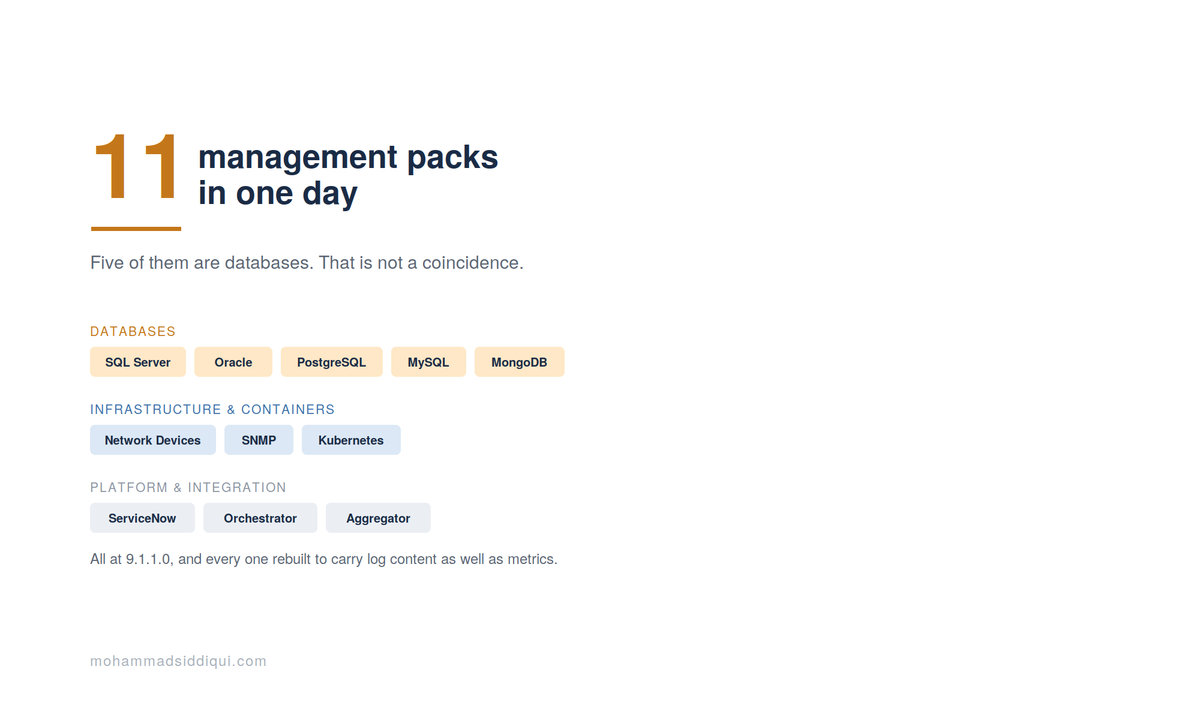
On 3 September 2026, the same day VCF 9.1.1.0 shipped, eleven VCF Management Packs reached general availability at version 9.1.1.0.
Eleven at once is unusual. Management packs normally trickle out on their own schedules. A simultaneous release of that size usually means something changed underneath them all, and in this case something did.
First, what a management pack actually is
If you have only ever used VCF Operations for vSphere, vSAN and NSX monitoring, management packs are the mechanism that extends it to everything else.
A management pack is distributed as a PAK file and installed through the VCF Operations interface: log in with administrator privileges, go to Repository, upload the PAK, accept the licence agreement, install. Once installed, you configure an adapter instance pointing at the target system with credentials, and the pack begins discovering objects, collecting metrics, and populating its dashboards and alert definitions.
What you get from a well-built pack is four things: object discovery and a topology model of the target system, metrics and properties collected on a schedule, out-of-the-box dashboards, and alert definitions with symptom and recommendation logic already written by people who know the product.
That last part is the actual value. Anyone can scrape metrics. Knowing which combination of metrics constitutes a problem worth waking someone for is domain knowledge, and it is what you are buying.
The eleven
Click any group below to expand.
Databases - five of the eleven
Five database packs in one release is a statement of intent, and it lines up with the Data Services Manager push. The database layer has historically been where infrastructure monitoring stops and someone else's tooling starts. The DBA team has its own console, the platform team has VCF Operations, and when a database performance problem turns out to be a storage latency problem, the two teams spend a morning comparing screenshots.
- Microsoft SQL Server - marketplace
- Oracle Database - marketplace
- PostgreSQL - marketplace
- MySQL - marketplace
- MongoDB - marketplace
Infrastructure reach - two
These do different jobs. Network Devices targets network hardware with a device-aware object model. SNMP is the generic escape hatch for anything that speaks SNMP but will never get a purpose-built pack - appliances, environmental sensors, UPS systems.
- Network Devices - marketplace
- SNMP - marketplace
Platform and integration - three
ServiceNow is operationally the most consequential of the eleven. An alert on a dashboard is information. An alert that files a correctly categorised incident with the right assignment group is a process.
- ServiceNow, the ITSM bridge - marketplace
- Orchestrator, the path from detection to automated remediation - marketplace
- Aggregator, consolidating across multiple VCF Operations instances - marketplace
Containers - one
VCF 9.1 already includes out-of-the-box monitoring and log management for VKS clusters natively. This pack is the broader Kubernetes story, for the clusters that are not VKS, which most enterprises have somewhere whether or not they appear on the architecture diagram.
- Kubernetes - marketplace
What changed underneath all eleven
This is the reason for the simultaneous release, and it is in the VCF Operations for Integrations 9.1 release notes rather than in any individual pack.
Before 9.1.1 - two products, two content libraries
From 9.1.1 - one pack carries both
That is why eleven packs shipped together. Every one was rebuilt to carry both.
The release notes also mention converting legacy content packs for unified operational visibility, which matters if you have built custom Log Insight content over the years.
The second change in that release: databases provisioned through Data Services Manager get automated monitoring with zero manual configuration, surfaced in a centralised Data Services view covering PostgreSQL and MySQL, filterable at organisation, region, namespace or project level.
Zero manual configuration is the operative phrase. If a tenant self-provisions a database through the catalogue, it appears in monitoring without anyone raising a ticket. Self-service that does not extend to observability just moves the ticket queue somewhere less visible.
The licensing detail that decides whether any of this applies to you
Broadcom's published feature comparison for VCF 9.1 and VVF 9.1 draws a line that is easy to miss and expensive to discover late.
Foundation
Edge
Source: Broadcom, VCF 9.1 and VVF 9.1 Feature Comparison and Upgrade Paths
Your move
Tick these off as you read. Nothing is stored, it is just for your own pass through the list.
Where this fits
Step back and the direction is consistent with everything else in the 9.1 line. VCF Operations is being positioned as the single operational console for the whole estate, not just the virtual infrastructure layer. Metrics and logs in one place. Infrastructure, databases, network hardware, containers and ITSM in one object model. AI-ready APIs for exporting into RAG pipelines and MCP frameworks for anyone building on top of it.
Whether it displaces your existing monitoring stack is a different question, and for most large estates the honest answer is partly. But the database packs are worth a serious look, because database monitoring is one of the few areas where the tooling is genuinely expensive and the integration with infrastructure context is genuinely poor.
Sources
- VCF Operations for Integrations 9.1 Release Notes - DSM monitoring, log-based content in management packs
- VCF 9.1 and VVF 9.1 Feature Comparison and Upgrade Paths - edition availability
- Scale, Simplify and Secure Your Private Cloud Operations with VCF 9.1 - Prometheus pack, AI-ready APIs, VKS monitoring
- Operations in VMware Cloud Foundation 9.0 - Management Pack Builder
- VCF Marketplace
Views expressed here are my own and do not represent those of my employer.