Bring Your Own Licence Is No Longer Optional
VMware on Azure, Google Cloud and Oracle has moved to BYOL, with deadlines. The nearest one is 31 October. And it quietly changes how you should compare clouds.
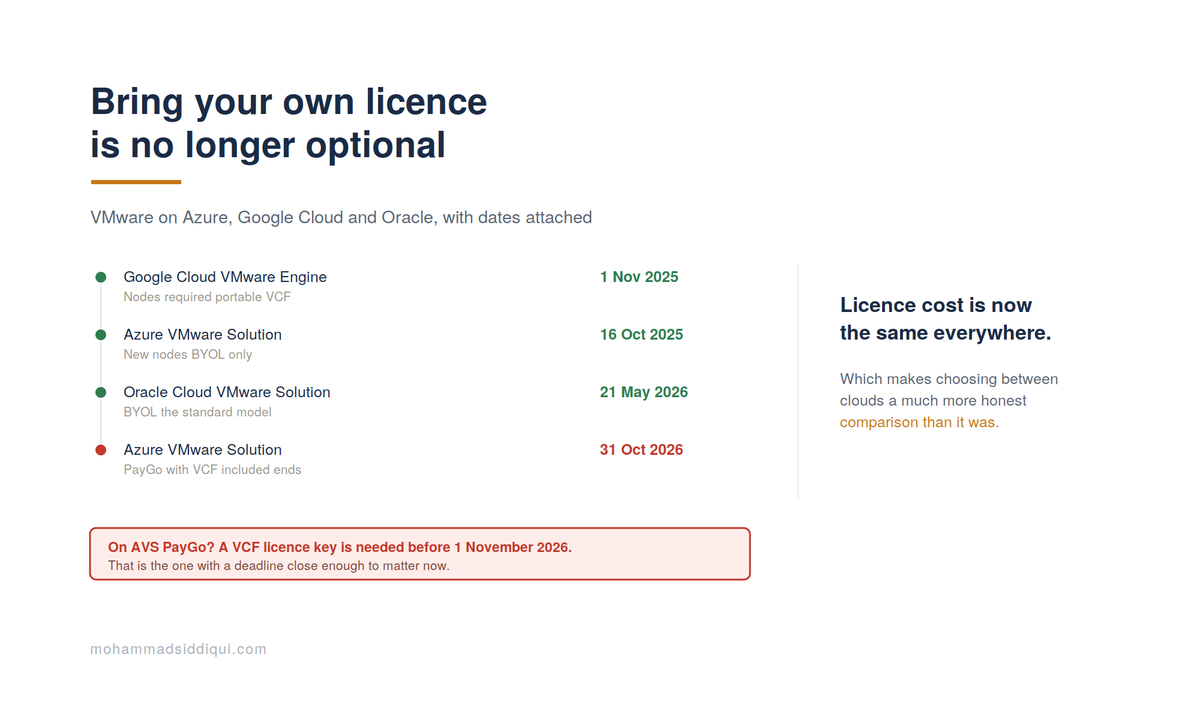
If you run VMware on Azure, Google Cloud or Oracle Cloud, the way you licence it has already changed. Not at some future point. Dates have passed, and one more is coming up fast.
Licence-included pricing is being retired across the hyperscalers in favour of bring your own licence. You buy a VCF subscription from Broadcom or a reseller and bring it to whichever cloud you're running on. Same software underneath, different purchasing path.
Most of what I've read about this treats it as a commercial footnote, which I think undersells it. There's work to do, there are deadlines, and there's a knock-on effect on how you compare clouds that I find more interesting than the licensing itself.
How we got here, briefly
Google Cloud went first, back in February 2024, agreeing that VCF subscriptions bought from Broadcom could be used on Google Cloud VMware Engine or in your own data centre, with the ability to move between them. Microsoft followed about three months later for Azure VMware Solution. Oracle announced its alignment in January 2026.
For a while this was presented as flexibility. Bring your own licence if you want to. What's happened since is that the alternative has been withdrawn, one platform at a time, and that turns an option into a migration.
Where each platform stands
Azure VMware Solution
Google Cloud VMware Engine
Oracle Cloud VMware Solution
Amazon EVS
The part that is actually interesting
There's a consequence here I haven't seen many people draw out.
When licensing was bundled into each platform's price, comparing clouds meant comparing bundles. The licence sat inside the node cost, with different discounts and different commitment structures on each side, and it was genuinely hard to get a like for like number.
Under BYOL the licence costs the same wherever you run it. Bought once, from Broadcom, at whatever your agreement says.
It also cleans up the placement conversation. If you picked Azure partly because of a bundled licensing deal, that reasoning has expired. If you picked it because your identity estate is already there and the integration genuinely matters, nothing has changed.
Practical things to get right
Core counting is now your problem
Check the certified list before you assume portability
Registration is per environment
Management pack support has moved too
What I would do this month
One last thing
There's been plenty of heat around VMware licensing these past two years and I'm not going to add to it. Whatever you make of the direction, the practical position is the same either way. These are published dates, the mechanics are documented, and the work is manageable as long as you start before the deadline rather than after.
The licensing is the boring half anyway. The placement question sitting underneath it is the one I'd actually spend an afternoon on.
Sources
- VCF License Portability: list of certified cloud providers, Broadcom. The authoritative list of eligible destinations.
- Azure VMware Solution portable VCF, Broadcom: how registration works per private cloud.
- Broadcom VMware licensing changes: what AVS partners need to know, Microsoft: the 15 and 16 October 2025 dates, the 31 October 2026 PayGo end, and the pricing position.
- Evolving Oracle Cloud VMware Solution for Broadcom's BYOL model, Oracle: GA timing, the 22 March new-SDDC requirement, and the VCF 9 upgrade condition.
- Azure VMware Solution licensing changes set October BYOL deadline: the Google Cloud VMware Engine dates and the quota adjustment.
- Oracle follows Broadcom on VMware BYOL model: the management pack support changes across OCVS, AVS and GCVE.
Dates and terms differ by agreement and region, and several of these transitions are still in progress. Confirm your own position with your provider and your Broadcom account team rather than relying on a summary.
Views expressed here are my own.