Assess, Architect, Implement, Upskill Broadcom's Frontier AI Security Programme, Read as a Design Method
A four-stage security framework with a scored assessment underneath it. The interesting part isn't the programme, it's the five pillars it scores you against, and the fact that one of them is people.
Buried in the Explore announcement noise was something more useful to an architect than most of the product news. Broadcom launched the Frontier AI Security Readiness Program globally on 31 August, and underneath the programme wrapper sits a scoring model and a set of blueprints that work as a design method whether or not you ever sign up for the programme.
The framing Prashanth Shenoy uses is worth quoting because it's the honest version. Hardening the private cloud is a critical mandate, but the complexity of individual customer environments makes universal playbooks ineffective. That's true and it's rarely said by a vendor, since vendors sell playbooks.
The four stages
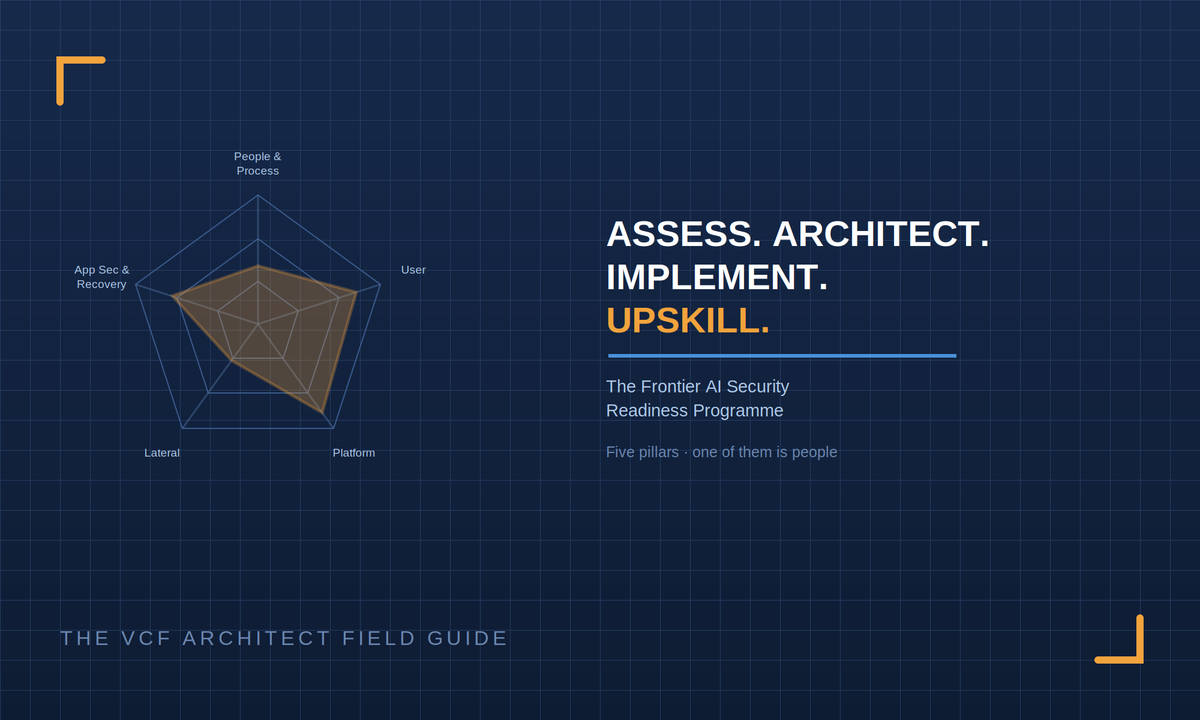
• Assess. Quantify exposure and posture gaps to establish a data-driven baseline.
• Architect. Define the target state by combining gap findings with five-pillar blueprints.
• Implement. Deploy hardened configurations with automated patching, continuous monitoring and AI-assisted triage.
• Upskill. Mature capability through VCF 9.1 curricula and the coming ARIE certification track.
Four stages is a common enough shape. What makes this one worth attention is the fourth. Most security frameworks stop at implementation and treat skills as somebody else's problem. Putting upskilling inside the framework as a stage rather than an afterthought is an implicit admission that the technology alone doesn't close the gap.
The Assess stage, and why the scoring model matters
The VCF Security Assessment is web-based and produces score-based visibility across the stack. Two details make it more useful than the usual questionnaire.
It uses risk-based scoring that prioritises production and DMZ environments over lab workloads. That sounds obvious until you've sat through an assessment that weights a dev cluster the same as a payments platform and produces a number nobody can act on.
And the output is a spider chart and gap heatmap across five architectural pillars rather than a single score. A single number tells you that you're at 62% and nothing about what to do. A five-axis chart tells you your platform security is fine and your lateral security is the hole.
The five pillars
These are the part worth writing into your own review process, independent of the programme.
• People and Process
• User Security
• Platform Security
• Lateral Security
• Application Security and Recovery
Note the first one. Putting People and Process as a scored architectural pillar alongside the technical ones is unusual, and it's correct. Most estates I've reviewed that scored badly on security didn't fail on capability. They failed because nobody owned patch cadence, or because the identity model had drifted for three years without a review, or because the recovery plan had never been executed. Those are process failures showing up as technical exposure.
If you take one thing from the programme without engaging with it at all, take the five-pillar structure and run your own estate against it. Even a rough self-score across those five axes will tell you where the actual hole is, and my experience is that it's rarely where the budget currently points.
The Architect stage
This combines the assessment scores and gap heatmaps with VCF Security Blueprints across the same five pillars, producing prescriptive recommendations. Named examples in the post run from strict RBAC and SSO through to upgrading to VCF 9.1 or later for automated lifecycle patching, plus networking, encryption and DR controls.
The threat argument underneath it is the one this series has tracked all year, stated cleanly. Autonomous attack engines exploit architectural inconsistency, configuration drift and delayed patching to chain exploits faster than teams can react manually. So the defence isn't a better control, it's the elimination of inconsistency. Standardised guardrails across the stack rather than per-cluster decisions made at different times by different people.
That reframes design consistency as a security property rather than an operational nicety. Worth using in a design review where someone is arguing for a one-off exception.
The Implement stage
Three core activities: deploy using validated hardened blueprints, run automated patching to maintain compliance, and use security scanners for VMware Security Advisories to prioritise vulnerabilities. Layered on top are AI-assisted operations, AI-powered triage and remediation, continuous policy enforcement, and real-time threat intelligence.
The specific threat model named here is precise and worth repeating: autonomous attack agents exploit the operational delay between when a security advisory is published and when a patch is applied. Not a vulnerability in your platform. The gap in your process.
Which is why the VMSA-to-remediation timing metric I've suggested in earlier posts matters more than it looks. If your exposure window is the gap between publication and patch, then measuring that gap is measuring your actual risk. Most estates don't measure it at all.
What to do with this
• Run the five pillars against your estate as a self-assessment before engaging anyone. It costs an afternoon and it tells you whether you need the programme or just need to fix one thing.
• If your worst pillar is People and Process, no product purchase will move it. Fix ownership first.
• Start measuring advisory-published to estate-remediated. That single number is the metric this entire framework is built around, and it's the one you can start collecting today.
• Treat design inconsistency as a security finding, not a tidiness issue. The argument is now vendor-supported if you need backup in a review.
• Note that Assess, Architect and Implement all have VCF Professional Services offerings attached. Useful to know before the conversation, so you can decide what you want to do yourself.
Sources
• Broadcom Introducing the Frontier AI Security Readiness Program (Prashanth Shenoy, 31 August 2026)
• Broadcom AI Has Changed the Threat Landscape. Is Your Infrastructure Ready?
• Broadcom Frontier AI Security Readiness Program interest form