A new edition, a dead product line, and a paragraph the press did not get
Eleven Broadcom posts in a week. vSphere Express is a 128-core floor rather than a discount, four capabilities quietly stopped being chargeable, Telco Cloud Platform is finished, and one licensing concession was missing from the version handed to the press.
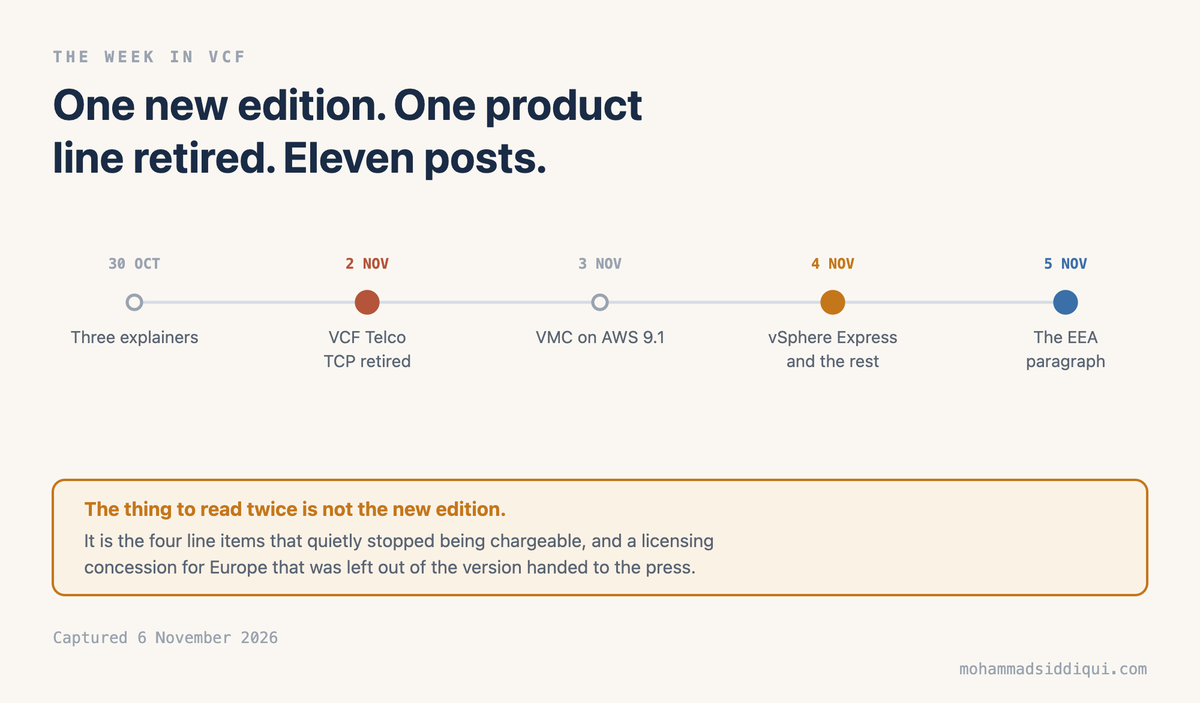
Broadcom published eleven posts to the Cloud Foundation blog between 30 October and 4 November. Most weeks that would be noise. This one is not, because two of those posts change what you are paying for, one retires a product line, and a third contains a paragraph that was missing from the version the press received.
I have spent the week reading all of it, along with what the trade press and the licensing specialists made of it, because the gap between those two readings is where the useful information usually sits. What follows is the five things worth your time, and the part of each one that nobody put in a headline.
None of this is a recommendation. It is what the documents say, what the people who negotiate these contracts for a living are reporting, and where the two disagree.
1. vSphere Express, and why it is a floor rather than a discount
The headline is that Broadcom has put a small edition back on the price list. vSphere Express is standalone vSphere, built on vSphere 9, capped at 128 cores. It carries vCenter Standard, ESX Standard, vMotion, HA, the vSphere Distributed Switch, vCenter Quick Patch, and TPM 2.0 and vTPM 2.0 support. Broadcom's own portfolio update is the primary source, and it is notably short on detail.
The detail is coming from elsewhere, and it changes the shape of the thing considerably.
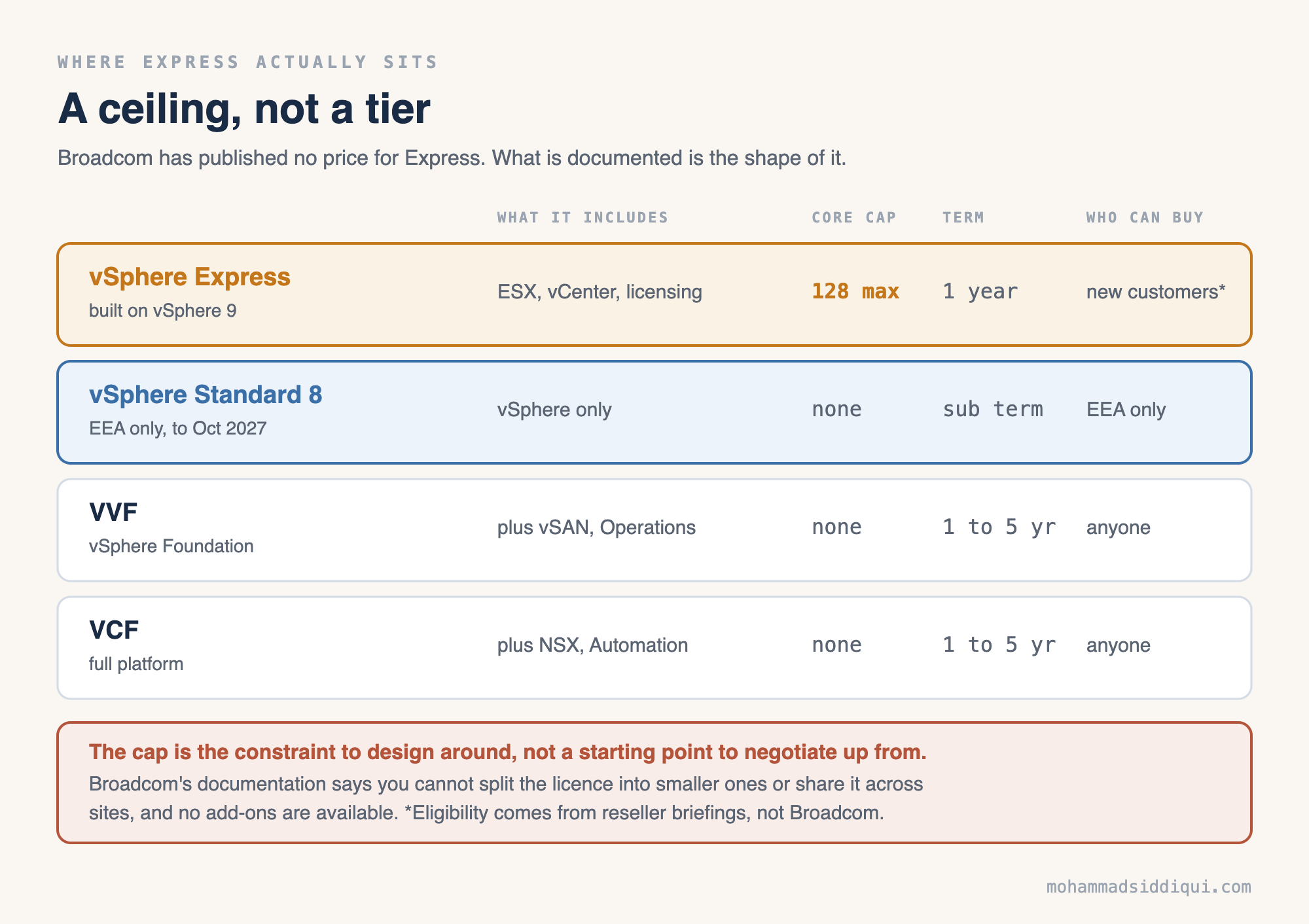
It is 128 cores whether you need them or not
You may not be allowed to buy it
Cheaper is doing a lot of work in that sentence
What is not in it
There is a documented upgrade path, and a documented way out
Nobody agrees on when you can have it
2. Four things stopped being chargeable, and that is the bigger story
If you read only one part of this week, make it this one. Both Network World and SiliconANGLE report that capabilities previously sold as advanced services have moved into core VCF. Broadcom's own post does not frame it that way, which is why it has had far less attention than the new edition.
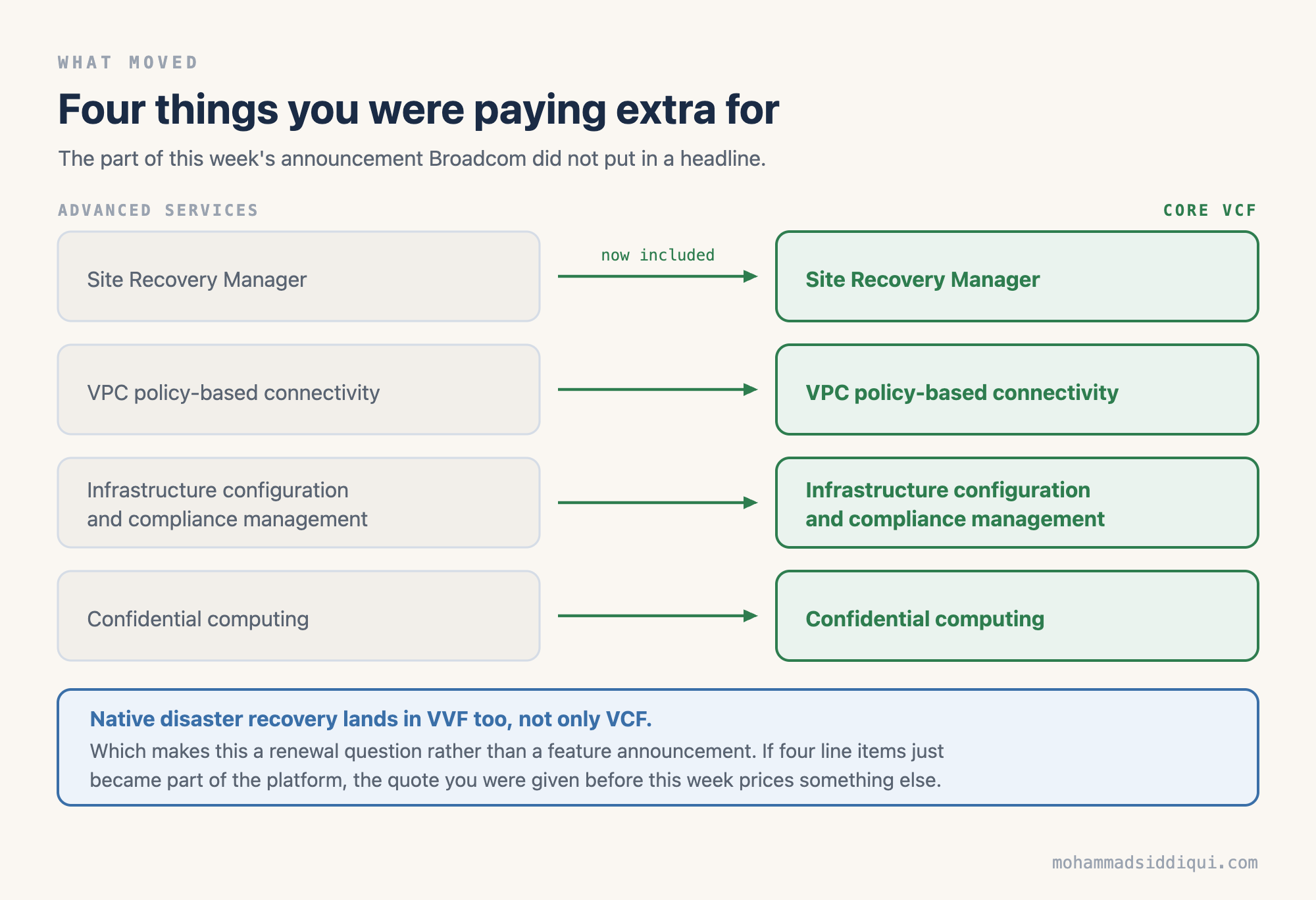
Site Recovery Manager, VPC policy-based connectivity, infrastructure configuration and compliance management, and confidential computing are now described as part of the platform rather than as things you add to it. Native disaster recovery is landing in both VCF and VMware vSphere Foundation, which is the detail most likely to matter to a mid-sized estate that was never going to buy the full stack.
3. The paragraph that was not in the press version
Broadcom's post carries a paragraph for customers in the European Economic Area. vSphere Standard version 8 and vSphere Enterprise Plus version 8 remain available for sale there until 31 October 2027, and Extended Support is included in any active subscriptions to those offerings until the earlier of the subscription end date or 31 October 2028.
The Register reported on 5 November that this paragraph was not in the version of the post it received, and was not mentioned in the briefing. Its earlier write-up of vSphere Express was based on the version without it.
Why it matters even if you are not in Europe
Australia and the UK are not in the EEA
4. Telco Cloud Platform is finished, and VCF Telco replaces it
This one went almost unremarked outside the telco press, and it is the clearest lifecycle statement of the week. Broadcom's VCF Telco announcement on 2 November says that rather than continuing to develop Telco Cloud Platform as a standalone platform, telco capability now ships inside VCF. Telco Cloud Platform licensing SKUs reached End of Availability on 2 November 2026.
Existing TCP subscriptions remain supported through the transition, with realignment handled at renewal. If you buy the VCF SKU you get the telco features, present and future.
What VCF Telco actually carries
The question to ask if you are a TCP customer
5. VKS 3.8, and the upgrade order that will catch people
Released 22 October, so slightly outside the week, but it lands on anyone moving to 9.1 and the release notes contain two prerequisites that are easy to miss.
VKS 3.8.0+v1.37 brings Kubernetes v1.37, Cluster API v1.14 and CAPV v1.17. It requires a minimum Supervisor Kubernetes version of 1.33, and the Supervisor must already be on VKS 3.5.0 or later.
The useful new things
Immutable Photon OS will break somebody's runbook
Scale limits that are documented but not prominent
The rest of the week, briefly
- VMware Compliance and Configuration Management, a new Advanced Service built on the Salt remote execution engine that Broadcom now sells standalone. CIS, DISA and customer-defined benchmarks, drift detection and automated remediation across VMs and containers.
- VMware Live Recovery added to Advanced Services. The on-premises cyber recovery workflow replicates across an air gap into an isolated vSAN clean room, with network isolation and EDR scanning before anything returns to production.
- VMware HyperArmor, announced at Explore on Tour Frankfurt on 13 October, added to the catalogue on 4 November. Virtual patching for ESX, blocking of unauthorised software, MFA on the SSH login path. GA expected Q1 FY27. SDxCentral has the detail.
- VMware Cloud on AWS moves to 9.1. GA expected during calendar 2027, fleet upgrades running throughout the year, no customer action required, and staying on 1.26 is not an option. All clusters in an SDDC must run the same version.
- AI Infrastructure Quickstart, a vCenter plugin that folds cluster deployment, Supervisor activation and VKS provisioning into one workflow. Next release.
- vSAN native S3-compatible object storage moves from tech preview to GA in the next release, with self-service provisioning through vSphere Supervisor or VCF Automation.
- Demystifying VCF Automation Node Architecture and Load Balancing, a technical deep dive published the same day as the portfolio update and almost entirely overshadowed by it.
- Three technical explainers on 30 October, on isolating infrastructure management, confidential computing, and why memory tiering is not simply swapping to NVMe.
What did not happen
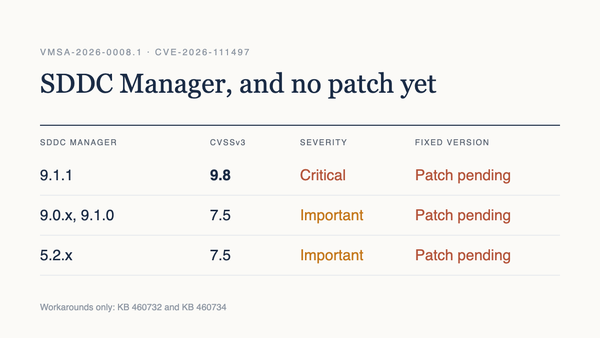
No new security advisory. The current one is still VMSA-2026-0006 from July. No new component patch set either: the most recent is 12 October, and the patch release page restates something worth repeating, which is that patch releases are not synchronised across VCF components and do not require a new Bill of Materials. You can apply only the components that apply to you. Any tool or tracker showing 9.1.1 as a single flat version is giving you a version number that does not exist in your estate.
Where I could not get to the bottom of it
Broadcom's own product documentation settles more of this than the announcement or the coverage does, which is worth saying because none of the trade pieces reference it. The mechanics of Express are documented. What is left open is commercial.
- The price. Broadcom has published none. The figures circulating come from distributor listings and reseller guides, not from Broadcom, which says only that Express sits significantly below VVF and VCF.
- Who is allowed to buy it. The new-customer rule and the post-order rejection both come from reseller briefings. Broadcom documents the technical cap but publishes no eligibility criteria.
- When you can have it. Broadcom says immediately in all regions. TechTarget says by the end of January 2027.
- And one on the other story. Whether the four capabilities moving into core VCF carry any change to the VCF SKU price. Neither Broadcom nor the trade press addresses it, and it is the question with the most money attached.
What I would actually do with this
- If you have a VCF quote dated before 4 November, ask in writing which of the four capabilities it includes and whether the number changes.
- If you are under 128 cores and not already a VMware customer, ask your partner about Express in writing, and ask specifically about eligibility and about the availability date.
- If you are between 130 and 200 cores, work out what consolidating under 128 would cost you operationally before you price VVF.
- If you hold Telco Cloud Platform, start the gap analysis against VCF now rather than at renewal.
- If you are heading to Supervisor 9.1, check every VKS cluster is on ClusterClass 3.6.0 or later first.
- If you are in the EEA, confirm the vSphere 8 extension applies to your agreement. If you are not, it is still a useful precedent to have in your pocket.
The pattern across all of it is the same one I keep running into. The announcement tells you what is new. The release notes tell you what breaks. The resellers tell you what it costs. You need all three before any of it reaches a plan, and this week none of the three agreed with the other two.
Tools that go with this
Most of the above only matters once you know what you are actually moving. Estate Readiness Triage sorts your clusters into what can move as is and what has to be replaced first, and Upgrade Runway works backwards from your end of general support date to the latest date you could still start.
Free to use, including with customers. Nothing you enter leaves your browser. Everything else on VCF.
Sources
All checked 6 November 2026.
- vSphere Express, Broadcom TechDocs, last updated 2 November 2026. The core cap, the licence restrictions, the mandatory components and the upgrade path. Published two days before the announcement and not referenced in any of the coverage I found.
- VCF 9.1 Licensing Overview, Broadcom TechDocs, last updated 2 November 2026. Where Express sits alongside VCF and vSphere Foundation, the add-on licences, and the usage reporting obligation.
- Broadcom Updates VMware Portfolio to Protect and Accelerate Private AI Cloud Deployments, 4 November 2026. The primary announcement, including the EEA paragraph.
- Introducing VMware Cloud Foundation Telco, 2 November 2026. Telco Cloud Platform End of Availability.
- VMware vSphere Kubernetes Service 3.8 release notes, released 22 October 2026.
- What's Coming Next: VMware Cloud on AWS SDDC Upgrade to Version 9.1, 3 November 2026.
- Patch Releases 9.1.1.x. Components are not patched in lockstep.
- The Register, VMware quietly offers European users extended sales and support for low-end vSphere, 5 November 2026.
- TechTarget, Broadcom vSphere Express brings back standalone VMware virtualization, 4 November 2026.
- Network World, Broadcom expands VMware Cloud Foundation with AI, security and recovery capabilities, 4 November 2026.
- SiliconANGLE, VMware gets simpler AI deployment and low-cost version for basic private clouds, 4 November 2026.
- StorageReview, Broadcom Launches 128-Core vSphere Express, 4 November 2026.
- Techzine, vSphere Express: a return to an affordable VMware?, 5 November 2026.
- C4C Group, vSphere Express Explained. Eligibility and commercial detail, from reseller briefings. C4C sell renewal negotiation services, so read their recommendations with that in mind.
- SDxCentral, Broadcom arms VMware security with HyperArmor.