A MATTER OF PRINCIPLE
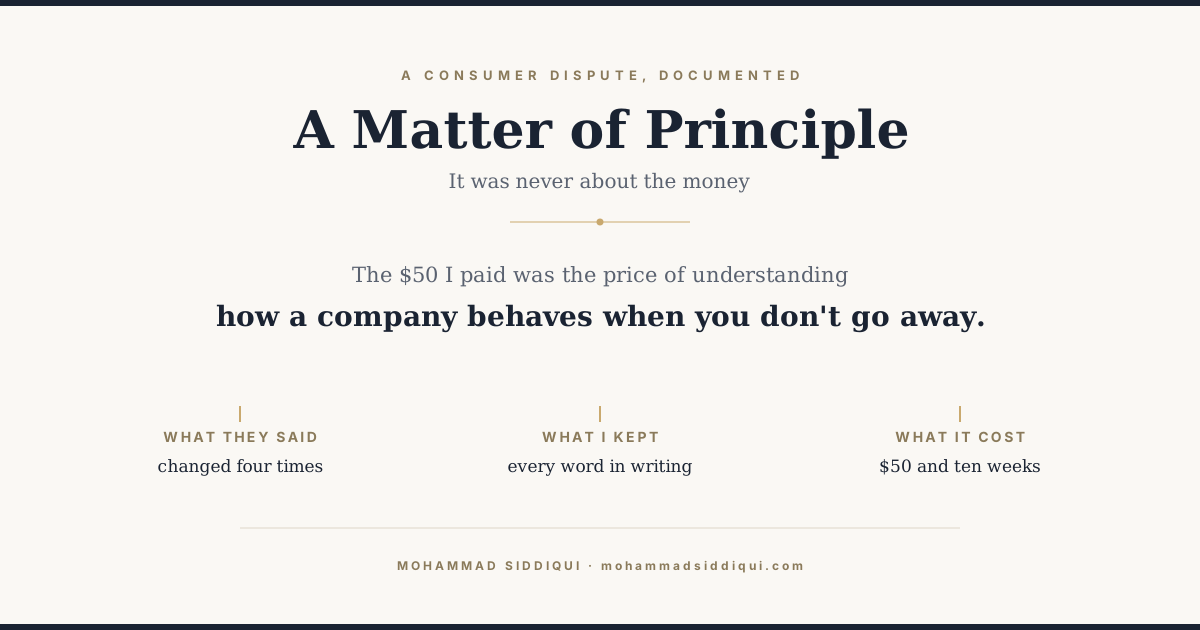
What ten weeks of a $101.30 billing dispute taught me about how companies behave when you don't go away.
The Bill I Didn't Agree To
In April 2026, my wife and I attended a collection centre operated by a major private pathology provider for a partner carrier-screening blood test. Before we went, we'd been told twice, by two different organisations that the test would be free of charge. We proceeded on that basis.
Three weeks later, an invoice for $101.30 arrived.
What followed was a ten-week dispute across five different teams at the provider. It ended with a $50 payment made on my terms, on principle, a formal Quality Department review that reframed the narrative in a way I could accept, a paid receipt showing $51.30 written off in their accounting system as a formal “non payment adjustment”, and critically a fully verified regulatory position confirming that the specific test I was billed for wasn't clinically required in my circumstances, wasn't Medicare-rebatable for a male partner, and shouldn't have been ordered without specific cost disclosure.
The dollar amount was small. The lessons were not.
This was never about the $101.30, or the $50 I eventually paid. It was about being told one thing at a counter and billed another three weeks later, and about what it takes to hold an institution to what its own staff said. This is the record of that experience and a playbook for anyone facing a similar situation.
The Setup
Here's what happened:
1. My wife had earlier undergone reproductive carrier screening through a hospital antenatal clinic. Her results came back as a carrier for one specific gene (SMA), and normal for the other two components of the panel (CF and Fragile X).
2. The clinic recommended follow-up partner testing for me. We were advised by the antenatal clinic that this partner testing would be free of charge.
3. We initially attempted this at the pathology lab that had done my wife's original test, who advised the partner test would be chargeable there. We then contacted a different provider, explained the situation, and were told the test could be done at their collection centre.
4. On the morning of the test, I raised the “free of charge” advice with the collection centre receptionist. She confirmed the test would proceed and that the provider would manage the billing with head office. I confirmed again with a second staff member, who added that if I did receive an invoice I should contact the provider and present my wife's report.
5. My wife had also been informed at the provider's collection centre during an earlier attendance that if her carrier screening returned positive, my partner testing would be provided free of charge. Her carrier result had returned positive.
6. Three weeks later, an invoice for $101.30 arrived covering the Fragile X (FMR1) component of the test.
The Test That Wasn't Required
This is the piece I only fully understood in the final week of the dispute and it turned out to be the most important part of the story.
Under Australia's Medicare Benefits Schedule (MBS), reproductive carrier screening for the three genes (CF, SMA, Fragile X) is covered by two items:
• MBS Item 73451 testing the pregnant patient or planning-pregnancy patient (in a heterosexual couple, the female partner) for all three genes.
• MBS Item 73452 testing the reproductive partner (in a heterosexual couple, the male partner) for CFTR and SMN1 only. FMR1 (Fragile X) is explicitly excluded.
The regulatory reasoning is clear: Fragile X is X-linked. The female partner's FMR1 result under item 73451 already determines reproductive risk for the pregnancy. Testing the male partner's FMR1 adds no clinically relevant information when the female partner's FMR1 is normal.
This isn't obscure. It's stated in the MBS item description itself. It's stated in the published professional guidance from major Australian pathology providers for example, Australian Clinical Labs' guidance to referring doctors reads: “Applicable for male partners who have female positive partners for CF and SMA, but NOT for FXS”. Eugene Labs states the same position in identical terms.
And it was known to the provider's own genetics team. In the first response I received from the provider's Complaints Officer on 29 May 2026, she wrote quoting verbatim “I have checked with our Genetics department since you do not meet the Medicare criteria for the Fragile X.” That statement confirms the genetics team recognised the FMR1 component was outside Medicare eligibility for me as the male partner.
So the position is this:
• My wife's FMR1 result was normal.
• The FMR1 test on me as her male partner was not clinically indicated under Australian professional guidance.
• The FMR1 test on me as her male partner was not Medicare rebatable per the MBS framework.
• The provider's own genetics team knew this before the test was run.
Despite all of that:
• The referring doctor ordered the full 3-gene panel including FMR1 for me.
• The provider ran the FMR1 test anyway, without flagging that it was outside Medicare criteria.
• The collection staff advised me the test would be free without disclosing that one component would attract a private fee.
• No one at any point in the chain offered me the option to decline the FMR1 component while proceeding with the SMA and CF components that were clinically indicated.
• I was billed $101.30 for a test that shouldn't have been part of the process in the first place.
That's not a Medicare misunderstanding. It's a systemic setup where a bundled panel gets run by default, the non-rebatable component gets billed to the patient, and the patient is never told they had an option to decline.
What I Learned Along the Way
The dispute produced more than a dozen emails across five different teams at the provider: Accounts, the Complaints Officer, the Accounts Receivable Team Leader, Patient Services (on notice), and finally the Quality Department. Here's what I learned that I wish I'd known at the start.
1. Verbal promises carry weight, but only if you document them immediately
Companies defend their position with written documents a signed consent form, an invoice, a policy on a website. Your recollection of a conversation at the counter is real, but harder to make stick.
The lesson: document conversations at the time. Not “someone told me it would be free” but “at 07:44 on 22 April, I was told by the receptionist at [location] that [specific words]. When I raised it again, a second staff member confirmed the same and added [specific words].”
The specificity is what makes a verbal representation credible in a written dispute. Time, place, name where possible, and critically the exact wording of what was said. If you can't note it in the moment, note it as soon as you're back in the car. Better still: send yourself an email that day with the details. A contemporaneous note in your own inbox, timestamped, is close to as good as a written promise from the provider.
2. The first response is almost never the final response
Every dispute I've handled has started with some version of “the account is correct.” That's not a real answer. It's a template. It tells you the file has been opened, someone glanced at it, and the presumption is you'll go away.
You don't go away. You reply in writing, in the same thread, with your substantive points. And you watch what happens next.
If the second response gives the same reasons as the first, you're at a real position. If it gives different reasons, the first position wasn't a real position it was a placeholder. Every shift in stated reason tells you something important about how solid the defence actually is.
In my dispute, the stated basis for the charge shifted four times before a fifth team landed on a coherent explanation. Each shift was a data point.
3. Escalation paths exist even when they're not advertised
Complaints staff will often act as if they are the final decision-maker. They rarely are. Every large organisation has:
• First-line accounts staff who follow scripts
• Team leaders who can vary the script within limits
• Patient services / customer relations who handle escalations
• Quality / compliance / risk who look at systemic issues
• The parent company's customer relations where relevant
• Regulators as the external backstop
If you're told “this is final,” ask directly: “Please confirm whether this is your final decision at your level of authority, or whether you can escalate this to a manager or to customer relations.” Most of the time, the wording changes when you ask that question.
In my case, the Complaints Officer's refusal to escalate even after I asked in writing became itself a documentable process failure that I used when I self-escalated to Patient Services and, eventually, reached the Quality Department.
4. Corporate language is decodable
After enough disputes, you learn to read corporate language. Some translations from my experience:
• “The account is correct” closed at this level, no further review contemplated
• “As a gesture of goodwill” we’re not admitting fault but we’ll take some money off
• “There may have been a misunderstanding” we’re not going to defend our staff but we’re not blaming them either
• “We have not identified any evidence that staff acted inappropriately” we’ve decided not to fight this at the individual level
• “We appreciate your continued correspondence” this is getting expensive to handle; we want it closed
Reading these tells you where you actually stand and whether the response is defending a position or preparing to concede one.
5. Decide your endpoint before you start
The single most valuable thing I did was, halfway through the dispute, work out what my endpoint was.
Was this about the money, or about principle?
If it's about money, calculate what your time is worth per hour and stop when the fight costs more than you'd recover. Most disputes fail this test somewhere in the second round.
If it's about principle, be honest with yourself about what “vindication” looks like. Is it a full waiver? A written acknowledgement of fault? A reframing of the narrative to match your account? A record you can point to if this happens again?
In my case, the endpoint was principle. Specifically: a formal acknowledgement that what I'd been told at point of service was accepted, and that the process I followed was the correct one. When the Quality Department response acknowledged both, I closed the matter even though I'd been arguing for a full waiver.
Knowing the endpoint in advance meant I could recognise when I'd reached it. Without that clarity, I'd have kept fighting for the last $50 and missed the more important win.
6. Small concessions can be big wins
Going from $101.30 to $50 is roughly a 50% reduction on the money. But the more valuable concessions in my dispute weren't dollar amounts. They were:
• Formal acceptance that the referring clinic had advised us the test would be free
• Reframing of the collection staff's advice in a way that matched my account, not the earlier corporate line
• A “misunderstanding” framing applied to the whole event, rather than fault assigned to me
Corporate concessions often arrive in language before they arrive in dollars. The narrative in a written response especially one from a Compliance or Quality function will live longer than a receipt.
7. The paper trail is your friend, and email is the paper trail
Wherever possible, keep the dispute in email. Phone calls are useful for status checks but not for substantive positions. The moment you make a substantive point, ask for it in writing.
The specific practices that helped me:
• Reply in the same thread so the full history is one document
• Quote back specific sentences from prior responses when you dispute them
• Include dates for every event you reference
• Number your points makes it hard to ignore any of them
• Keep tone professional never send a reply while angry
• Wait 24 hours on any reply that feels sharp before sending
Reference numbers, transaction IDs, invoice numbers anything with a code should appear in every email. That's what search will find in the corporate system three months from now.
8. Australian Consumer Law exists and knowing it exists is often enough
Under Australian Consumer Law, verbal representations made by staff at the point of service are part of the contractual relationship. A signed consent form does not override misleading verbal advice given at the same time. State Fair Trading agencies handle billing disputes and misleading conduct complaints.
Most disputes never need to reach Fair Trading, because the mere reference to it in correspondence signals the consumer knows what channels exist:
If this matter cannot be resolved internally, I would consider the external options available, including a complaint to Fair Trading in relation to Australian Consumer Law.
One sentence, in the right place, changes the tone of the response you get back.
Use it sparingly, and only when you'd actually escalate. Consumer-law tone bluffs are transparent, and a competent complaints officer sees through them immediately.
9. Get the receipt it's the proof of concession
A verbal concession is not the same as a booked adjustment. A goodwill offer in an email even one from a formal Quality function is not the same as an account showing $0 balance and a formal write-off on the paid receipt.
In my case, the final receipt showed:
• Total: $101.30 (the original invoice)
• Payment received: –$50.00
• Non payment adjustment: –$51.30
• Amount due: $0.00
That “non payment adjustment” line is the one that matters. It isn't a discount, or a courtesy note in the file. It's the provider's accounting system formally recording that $51.30 has been written off. Their books now show they wrote off nearly half the invoice. That's a stronger form of concession than any email confirmation, because it's how they actually account for the money.
When you close a dispute, wait for the final receipt showing the $0 balance and save it somewhere durable. It's the piece of paper you'd reach for if the same charge or a related one ever appeared again on a future account.
What It Was Really About
The $50 that I eventually paid isn't the story.
The story is that a large private pathology provider had, over four responses from their Accounts function, given me four different characterisations of what I'd signed and why. Each was internally coherent, but they weren't coherent with each other. The stated basis shifted from “Financial Consent” to “non-claimable sticker” to “no sticker specifically for this test” to “financial consent sticker” before the Quality Department, on 5 August, produced a properly considered response that quietly walked away from all four earlier characterisations and acknowledged the substance of my complaint.
But the deeper story is the one about the panel and the regulatory framework. The Fragile X test I was ultimately charged for wasn't a test that any professional guidance in Australia says should be run on a male partner when the female partner's FMR1 is normal. Medicare's own item description excludes it. Every major pathology provider's published guidance excludes it. The provider's own genetics team knew this before the test was run.
But it was ordered by default in a 3-gene panel. It was run without disclosure. It was billed. And when I disputed the bill, the position defended by Accounts across four responses was, in effect, that the account was correct because I'd signed something first a Financial Consent, then a sticker that turned out not to exist, then a hybrid term that conflated the two.
That matters not because it saved me money, but because that's how institutions get better. They improve when consumers push back thoughtfully, methodically, and with a paper trail. They improve when the file for a complaint contains something more than “customer accepted the account.”
Corporate complaint handling has a certain shape. It expects most complainants to give up somewhere between the first “the account is correct” and the second offer of a small goodwill reduction. If you don't give up, and if you push with structure rather than heat, the process eventually reaches someone whose job is to think about the institution's reputation and process integrity, not the individual invoice. In my case, that was the Quality Department, which acknowledged what needed acknowledging, apologised for how the earlier handling had gone, and confirmed the feedback would be forwarded to the relevant managers.
What I'd Do Differently
Three things.
First, I’d document verbal representations in writing immediately a follow-up email to the provider on the day of the appointment, confirming what I’d been told. That would have shortened the dispute by weeks. Something as simple as:
Just confirming our conversation this morning I attended for [service] at [time], and understand from [staff member] that [specific promise]. Please let me know if this isn't correct.
Even without a reply, that email becomes contemporaneous evidence, timestamped and unambiguous.
Second, I’d have asked for the pricing in writing at the counter, before the service. Not because I distrusted the staff but because a printed line item at point of service removes all ambiguity. In hindsight, “the test will be free” was a verbal promise. A printed line saying “$0.00 for this test” would have been contractual.
Third and this is the one I’d most emphasise I’d have asked what specific tests were being run and whether each one was necessary for my situation. Bundled panels are the default in a lot of diagnostic and screening contexts. That’s efficient for the provider, but it means components can get run on you even when your circumstances don’t clinically indicate them. In my case, the specific test I was ultimately billed for wasn’t independently necessary given my wife’s earlier normal result on that gene, and it wasn’t Medicare-rebatable for me as the male partner. But it was part of the standard package, and nobody at any point in the chain referrer, collection centre, or laboratory asked whether I wanted to opt out of components that weren’t indicated for me. A simple “what’s in this panel and do I need all of it?” asked at the referrer’s rooms or at the collection point would have surfaced that. You have the right to decline components. Providers rarely offer this framing unprompted.
All three of these are one-minute actions that would have replaced ten weeks of correspondence.
The Practical Takeaway
If a bill arrives that doesn't match what you were told:
1. Reply in writing, in a thread you’ll keep
2. Document your verbal recollection with dates, places, and words as best you can
3. Watch how the response changes across replies shifting reasons are meaningful
4. Ask about escalation if the first response isn’t satisfactory
5. Decide your endpoint money or principle and hold to it
6. Read the corporate language for what it actually means
7. Reference the external options if the internal path stalls
8. Don’t pay while a dispute is genuinely open payment closes off options
9. Close professionally when you’re done, on a note you’d be comfortable seeing quoted back at you
10. Save the final receipt showing $0 balance that’s the accounting-system proof of everything you achieved
And before you're ever in that position:
11. Ask what’s actually being ordered. Panels can include components that aren’t necessary for your specific situation but that will end up on your bill. You have the right to decline components. Ask what’s in the bundle and whether each part is indicated for reproductive carrier screening specifically, Medicare item 73452 covers male partners for CF and SMA only, not Fragile X. If your referrer has ordered a 3-gene panel for a male partner, ask whether the Fragile X component is being included as part of the bundle by default and whether it will attract a private fee.
None of this is a guarantee. Some disputes end with you paying because the provider's position is defensible and yours isn't. But most disputes worth having produce something a reduction, an acknowledgement, a reframed narrative, or at least a record. And the process itself is a skill that transfers to every subsequent negotiation you'll have with any institution.
The $50 was the price of learning. It was worth it.
This is a factual record of my experience. If you’ve been through a similar dispute with any provider I’d be interested to hear how you handled it. The specifics vary, but the shape of these things is remarkably consistent across industries.