Same Stack Underneath, Different Deal About Who Does the Work
Licensing now costs the same wherever you run it, which takes one variable out of every comparison. What separates the four hyperscaler VMware services is who operates the stack, not what is underneath it.
Now that licensing costs the same wherever you run it, comparing the hyperscaler VMware services has got a lot simpler. Not easier necessarily, but simpler, because one of the variables that used to muddy every spreadsheet has been taken out of it.
So here's how I'd run that decision now, and where I think each of the four lands.
Start with the thing that actually separates them
It isn't price. It isn't feature parity either, because underneath they're all running the same VCF stack, which is rather the point of the arrangement.
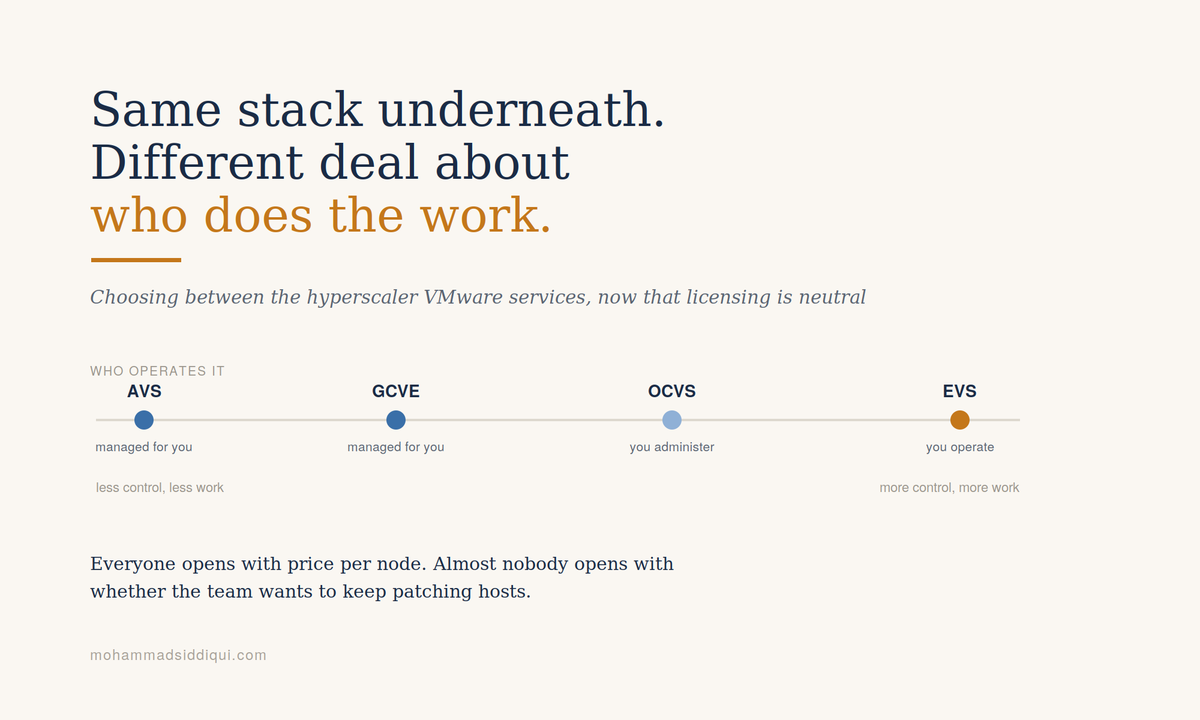
What separates them is who operates it.
Azure VMware Solution and Google Cloud VMware Engine: managed
Oracle Cloud VMware Solution: full administrative control
Amazon EVS: you operate it
That axis should drive the decision more than anything else, and it's the one people discuss least. Everyone wants to talk about price per node. Almost nobody opens with whether their operations team actually wants to keep patching hosts.
The dimensions worth scoring
Same method as any platform evaluation. Weight these before you look at any option, not after, or you'll end up justifying a decision you already made.
Operational model
Ecosystem gravity
Networking and integration
Region and sovereignty
Migration path
Exit cost
Where I think each one fits
Broad strokes, and your estate may contradict all of it.
A managed service, when lifecycle is the problem
OCVS, when Oracle is the centre of gravity
EVS, when you want cloud hardware and your own operating model
And genuinely consider staying where you are
Questions I'd want answered before committing
What I'd avoid
Comparing on node price alone. It's the most available number and the least useful one, because it tells you nothing about the operating model you're signing up to or what the surrounding services will cost once you actually use them.
And picking based on a relationship. Vendor relationships are genuinely valuable and they're also the thing most likely to survive a decision that turns out wrong, which means they're not evidence.
The honest summary
These services are more similar than the marketing suggests and more different than the architecture diagrams suggest. Same stack underneath, quite different propositions about who does the work.
Work out which of those propositions you want, and most of the rest of the decision follows.
Sources
- VCF License Portability: certified cloud providers, Broadcom.
- Broadcom VMware licensing changes: what AVS partners need to know, Microsoft: the managed service description and BYOL position.
- Azure VMware Solution portable VCF, Broadcom.
- Evolving Oracle Cloud VMware Solution for Broadcom's BYOL model, Oracle: administrative control and lifecycle positioning.
- Amazon EVS architecture, AWS: the VPC and consolidated domain model.
- Azure VMware Solution licensing changes: the GCVE dates and quota changes.
Service capabilities, regions and terms change regularly across all four. Verify anything decision-critical with the provider rather than relying on a comparison written at a point in time.
Views expressed here are my own.
More on VCF
This is one of the VCF pieces here. The rest are grouped by problem rather than by date on the VCF index, which is the fastest way to find the one you actually need.
Two free planning tools run in your browser, with nothing sent anywhere: Estate Readiness Triage and Upgrade Runway.